

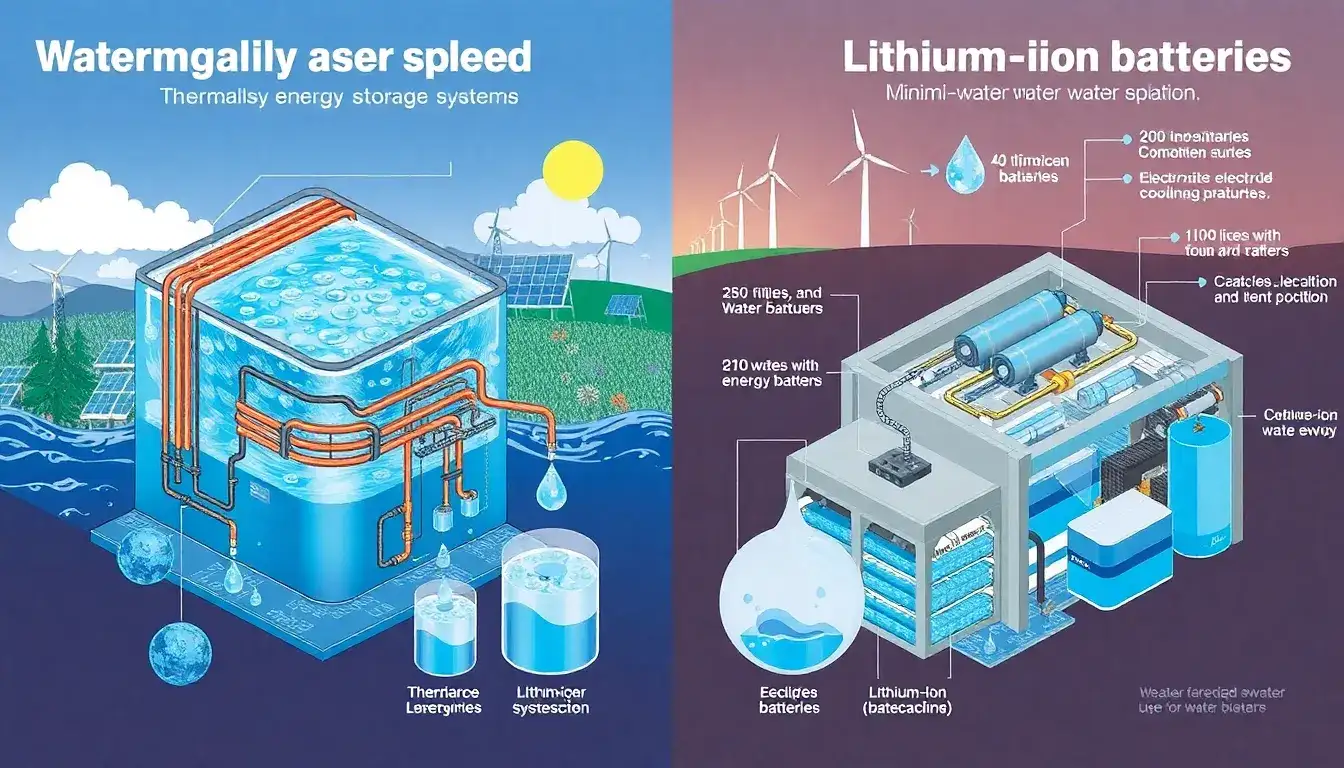
Comparing the water usage of thermal energy storage (TES) systems and lithium-ion batteries involves different considerations due to their distinct operational mechanisms.
Water Usage in Thermal Energy Storage (TES) Systems
- Mechanism: TES systems often use water as a medium to store thermal energy. This typically involves heating water to high temperatures when energy is abundant and using it later when needed. Water can be stored in tanks or underground caverns.
- Water Usage: TES systems primarily require water for storing thermal energy. The quantity of water used is determined by the storage capacity, which can be substantial. For instance, the system in Västerås, Sweden, uses caverns that can hold about 300,000 cubic meters of water. However, once the system is filled, water is not continuously consumed; rather, it is circulated and reused within the system.
Water Usage in Lithium-Ion Batteries
- Mechanism: Lithium-ion batteries store energy electrochemically without using water as a storage medium. However, water is required in the manufacturing process and for cooling systems in large-scale battery installations.
- Water Usage: The primary water usage in lithium-ion batteries is during the manufacturing phase. Manufacturing requires water for various processes like electrode production and cleaning. Additionally, large battery installations may use water-based cooling systems to maintain optimal operating temperatures, but this is not inherent to the battery’s energy storage mechanism.
Comparison
- Direct Water Usage: TES systems directly use large quantities of water for energy storage, while lithium-ion batteries do not use water for energy storage but consume it during manufacturing and cooling.
- Reusability: In TES systems, water is reused within the system, whereas lithium-ion batteries require water only during manufacturing and possibly for cooling, with no water reuse in the energy storage process itself.
- Efficiency and Environmental Impact: TES can contribute to energy efficiency by utilizing waste heat and renewable energy sources, potentially reducing overall water and energy demands. Lithium-ion batteries, while efficient in terms of energy storage density, have a different environmental footprint related to material extraction and end-of-life recycling.
In summary, while TES systems use significant amounts of water for energy storage, lithium-ion batteries primarily use water in manufacturing and some cooling processes. The water usage in both technologies serves different purposes and scales.
Original article by NenPower, If reposted, please credit the source: https://nenpower.com/blog/how-does-the-water-usage-of-thermal-energy-storage-systems-compare-to-that-of-lithium-ion-batteries/

