

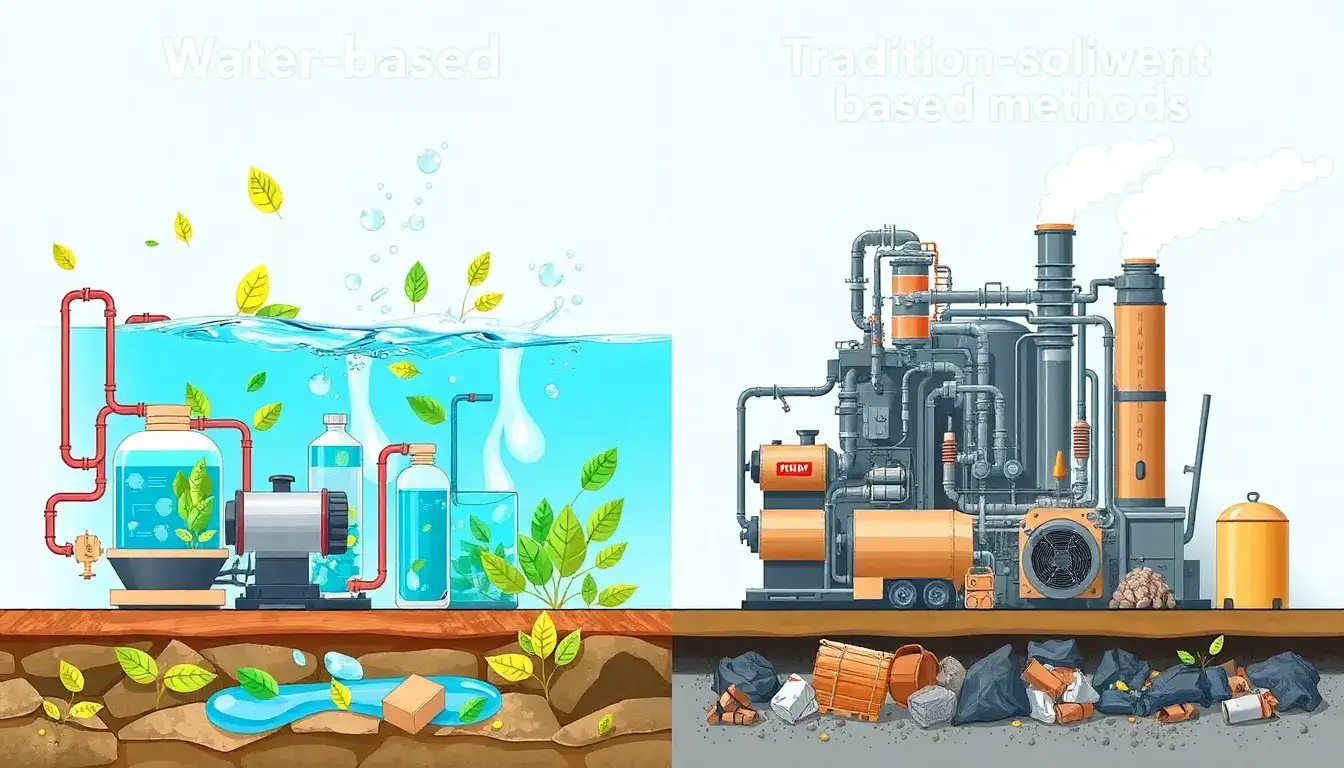
The water-based recycling method and traditional solvent-based methods differ significantly in their processes, environmental impact, and scalability.
Traditional Solvent-Based Recycling Methods
- Process: Solvent-based recycling, often called solvolysis or dissolution recycling, involves dissolving sorted plastic waste in chemical solvents to separate polymers from additives and contaminants without altering the polymer’s chemical structure. Typical solvents are used to dissolve plastics like PET or polypropylene, then polymers are recovered and new additives are added to produce recycled plastic. This process can purify polymers by removing dyes, adhesives, and metals, improving the quality of recycled output.
- Advantages: Solvent-based methods preserve polymer structure, avoiding the need for deconstructing plastics into base monomers like other chemical recycling methods (pyrolysis or depolymerization). This leads to lower energy consumption, reduced emissions, and less water use compared to more intensive chemical methods. It also yields higher output volumes, increasing recycling efficiency. Additionally, solvent dissolution can serve as a pretreatment to enhance mechanical recycling and other chemical recycling processes.
- Disadvantages: However, solvent-based recycling faces challenges such as high costs of solvents and anti-solvents, which require a high reuse rate (70%+) to be economically viable. The process is energy-intensive due to the need to remove solvents after purification. There is also a limit to how many times plastic can be recycled this way because solvents can degrade polymer properties, and contaminants may accumulate over cycles. These factors create scalability and cost barriers.
Water-Based Recycling Methods
- While specific water-based recycling details are less covered in the search results, there is an indication that some solvent-based recycling processes use water under supercritical conditions as a solvent to both heat and dissolve plastics. This water-based approach can act as a greener alternative to organic solvents, potentially reducing hazardous chemical use and environmental impact.
- Such water-based processes aim to reduce the use of toxic solvents and may involve conditions where water’s properties change (supercritical water), enabling effective dissolution and purification of mixed plastic waste. However, like solvent methods, they may still face issues with energy consumption and limitations on repeated recycling cycles due to polymer degradation and contamination risks.
Summary Comparison
| Aspect | Water-Based Recycling | Traditional Solvent-Based Recycling |
|---|---|---|
| Solvent Type | Water, often under supercritical conditions | Organic solvents and anti-solvents |
| Energy Consumption | High, especially due to supercritical conditions | High, mainly for solvent removal |
| Polymer Structure Impact | Potential degradation over multiple cycles | Generally preserves polymer but limited cycles due to solvent damage and contamination |
| Environmental Impact | Potentially less toxic solvents, greener option | Uses hazardous solvents; requires high reuse to be sustainable |
| Cost | Potentially lower chemical cost, but energy intensive | High chemical and solvent costs, expensive solvents and anti-solvents |
| Scalability | Limited by energy use and polymer degradation | Limited by solvent costs and polymer degradation |
In essence, traditional solvent-based methods have a proven ability to purify polymers efficiently with some energy and cost challenges, while water-based methods aspire to be more environmentally friendly by using water as a solvent under special conditions but still face similar issues with energy demands and limits in repeated recycling cycles. Both methods are more advanced than simple mechanical recycling but have trade-offs between sustainability, cost, and process complexity.
Original article by NenPower, If reposted, please credit the source: https://nenpower.com/blog/how-does-the-water-based-recycling-method-compare-to-traditional-solvent-based-methods/

