

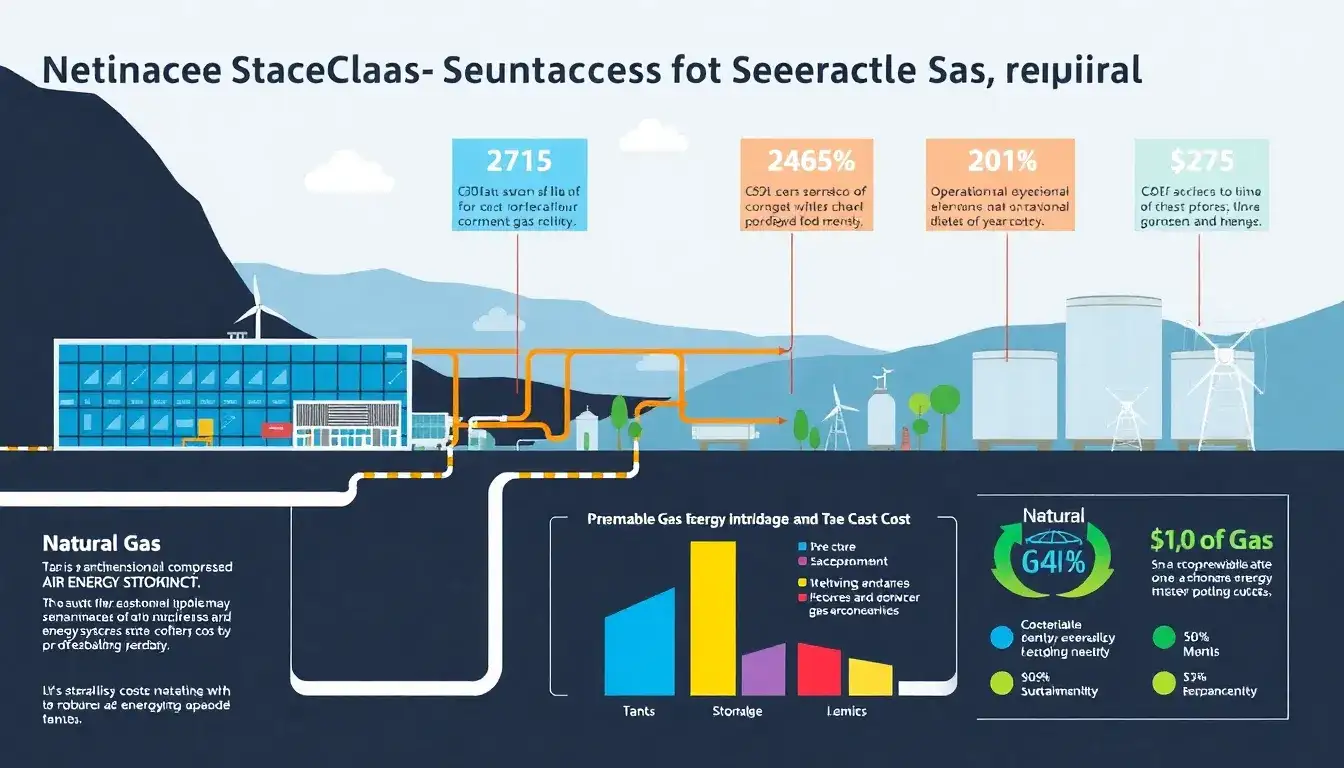
The use of natural gas in Compressed Air Energy Storage (CAES) systems impacts their overall cost in several ways, primarily due to its role in the generation phase and its influence on energy efficiency.
Impact on Cost
- Generation Cost: CAES systems use natural gas to generate electricity during the expansion phase. The cost of natural gas directly affects the operating cost of CAES, as it is used as the fuel source to heat the compressed air before expansion across a turbine to generate electricity. High natural gas prices can increase the operational costs, while low prices can make CAES more competitive.
- Efficiency and Energy Loss: CAES systems have lower round-trip efficiencies compared to other energy storage technologies, typically in the range of 60-65%. This means more energy is lost as heat during compression and storage. The use of natural gas helps mitigate this by adding energy for expansion, but it also introduces additional costs due to the fuel itself. The efficiency of CAES can be improved by using waste heat from gas combustion or compressors, but this requires additional infrastructure.
- Capital Costs: The initial investment in a CAES facility includes the cost of the power island, mechanical and electrical equipment, cavern construction, and other infrastructure. While the use of natural gas doesn’t directly affect these capital costs, it influences the operational viability and profitability of the system, as fluctuations in natural gas prices can impact the facility’s economic performance.
- Comparison with Other Technologies: CAES facilities often require a higher storage spread (difference between the cost of charging and discharging) than lithium-ion batteries to achieve profitability. This is partly due to the lower efficiency and higher maintenance costs associated with the mechanical components and natural gas usage in CAES systems.
Economic Viability
- Natural Gas Price Sensitivity: The cost-effectiveness of CAES systems is sensitive to natural gas prices. Higher prices decrease competitiveness, while lower prices enhance it.
- Scalability and Storage Durations: CAES can be scaled to provide long-duration energy storage at costs potentially competitive with other long-duration storage solutions like redox flow batteries or thermal energy storage.
- Alternative Configurations: Hybrid configurations, such as combining CAES with other renewable energy sources or novel geothermal-enhanced designs, can provide competitive Levelized Costs of Electricity (LCOE) and improve overall economic viability.
In summary, natural gas plays a crucial role in the operational costs and efficiency of CAES systems. The cost of natural gas, along with other factors like system efficiency and scalability, affects the overall cost and economic viability of CAES facilities.
Original article by NenPower, If reposted, please credit the source: https://nenpower.com/blog/how-does-the-use-of-natural-gas-in-caes-impact-its-overall-cost/

