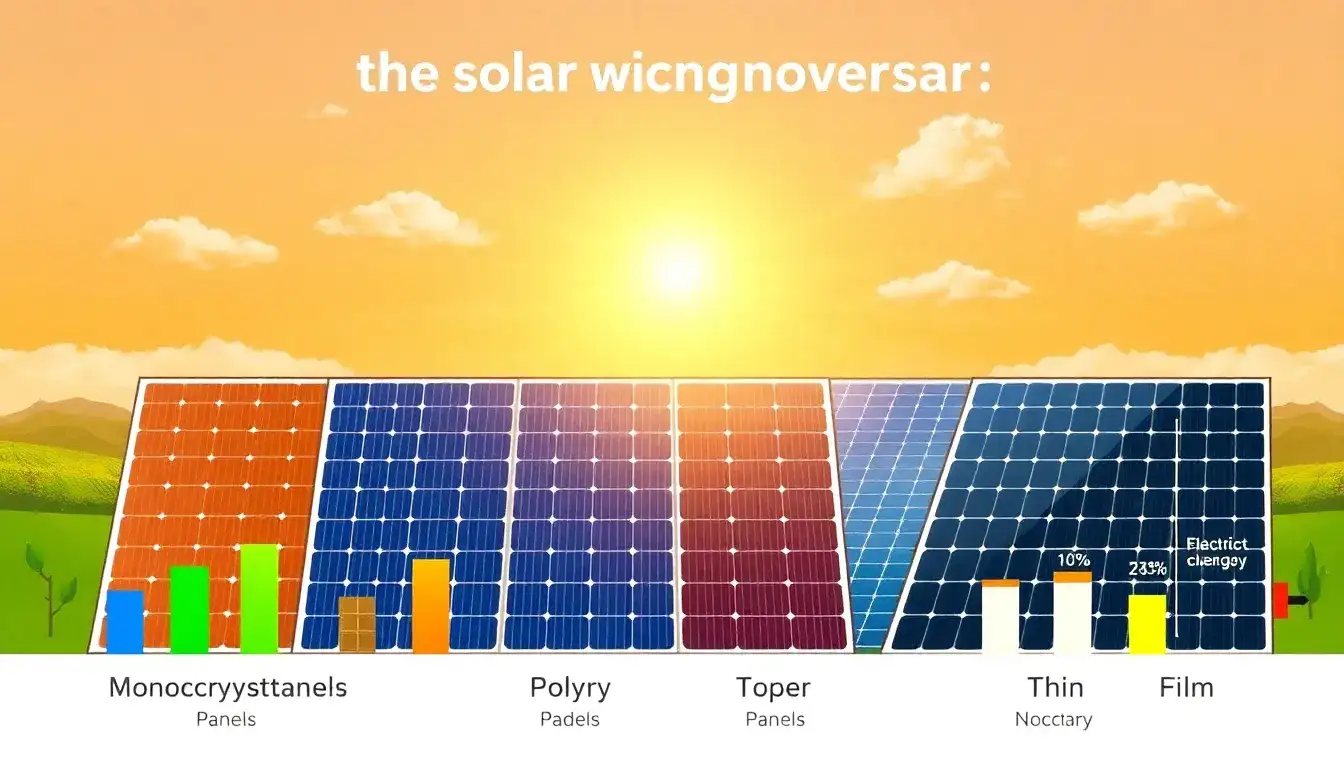
The type of solar panel material significantly affects the efficiency of the panel, which is the percentage of sunlight converted into usable electricity. Different materials and cell technologies yield varying efficiency levels due to their physical and chemical properties, manufacturing processes, and cell design.
Key Solar Panel Materials and Their Efficiencies
1. Monocrystalline Silicon Panels
- Material: Made from a single, pure silicon crystal.
- Efficiency: Typically 18–24%, often exceeding 20% due to the high purity and uniformity of the silicon crystal structure, which allows electrons to move more freely with fewer recombination losses.
- Characteristics: These panels have a sleek black appearance and higher power capacity per square foot.
- Cost: Generally more expensive because of the energy-intensive manufacturing process and lower material waste.
- Advantages: Highest efficiency among widely available silicon panels and perform better in limited space.
- Disadvantages: Higher upfront costs.
2. Polycrystalline Silicon Panels
- Material: Made from multiple fragments of silicon melted together, resulting in crystal boundaries.
- Efficiency: Typically 13–18%, lower than monocrystalline due to impurities and grain boundaries that cause higher electron recombination.
- Characteristics: Blueish color with a granular, less uniform structure.
- Cost: More affordable because of simpler and more material-efficient manufacturing.
- Advantages: Lower cost; good for larger roof areas where space is not a constraint.
- Disadvantages: Lower efficiency and heat tolerance compared to monocrystalline, leading to reduced performance in hot environments.
3. Thin-Film Solar Panels
- Material: Made by depositing very thin layers of photovoltaic materials such as cadmium telluride (CdTe), copper indium gallium selenide (CIGS), or amorphous silicon (a-Si) on a substrate.
- Efficiency: Varies by material—CIGS at 13–15%, CdTe at 9–11%, and a-Si at 6–8%. Overall, thin-film panels are less efficient than crystalline silicon panels, typically 7–13%.
- Characteristics: Lightweight, flexible, and easier to install, suitable for certain commercial or portable applications.
- Cost: Generally lower upfront cost but shorter lifespan and lower efficiency.
- Advantages: Portability and design versatility.
- Disadvantages: Lower efficiency and power output, shorter lifespan, and in some cases, environmental concerns (e.g., CdTe toxicity).
4. Advanced and Emerging Materials
- PERC (Passivated Emitter and Rear Cell): An enhancement to crystalline silicon that reflects light back into the cell, improving efficiency by about 5% above standard monocrystalline panels.
- N-type silicon and Back-Contact Cells: Use higher purity N-type silicon and improved design such as interdigitated back contact (IBC) cells, achieving efficiencies up to 24.4%. These designs reduce losses from shading and improve electron collection.
- Perovskite Solar Cells: A promising new material with potential efficiencies above 27%, even reaching record 30% in tandem with silicon cells. Still under development due to stability and lifespan challenges but expected to revolutionize efficiency in the near future.
Summary Table of Solar Panel Efficiency by Material Type
| Solar Panel Material/Type | Typical Efficiency Range | Key Characteristics | Cost |
|---|---|---|---|
| Monocrystalline Silicon | 18% – 24% | Highest efficiency, pure crystal silicon | High |
| Polycrystalline Silicon | 13% – 18% | Multiple silicon crystals, lower purity | Moderate |
| Thin-Film (CIGS, CdTe, a-Si) | 6% – 15% | Flexible, lightweight, lower efficiency | Low |
| PERC (Enhanced Crystalline Silicon) | Up to ~25% | Reflective layer, improved light capture | Moderate-High |
| N-type Back-Contact and HJT Cells | 21% – 24.4% | Advanced design, high purity silicon | High |
| Perovskite Tandem Cells (Emerging) | Up to 30% (experimental) | High efficiency potential, stability issues | Experimental |
Why Material Affects Efficiency
- Purity and Crystal Structure: Single-crystal (monocrystalline) silicon offers fewer defects and impurities, allowing electrons to flow more freely, reducing recombination losses.
- Cell Design: Advanced designs like PERC and back-contact reduce shading and electron losses, enhancing efficiency.
- Material Properties: Thin-film materials have different absorption and electron mobility characteristics, often resulting in lower efficiencies but offering other benefits like flexibility.
- Manufacturing Processes: More complex and precise methods yield better material quality but at higher costs.
Practical Impact
- Higher efficiency panels (monocrystalline, N-type) produce more power per square foot, beneficial where roof space is limited.
- Lower efficiency panels (polycrystalline, thin-film) cost less but require more area to generate the same power.
- Emerging technologies like perovskite promise future efficiency gains but are not yet widely commercial.
In conclusion, the type and quality of solar panel material directly determine the efficiency of converting sunlight to electricity. Monocrystalline silicon leads in efficiency and power density, polycrystalline offers a cost-effective balance, and thin-film panels provide versatility at lower efficiency. Continuous innovations in materials and cell design are pushing the efficiency boundaries further, promising more cost-effective and powerful solar solutions soon.
Original article by NenPower, If reposted, please credit the source: https://nenpower.com/blog/how-does-the-type-of-solar-panel-material-affect-efficiency/