

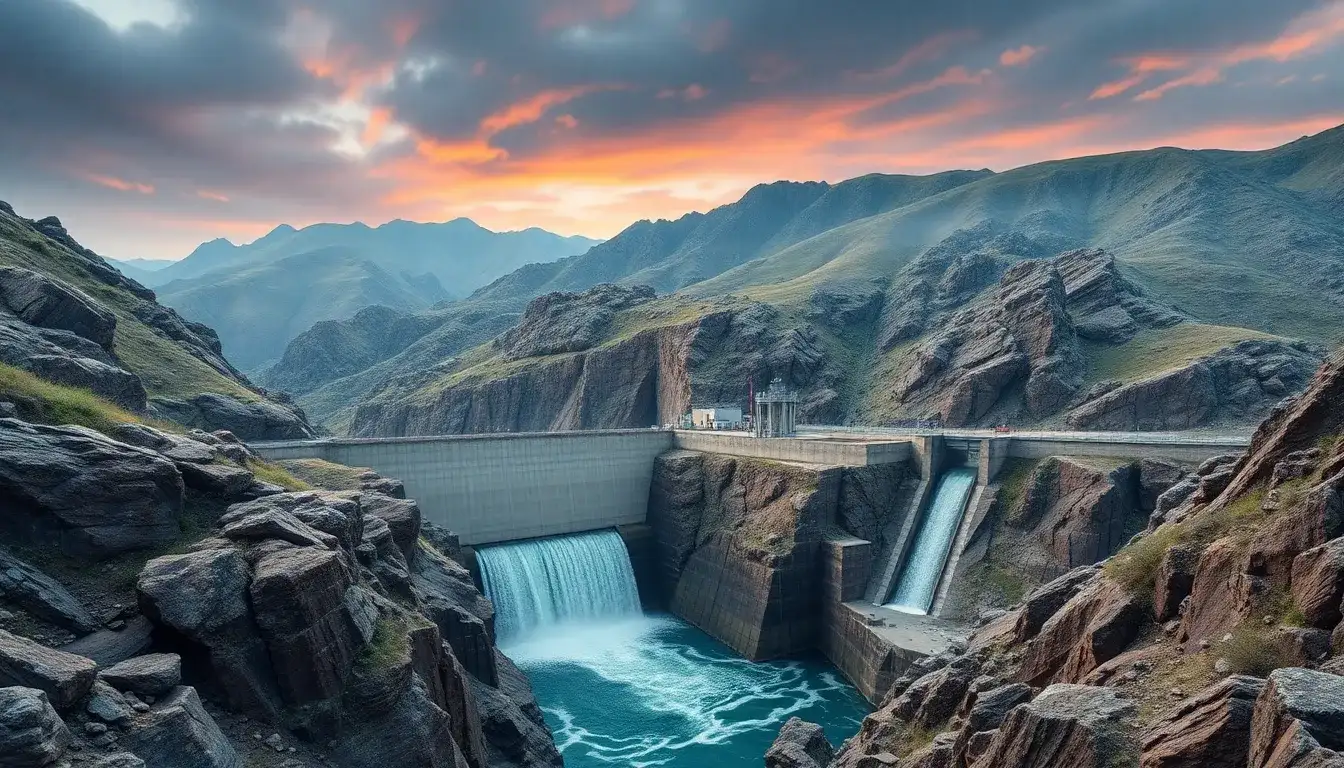
The type of rock significantly impacts the safety and stability of pumped hydro storage facilities due to its influence on excavation stability, foundation strength, and overall structural integrity.
Impact of Rock Type on Safety and Stability
- Excavation Stability: Different rock types and their structural characteristics affect how stable the excavated spaces for reservoirs, tunnels, and caverns will be. Weak or fractured rock may require additional support measures to prevent collapses or ground movement. Fault zones within the rock formations further complicate stability and require careful assessment and engineering solutions to manage risks.
- Foundation Stability: The dam and other critical structures need to be founded on stable rock to withstand the pressure of large water volumes. A solid, unfractured rock foundation ensures better load distribution and reduces the risk of settlement or failure under operational stresses.
- Groundwater Conditions: The presence of groundwater within certain rock types can affect the stability of excavations and foundations. Water inflow can lead to erosion, weakening of rock masses, or increased pressure against structural elements, requiring engineering controls such as grouting or waterproof linings.
- Rock Support Methods: In cases of unstable or less competent rock types, additional ground support techniques like pneumatically applied concrete (shotcrete) are used to quickly stabilize tunnels and caverns, ensuring safety during construction and operation phases.
- Seismic Considerations: The rock type influences how seismic waves propagate; therefore, designs must consider the rock’s behavior under seismic loads. Stable rock formations may offer better resistance to earthquake shaking, while faulted or highly fractured rock could amplify seismic risks. The dam and appurtenant structures are designed accordingly to withstand such conditions.
- Testing and Monitoring: Full-scale testing of machine halls and penstock chambers within rock formations helps assess how the rock will behave under load conditions, enabling engineers to design safer and more reliable infrastructure.
Summary Table
| Aspect | Influence of Rock Type | Safety and Stability Implication |
|---|---|---|
| Excavation Stability | Strong, intact rock preferred; fault zones risky | Stable excavations reduce risk of collapse and ground failure |
| Foundation Stability | Solid rock foundation needed | Ensures dam and structures withstand water pressure |
| Groundwater Presence | More groundwater in porous/fractured rock | Can weaken rock, cause erosion; requires waterproofing |
| Support Methods | Use of shotcrete for weak rock | Enhances tunnel and cavern safety during construction |
| Seismic Response | Rock type affects seismic wave behavior | Design must accommodate rock-specific seismic risk |
| Structural Testing | Rock behavior tested under load | Confirms stability and informs safer design choices |
In conclusion, the rock type at pumped hydro storage sites is a fundamental geotechnical factor determining excavations’ stability, dam foundations’ integrity, and the overall safety of the project. Proper assessment and engineering adaptation to the rock conditions are essential for creating robust and long-lasting pumped hydro storage facilities.
Original article by NenPower, If reposted, please credit the source: https://nenpower.com/blog/how-does-the-type-of-rock-impact-the-safety-and-stability-of-pumped-hydro-storage-facilities/

