

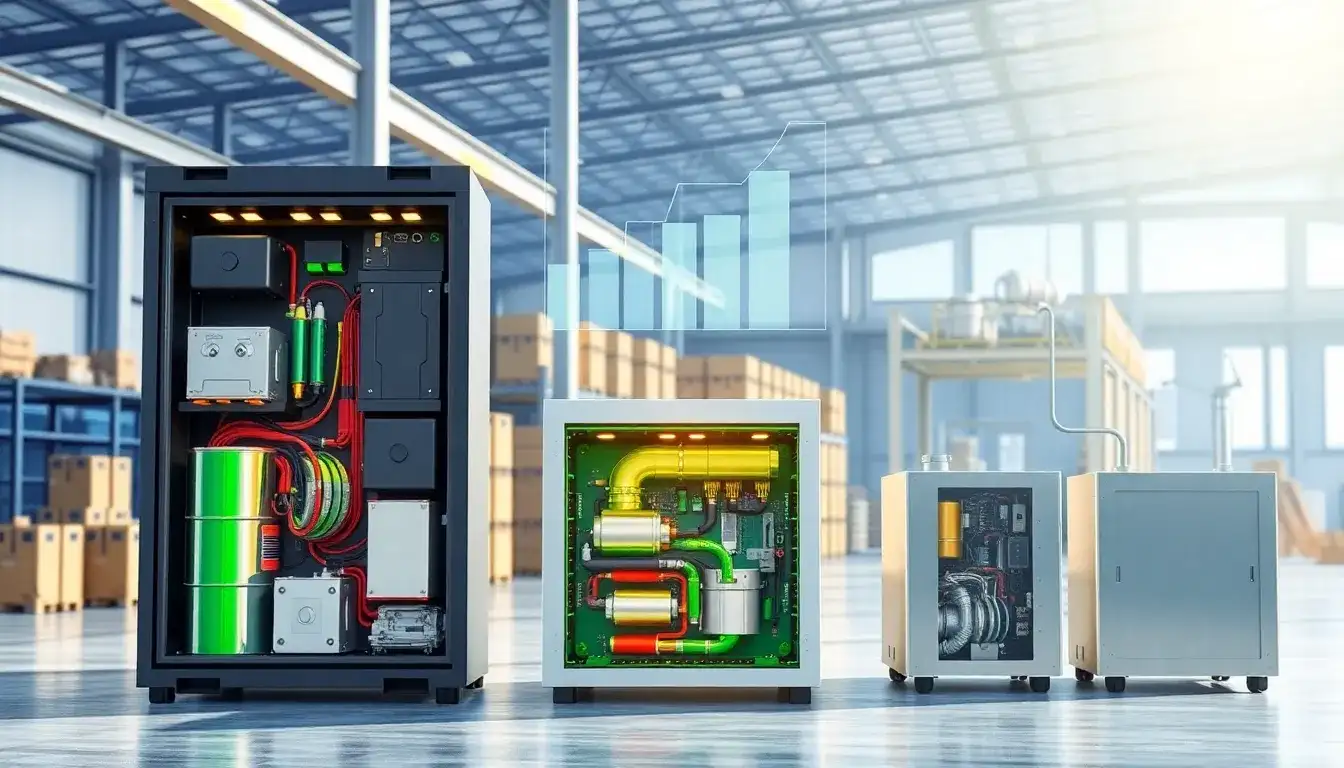
The type of battery used in a commercial battery storage system significantly impacts the overall cost, influenced by factors such as upfront capital expense, energy density, lifespan, maintenance, scalability, and operational requirements. Here is a detailed breakdown:
Battery Types and Cost Implications
Lithium-ion Batteries
- Upfront Cost: Higher initial investment compared to other types due to advanced materials and manufacturing processes.
- Benefits: High energy density, long cycle life (around 5,000 cycles), and efficient charge/discharge capabilities reduce replacement frequency and operational costs over time. Their compact size means less space required, potentially lowering facility costs.
- Drawbacks: Sensitivity to extreme temperatures may require additional thermal management to avoid performance loss or safety issues, which can add cost.
- Applications: Widely used in commercial systems due to their balance of performance and cost, especially where space and efficiency are priorities.
Lead-Acid Batteries
- Upfront Cost: Lower initial cost relative to lithium-ion, making them attractive for budget-conscious projects.
- Benefits: Mature technology, widely available, and recyclable; suitable for backup and smaller-scale commercial applications.
- Drawbacks: Shorter lifespan (5-10 years) and fewer charge cycles (200-800), leading to more frequent replacements and higher lifecycle costs. Lower energy density means larger space requirements, increasing installation costs.
- Applications: Typically used for backup power or in situations where upfront capital is limited.
Flow Batteries
- Upfront Cost: Typically higher than lithium-ion due to complex systems involving large electrolyte tanks.
- Benefits: Extremely long cycle life (up to 20,000 cycles), scalability, and suitability for long-duration storage reduce replacement frequency and operational costs. Non-flammable electrolytes enhance safety, potentially lowering insurance and regulatory costs.
- Drawbacks: Larger physical footprint and lower energy density increase installation complexity and space costs. Higher capital costs limit their use mainly to large-scale or grid applications.
- Applications: Ideal for utility-scale or industrial applications requiring long-duration and high-cycle storage.
Sodium-Sulfur (NaS) Batteries
- Upfront Cost: Moderate to high, related to the need for thermal management systems to maintain high operating temperatures (~300°C).
- Benefits: High energy density and efficiency make them suitable for large-scale grid support and load balancing.
- Drawbacks: Complexity and cost of thermal maintenance systems limit application to stationary, large setups. Lifespan is less than lithium-ion but generally adequate for grid applications.
- Applications: Utility-scale storage and grid stabilization.
Nickel-Cadmium Batteries
- Upfront Cost: Relatively high due to specialized manufacturing and environmental handling requirements.
- Benefits: Robust performance in extreme conditions and long life cycle.
- Drawbacks: Cadmium toxicity necessitates careful disposal/recycling, increasing operational costs and regulatory burden. Lower energy density than lithium-ion.
- Applications: Specialized commercial or industrial environments requiring durability under harsh conditions.
Summary Table of Cost-Related Factors
| Battery Type | Upfront Cost | Energy Density | Cycle Life (Approx.) | Lifespan | Maintenance/Operational Cost | Typical Applications |
|---|---|---|---|---|---|---|
| Lithium-ion | High | High | ~5,000 cycles | Up to 20 years | Moderate (thermal management needed) | Commercial, residential, grid-scale |
| Lead-Acid | Low | Low | 200-800 cycles | 5-10 years | Higher (frequent replacements, large space) | Backup, budget-limited projects |
| Flow Batteries | High | Moderate | >10,000 cycles | Up to 25 years | Low (long cycle life, scalable) | Utility-scale, long-duration storage |
| Sodium-Sulfur (NaS) | Moderate to High | High | Moderate | Long | High (thermal management) | Large grid applications |
| Nickel-Cadmium | High | Low to moderate | Long | Long | High (disposal/regulatory) | Harsh environments, specialized use |
Conclusion
Choosing the battery type directly affects the total cost of a commercial battery storage system. Lithium-ion batteries, despite higher upfront costs, often provide the best balance of efficiency, longevity, and space savings, lowering lifetime costs. Lead-acid systems have lower initial costs but higher replacement and operational expenses. Flow batteries and sodium-sulfur batteries are more expensive upfront but suitable for long-duration, large-scale grid applications where longevity and scalability offset costs. Specialized batteries like nickel-cadmium are costlier due to environmental handling but may be necessary for extreme conditions.
Original article by NenPower, If reposted, please credit the source: https://nenpower.com/blog/how-does-the-type-of-battery-used-affect-the-overall-cost-of-a-commercial-battery-storage-system/

