

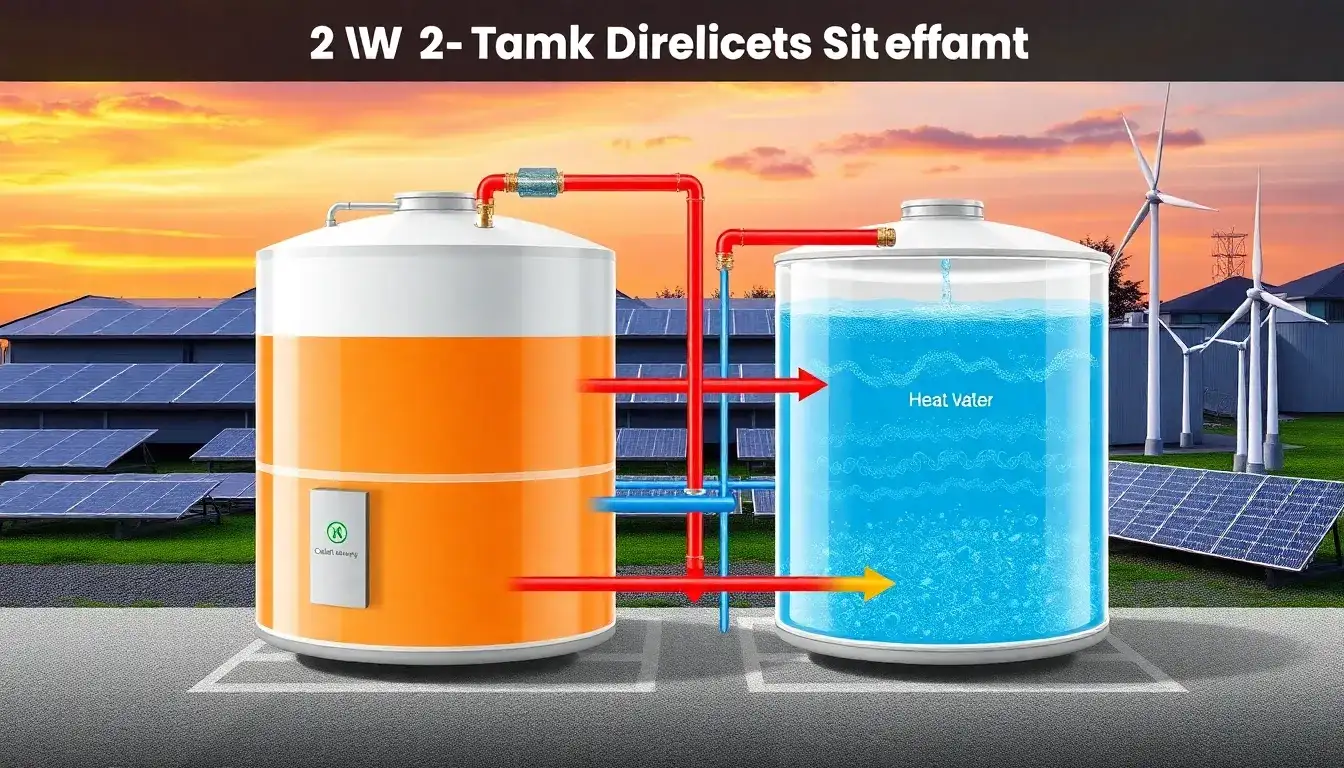
The two-tank direct system in thermal energy storage is a simple yet effective method used primarily in Concentrated Solar Power (CSP) plants. Here’s how it works:
Key Components
- Fluid: The system uses a single fluid for both heat collection and storage.
- Tanks: Two separate tanks are used: one for storing the fluid at a high temperature and the other at a low temperature.
Operation Process
- Collection and Heating: The fluid from the low-temperature tank is pumped through a solar collector or receiver where it is heated by solar energy to a high temperature.
- Storage: The heated fluid is then stored in the high-temperature tank.
- Energy Use: When energy is needed, the hot fluid from the high-temperature tank is circulated through a heat exchanger.
- Steam Generation: In the heat exchanger, the hot fluid transfers its heat to produce steam. This steam is used to generate electricity in a turbine.
- Cooling and Return: After transferring its heat, the fluid cools down and returns to the low-temperature tank, ready to be reheated.
Advantages
- Simplicity: The system is straightforward to implement and manage.
- Direct Interface: It allows for a direct interface between the solar field and the power generation system, reducing the need for intermediate heat exchangers.
- Efficiency: It can maintain efficiency in certain CSP configurations.
Examples
This system has been used in early parabolic trough plants like Solar Electric Generating Station I and the Solar Two power tower in California. In these applications, mineral oil or molten salt can be used as the heat-transfer and storage fluid.
While the two-tank direct system is effective, it can be compared with other systems like the thermocline or indirect two-tank systems for specific advantages in terms of cost, thermal efficiency, and storage density.
Original article by NenPower, If reposted, please credit the source: https://nenpower.com/blog/how-does-the-two-tank-direct-system-work-in-thermal-energy-storage/

