

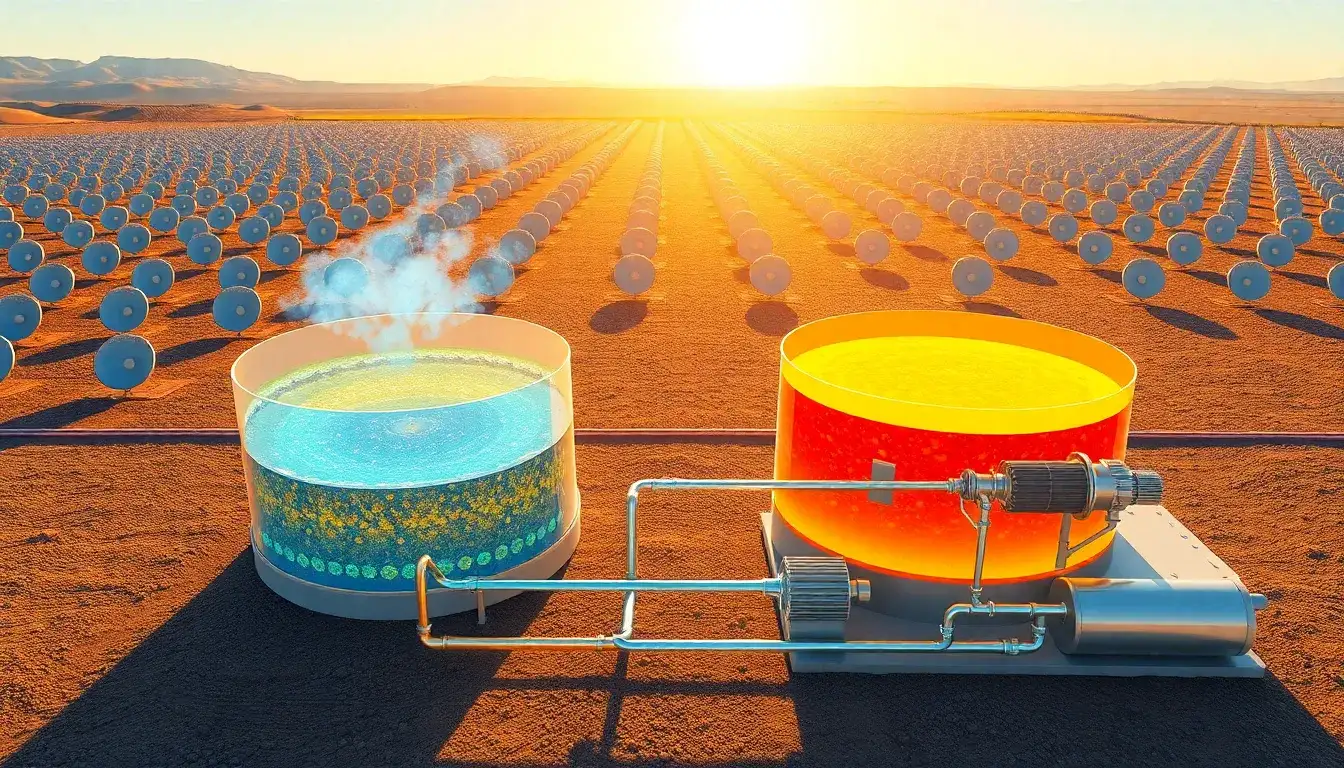
The two-tank direct thermal energy storage (TES) system integrates with Concentrated Solar Power (CSP) plants by serving as a direct interface between the solar field (collector or receiver) and the power cycle, typically an Organic Rankine Cycle (ORC) or steam turbine system. The key aspects of this integration are as follows:
Integration Mechanism
- In the two-tank direct TES system, the same heat-transfer fluid (HTF) used to collect solar thermal energy is also used for energy storage. This eliminates the need for a secondary heat exchanger between the storage and the power block, simplifying the system design and reducing thermal losses.
- The system consists of two tanks: a hot tank and a cold tank. Fluid from the cold tank is pumped through the solar collector or receiver where it is heated by concentrated solar radiation. This high-temperature fluid is then stored in the hot tank.
- When electricity generation is needed, the hot fluid from the hot tank flows directly through the power block heat exchanger (such as a steam generator), producing steam to drive turbines. The cooled fluid exiting the power block is returned to the cold tank, completing the cycle.
Operational Benefits and Performance
- This direct two-tank system provides a straightforward thermal storage solution enabling dispatchability by storing excess heat during peak sunlight for later use during cloud cover or nighttime, thereby improving the capacity factor of CSP plants.
- Compared to indirect two-tank systems (where separate fluids and extra heat exchangers are used), the direct system avoids additional components and associated costs, thereby offering potential economic advantages.
- Studies comparing two-tank direct TES to alternative configurations (like thermocline or one-tank systems) show that two-tank direct TES yields higher efficiency in certain operational aspects, specifically better response to fluctuations in fluid temperature entering the power cycle, which improves overall thermal-to-electric conversion efficiency (e.g., 19.7% vs. 18.2% ORC efficiency observed).
- However, some alternative TES designs might achieve higher energy density and lower thermal losses, but often at the cost of operational complexity or reduced cycle efficiency.
Summary
| Aspect | Two-Tank Direct TES in CSP Plants |
|---|---|
| Heat-transfer fluid | Same fluid used for solar collection and storage |
| Storage tanks | Two: hot tank (high temperature), cold tank (low temperature) |
| Interface | Direct fluid flow between solar field, storage, and power block (no intermediate heat exchanger) |
| Advantages | Simpler design, lower thermal losses, better response to temperature fluctuations, cost-effective |
| Typical Usage | Applied in parabolic trough CSP plants, e.g., in Spain and proposed U.S. projects |
| Performance | Supports dispatchability, improved plant efficiency, moderate thermal storage density |
In essence, the two-tank direct TES system integrates into CSP plants by directly storing and delivering solar thermal energy in the same fluid that collects it, enabling efficient, cost-effective, and flexible power production.
Original article by NenPower, If reposted, please credit the source: https://nenpower.com/blog/how-does-the-two-tank-direct-system-integrate-with-concentrated-solar-power-csp-plants/

