

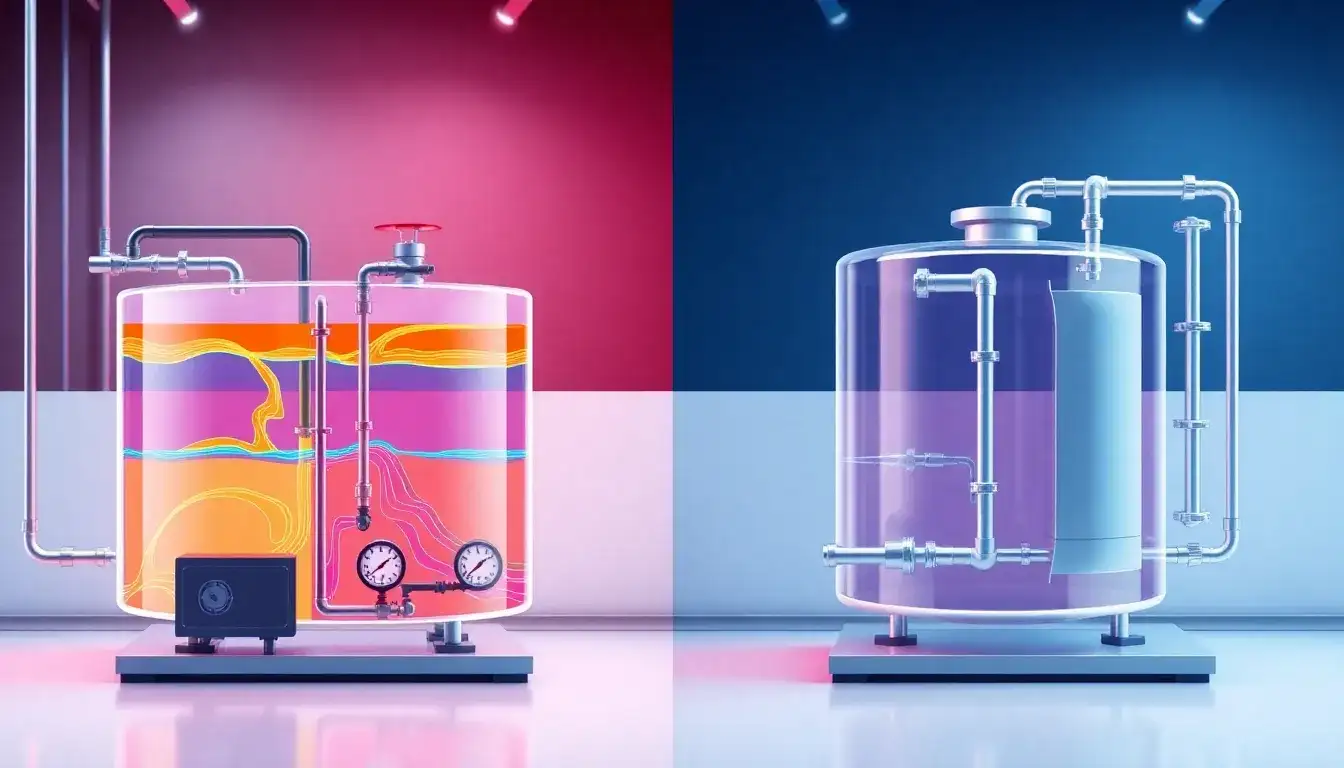
The two-tank direct and two-tank indirect systems for thermal energy storage serve distinct purposes in solar thermal power plants, differing primarily in how they manage heat transfer and storage fluids.
Two-Tank Direct System
- Fluid Usage: Both heat transfer and storage are done using the same fluid. This fluid is heated by solar collectors and stored in two separate tanks at high and low temperatures.
- Operation: The fluid from the low-temperature tank is heated by the solar collector and moved to the high-temperature tank. It then flows through a heat exchanger to generate steam for electricity, resulting in a lower temperature fluid that returns to the low-temperature tank.
- Examples: Early parabolic trough power plants and the Solar Two power tower used this system with mineral oil and molten salt as fluids.
Two-Tank Indirect System
- Fluid Usage: Uses different fluids for heat transfer and storage. This is beneficial when the heat-transfer fluid cannot or should not be used for storage due to cost or compatibility issues.
- Operation: An additional heat exchanger is required to transfer heat from the heat-transfer fluid to the storage fluid. This system is advantageous when using organic oil as the heat-transfer fluid and molten salt as the storage fluid, such as in some Spanish and proposed U.S. parabolic plants.
- Cost and Complexity: The indirect system is more complex and costly due to the additional heat exchanger required for heat transfer between the two fluids.
Key Differences
- Fluid Compatibility: Direct systems use a single fluid for both heat transfer and storage, whereas indirect systems use separate fluids.
- System Complexity: Indirect systems are more complex due to the need for an additional heat exchanger.
- Cost: Direct systems generally offer cost savings by not requiring an extra heat exchanger.
Original article by NenPower, If reposted, please credit the source: https://nenpower.com/blog/how-does-the-two-tank-direct-system-differ-from-the-two-tank-indirect-system/

