

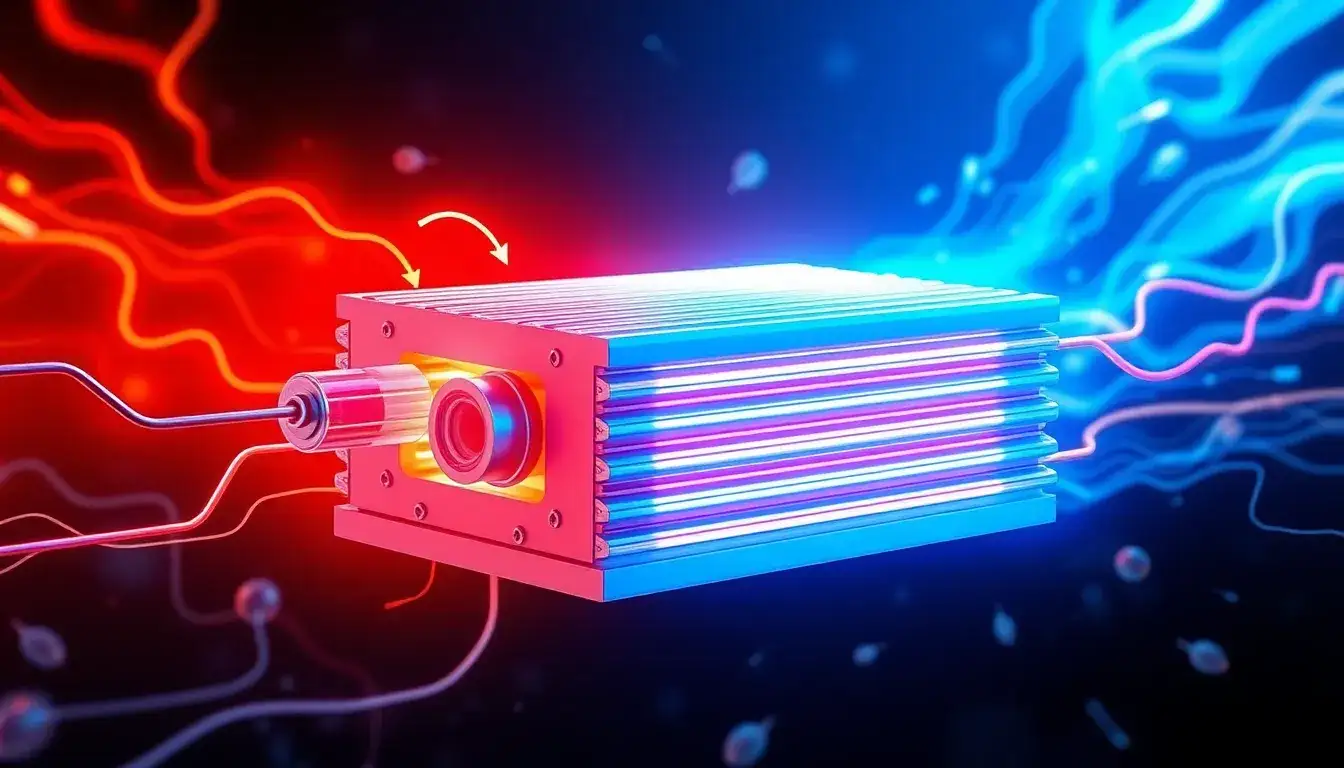
A thermoelectric generator (TEG) converts heat directly into electricity using the Seebeck effect, a thermoelectric phenomenon where a temperature difference between two dissimilar materials generates an electric voltage. Here’s how it works:
Core mechanism
- Temperature gradient: A TEG requires a heat source (hot side) and a cooling mechanism (cold side). The larger the temperature difference (ΔT), the higher the voltage generated.
- Charge carrier diffusion: In semiconducting materials (n-type and p-type), heat causes electrons (n-type) and electron “holes” (p-type) to diffuse from the hot side to the cold side.
- Voltage generation: This diffusion creates a charge imbalance, producing a voltage difference between the hot and cold ends. Connecting multiple thermocouples in series increases the output.
Material requirements
Effective thermoelectric materials must balance:
- High electrical conductivity (σ) to minimize energy loss from resistance.
- Low thermal conductivity (κ) to maintain the temperature gradient.
- High Seebeck coefficient (S), which measures voltage generated per degree of temperature difference.
Common materials include bismuth telluride (Bi₂Te₃) and tin selenide (SnSe). Advanced designs use nanostructuring or topological materials to optimize electron flow while suppressing heat conduction.
Efficiency factors
- Carnot limit: Maximum theoretical efficiency depends on ΔT (efficiency ≈ 1 – Tc/Th).
- Figure of merit (zT): Calculated as zT = S²σT/κ, where higher zT indicates better performance. Recent breakthroughs with polycrystalline SnSe achieved zT ≈ 3.1.
- Design: Microscale structuring (e.g., grain size reduction) minimizes thermal conductivity and enhances electron flow.
Applications
- Waste heat recovery: Converts exhaust heat from vehicles, factories, or power plants into electricity.
- Space probes: Radioisotope thermoelectric generators (RTGs) power missions like Mars rovers.
- Wearable tech: Flexible TEGs harvest body heat for low-power sensors.
Key challenge: Efficiency remains low (typically <10%), but advances in materials science and nanostructuring aim to improve cost-effectiveness and scalability.
Original article by NenPower, If reposted, please credit the source: https://nenpower.com/blog/how-does-the-thermoelectric-generator-convert-heat-into-electricity/

