

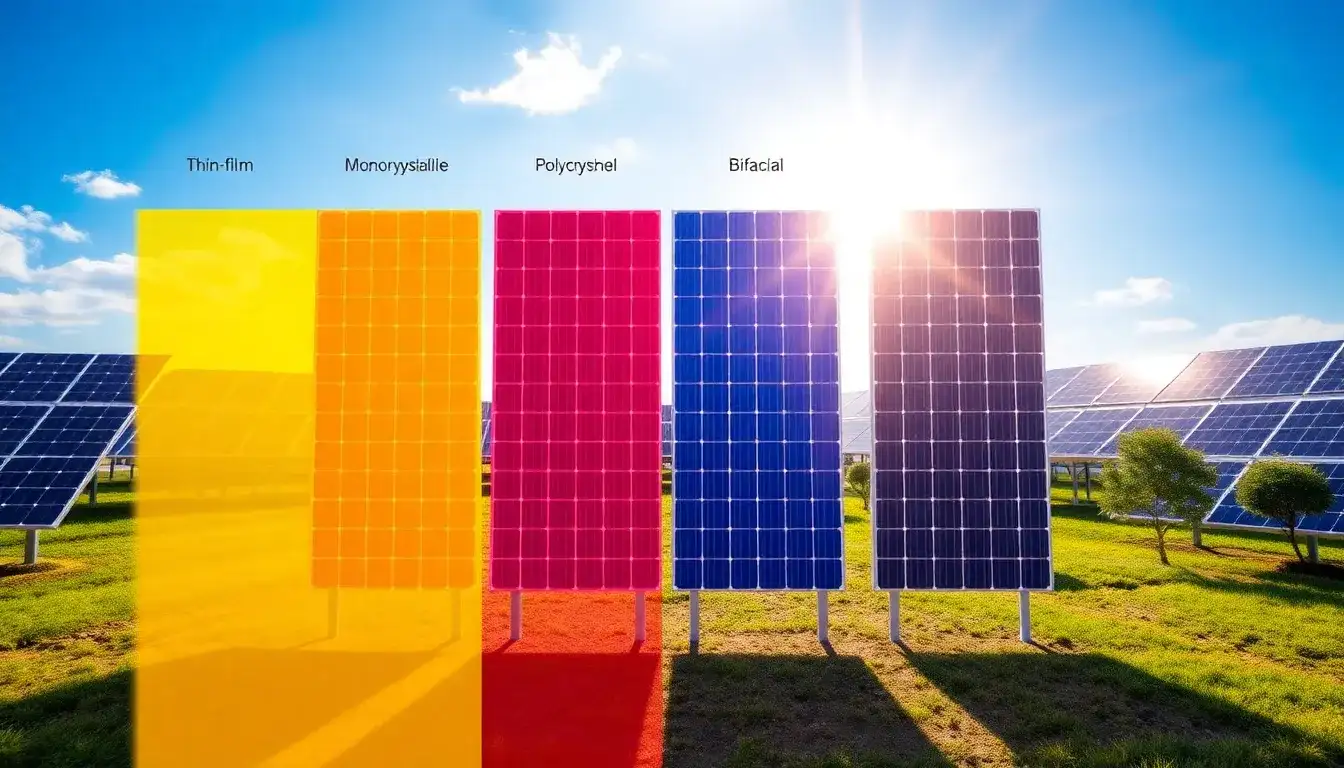
The temperature coefficient of solar panels quantifies how much their efficiency decreases as temperature rises above the standard testing condition of 25°C (77°F), expressed as a percentage loss in power output per degree Celsius increase.
Variation of Temperature Coefficient Among Solar Panel Types
- Crystalline Silicon Panels (Monocrystalline and Polycrystalline):
- Most commonly used solar panels have temperature coefficients ranging roughly between -0.29%/°C and -0.5%/°C.
- Polycrystalline and standard monocrystalline panels typically exhibit coefficients around -0.44% to -0.50%/°C.
- Specific brands and higher-quality monocrystalline panels, like Maxeon, can have better coefficients around -0.29% to -0.38%/°C, representing less power loss with heat.
- For example, REC Group Alpha Pure-R and Panasonic Evervolt HK2 panels offer very low temperature coefficients of about -0.24%/°C, among the best available in the market.
- Thin Film Solar Panels:
- Thin film panels generally have much lower temperature coefficients, closer to -0.2%/°C.
- This means thin film panels lose less efficiency as temperature rises, making them more suitable for hotter climates.
Impact of Temperature Coefficients
- The higher (more negative) the temperature coefficient, the more efficiency a panel loses as it heats up.
- For instance, a panel with a -0.5%/°C coefficient loses 0.5% of its efficiency for every degree above 25°C, whereas a panel with -0.24%/°C loses less than half that amount.
- Operating temperatures on rooftops can exceed 50°C, resulting in significant power loss for panels with higher coefficients; for example, a 40°C rise leads to about 16% power loss for a -0.41%/°C panel.
Summary Table
| Solar Panel Type | Typical Temperature Coefficient (% / °C) |
|---|---|
| Thin Film Panels | About -0.2 |
| High-Quality Monocrystalline (e.g., Maxeon, REC, Panasonic) | -0.24 to -0.29 |
| Standard Monocrystalline | Around -0.30 to -0.38 |
| Polycrystalline | Around -0.44 to -0.50 |
Additional Notes
- Temperature coefficient is a critical parameter for solar panel performance in hot climates but less influential in cooler regions where panels rarely exceed 25-35°C.
- The physical design of panels, materials used, and mounting methods can influence operating temperature and thus the effect of the temperature coefficient.
- Roof material colors and types also affect panel temperature and subsequent efficiency losses.
In conclusion, thin film panels have the lowest temperature coefficients and therefore perform better at high temperatures, but they often have lower overall efficiency. High-end monocrystalline panels provide a good balance with relatively low temperature coefficients, minimizing efficiency loss in heat while maintaining high baseline efficiency. Standard crystalline panels generally have higher temperature coefficients and thus greater efficiency loss as temperature rises. Selecting panels with favorable temperature coefficients is especially important in hot climates to optimize energy yield.
Original article by NenPower, If reposted, please credit the source: https://nenpower.com/blog/how-does-the-temperature-coefficient-vary-between-different-types-of-solar-panels/

