

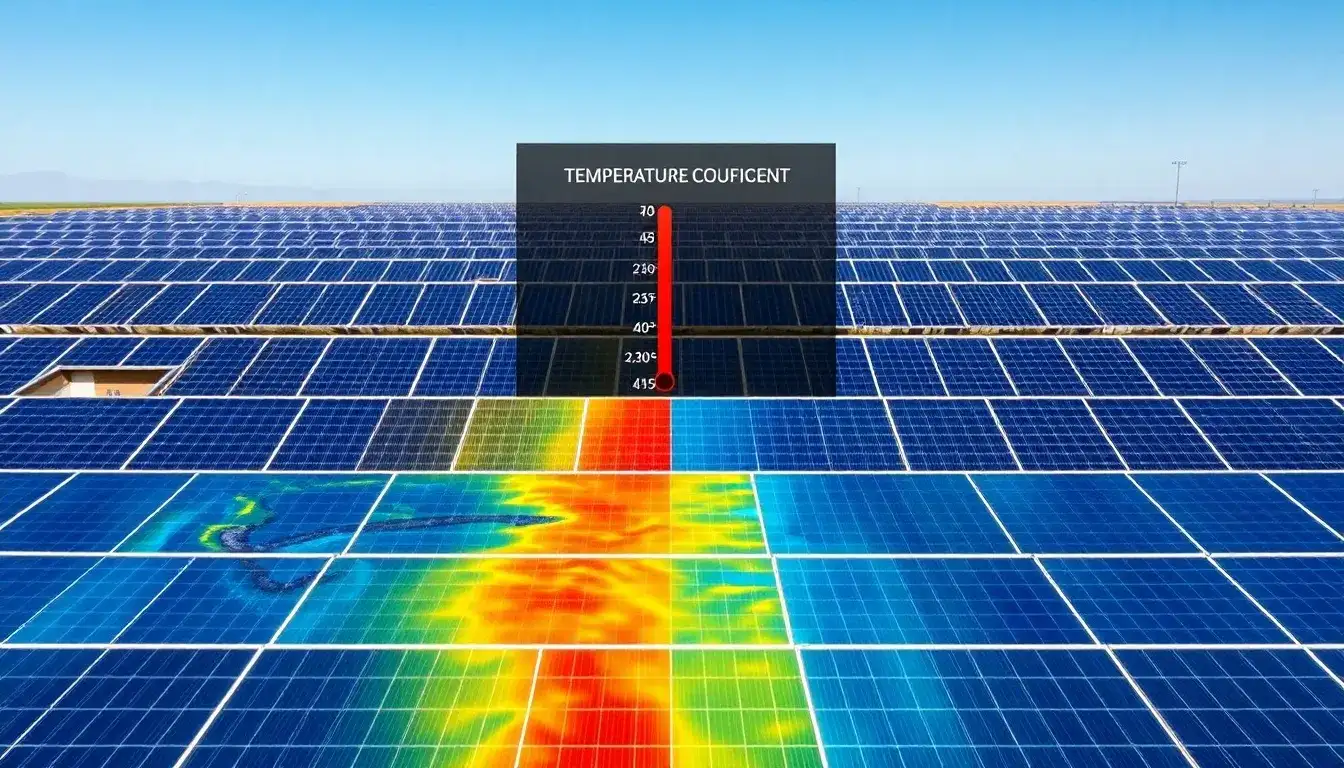
The temperature coefficient of solar panels significantly influences their lifespan by affecting how thermal stresses impact panel efficiency and durability over time.
What Is Temperature Coefficient?
The temperature coefficient quantifies the percentage decrease in a solar panel’s power output for every degree Celsius increase above the standard test temperature of 25°C (77°F). It is expressed as a negative percentage per °C because higher temperatures reduce panel efficiency. For example, a temperature coefficient of -0.35%/°C means the panel loses 0.35% of its power output for every degree Celsius above 25°C.
Influence on Lifespan and Durability
- Thermal Stress Reduction: Panels with a lower (less negative) temperature coefficient undergo fewer losses in performance as temperature rises, resulting in reduced thermal stress on the panel materials. This mitigates material expansion and contraction cycles that lead to wear, microcracking, and solder joint fatigue inside the panel.
- Longevity: Because thermal stresses accelerate degradation of solar cells and internal connections, a lower temperature coefficient correlates with longer solar panel lifespan. Panels better able to maintain performance at high temperatures experience less structural and performance degradation over decades.
- Degradation Rate: The temperature coefficient impacts the annual degradation rate of the panel. Panels with higher temperature coefficients typically degrade faster, reducing their energy yield over their 25+ year lifespan.
Impact on Energy Production and Return on Investment
- Consistent Energy Output: Panels with low temperature coefficients maintain more consistent energy production even during hot weather. This is especially important in hot climates where ambient temperatures regularly exceed 25°C, such as India.
- Better Efficiency in Heat: Thin-film and certain monocrystalline panels often have lower temperature coefficients, performing better under heat and maintaining higher efficiency, thereby extending their effective operational life.
- Improved ROI: By reducing efficiency losses and degradation, lower temperature coefficients help increase the total energy produced over the panel’s lifetime, enhancing the return on investment for solar installations.
Summary Table
| Aspect | Effect of Low Temperature Coefficient | Effect of High Temperature Coefficient |
|---|---|---|
| Power output loss per °C | Smaller loss (e.g., -0.29%/°C) | Greater loss (e.g., -0.5%/°C or more) |
| Thermal stress | Reduced expansion/contraction, less microcracking | Increased material stress leading to faster degradation |
| Lifespan | Longer lifespan due to reduced degradation | Shorter lifespan due to accelerated wear |
| Annual energy yield | Higher, more consistent energy production | Lower due to greater efficiency drop under heat |
| ROI | Improved due to sustained output over time | Reduced due to higher degradation and efficiency loss |
In conclusion, the temperature coefficient serves as a critical factor in determining both the short-term efficiency and long-term durability of solar panels. Lower temperature coefficients reduce thermal stresses that deteriorate panel materials, leading to a longer lifespan and better performance in hot climates, ultimately maximizing energy production and investment returns.
Original article by NenPower, If reposted, please credit the source: https://nenpower.com/blog/how-does-the-temperature-coefficient-influence-the-lifespan-of-solar-panels/

