

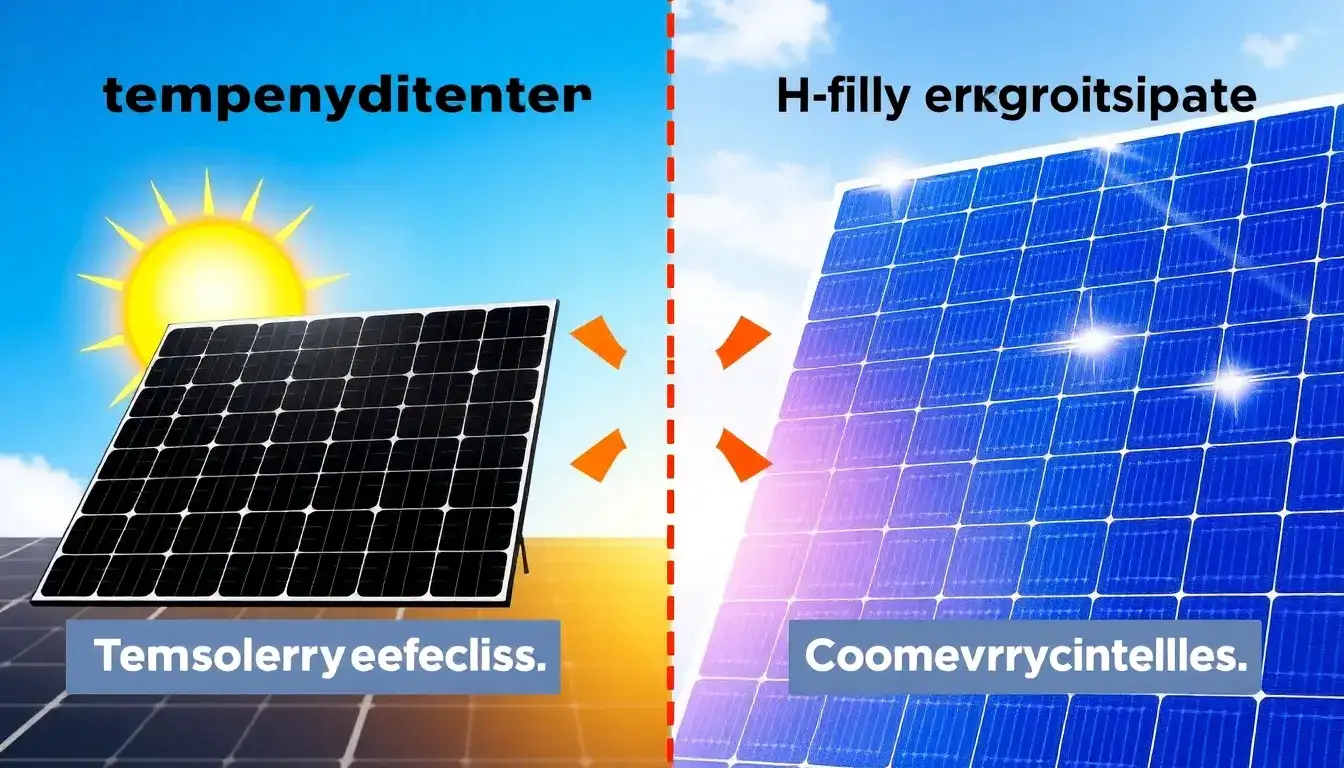
The temperature coefficient measures how much a solar panel’s efficiency drops for every 1°C increase above 25°C (77°F). It is expressed as a negative percentage, indicating efficiency loss at higher temperatures.
Comparison of Temperature Coefficients: Monocrystalline vs Polycrystalline
- Monocrystalline Solar Panels generally have a temperature coefficient ranging from about -0.3%/°C to -0.4%/°C. This means their efficiency decreases by 0.3% to 0.4% for each degree Celsius above 25°C. High-quality monocrystalline panels, such as those from Maxeon and SunPower, can have even better coefficients around -0.29% to -0.38%/°C, indicating superior performance in heat.
- Polycrystalline Solar Panels typically have a slightly higher temperature coefficient, around -0.37%/°C to -0.5%/°C. This means they lose a bit more efficiency per degree of temperature increase compared to monocrystalline cells. The range is slightly broader but generally indicates more sensitivity to heat.
Summary Table
| Panel Type | Typical Temperature Coefficient (% per °C) | Notes |
|---|---|---|
| Monocrystalline | -0.29% to -0.4% | Better heat tolerance, higher efficiency, often more costly |
| Polycrystalline | -0.37% to -0.5% | Slightly higher efficiency loss with temperature, lower cost |
Explanation
- A lower (closer to zero) temperature coefficient is more desirable as it means the panel loses less efficiency as it gets hotter.
- Monocrystalline panels, due to their single-crystal silicon structure, generally perform better in hot conditions, maintaining efficiency better than polycrystalline panels.
- Polycrystalline panels, made from multiple silicon crystals, typically have a higher temperature coefficient, meaning more efficiency loss at elevated temperatures.
Additional Notes
- Thin-film panels have even lower temperature coefficients (around -0.2%/°C), but this question concerns crystalline silicon panels.
- Temperature coefficients influence overall energy production, especially in hot climates where panel temperatures can exceed 65°C, making the difference between monocrystalline and polycrystalline meaningful for system performance.
- Other factors such as panel design, brand, roof material, and installation angle also affect operating temperatures and performance.
In conclusion, monocrystalline solar panels typically have a better (lower) temperature coefficient than polycrystalline panels, meaning monocrystalline panels maintain their efficiency better as temperature rises. This makes monocrystalline panels more suitable for hot environments where temperature-related power loss is a concern.
Original article by NenPower, If reposted, please credit the source: https://nenpower.com/blog/how-does-the-temperature-coefficient-compare-between-monocrystalline-and-polycrystalline-solar-panels/

