

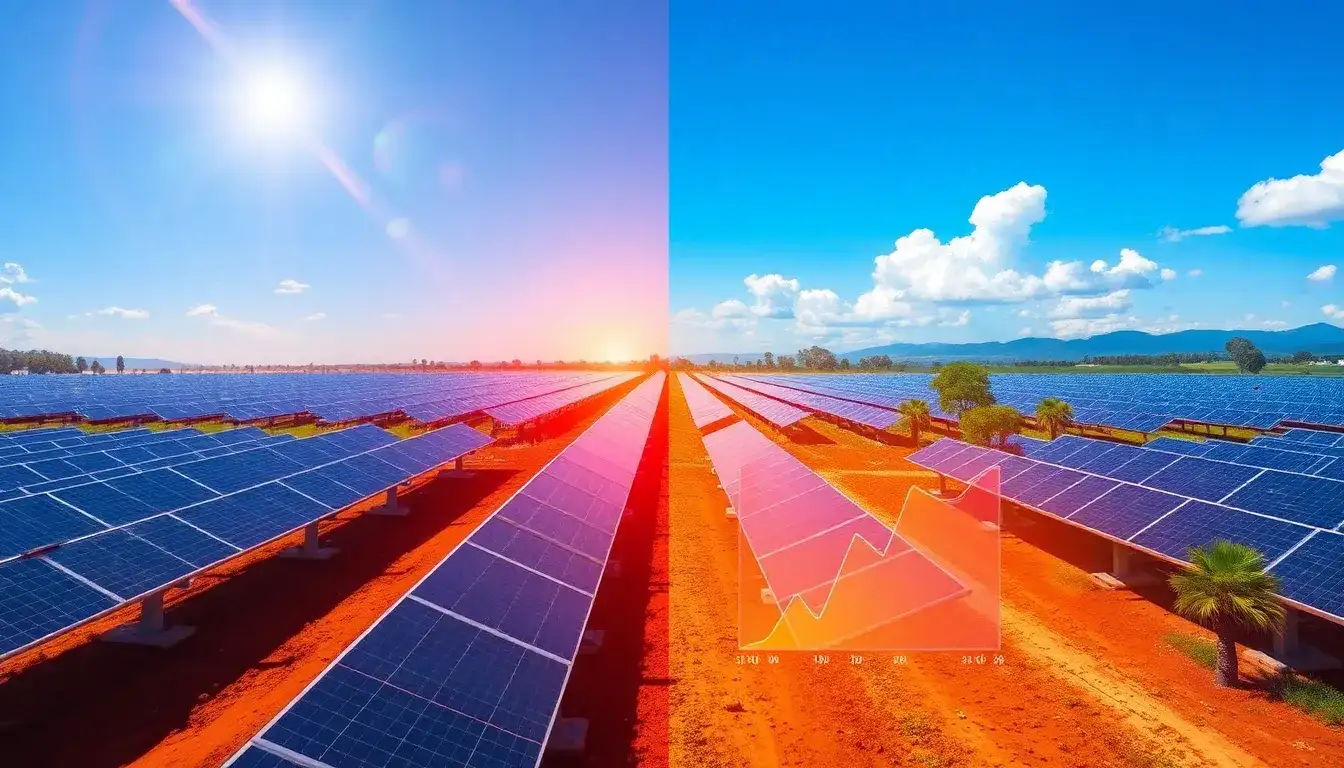
The temperature coefficient significantly impacts the long-term energy savings of solar panels because it quantifies how much a panel’s power output decreases as the temperature rises above the standard testing condition (25°C or 77°F). Solar panels generally perform best at moderate temperatures, around 25°C; when the panel temperature exceeds this, efficiency drops at a rate indicated by the temperature coefficient, typically expressed in % per degree Celsius (°C).
How the temperature coefficient affects energy output:
- The temperature coefficient shows the percentage loss in efficiency for each degree Celsius above 25°C. For example, a coefficient of -0.4%/°C means the panel loses 0.4% of its power output per degree above 25°C.
- This loss accumulates as panel temperature increases. For instance, if a solar panel operates at 65°C, 40°C above the standard 25°C, with a temperature coefficient of -0.41%/°C, the power loss is approximately 16.4%.
- Since solar panels installed on rooftops or in hot environments often face temperatures much higher than 25°C, these losses are significant over time and reduce the total energy generated annually.
Consequences for long-term energy savings:
- Panels with lower (closer to zero) temperature coefficients retain more efficiency in hot conditions. Over the lifetime of the system, this translates into higher energy generation and greater savings on electricity bills.
- Conversely, panels with higher negative temperature coefficients suffer greater efficiency drops, eroding the expected savings from solar investment.
- This impact is especially important in hot climates where panels frequently operate far above standard testing temperatures, whereas in cooler climates the effect is less critical.
Additional factors influencing the temperature effect:
- Panel technology matters: monocrystalline silicon panels generally have temperature coefficients around -0.38% to -0.5%/°C, while thin-film panels can have lower coefficients (better performance in heat) around -0.2%/°C.
- Installation methods (e.g., mounting with airflow underneath) and roofing materials can influence panel temperature and thus efficiency loss.
- Advances in panel design aim to reduce operating temperature and improve temperature coefficients, decreasing energy loss over time.
Summary Table of Temperature Coefficients and Effects
| Factor | Effect on Panel Efficiency & Energy Savings |
|---|---|
| Temperature coefficient value | % drop in panel efficiency per °C above 25°C; lower absolute value means less loss |
| Typical range | About -0.29% to -0.5% / °C for crystalline silicon panels |
| Example loss at 65°C | Up to ~16% power loss vs. rated power at 25°C |
| Impact on long-term savings | Lower temperature coefficient = higher energy output → greater savings |
| Climate influence | Hot climates amplify losses; cooler climates mitigate temperature effects |
| Technology variations | Thin-film panels have better coefficients; monocrystalline worse but more efficient at 25°C |
| Installation & materials | Proper mounting and cool roofs reduce panel temp, improving output |
In essence, the temperature coefficient is a key factor in the long-term energy savings of solar panels because it governs how much their efficiency degrades when operating at real-world temperatures often higher than lab conditions. Choosing panels with a low temperature coefficient and considering installation details that enhance cooling can significantly improve overall solar system performance and financial returns over the system’s lifetime.
Original article by NenPower, If reposted, please credit the source: https://nenpower.com/blog/how-does-the-temperature-coefficient-affect-the-long-term-energy-savings-of-solar-panels/

