

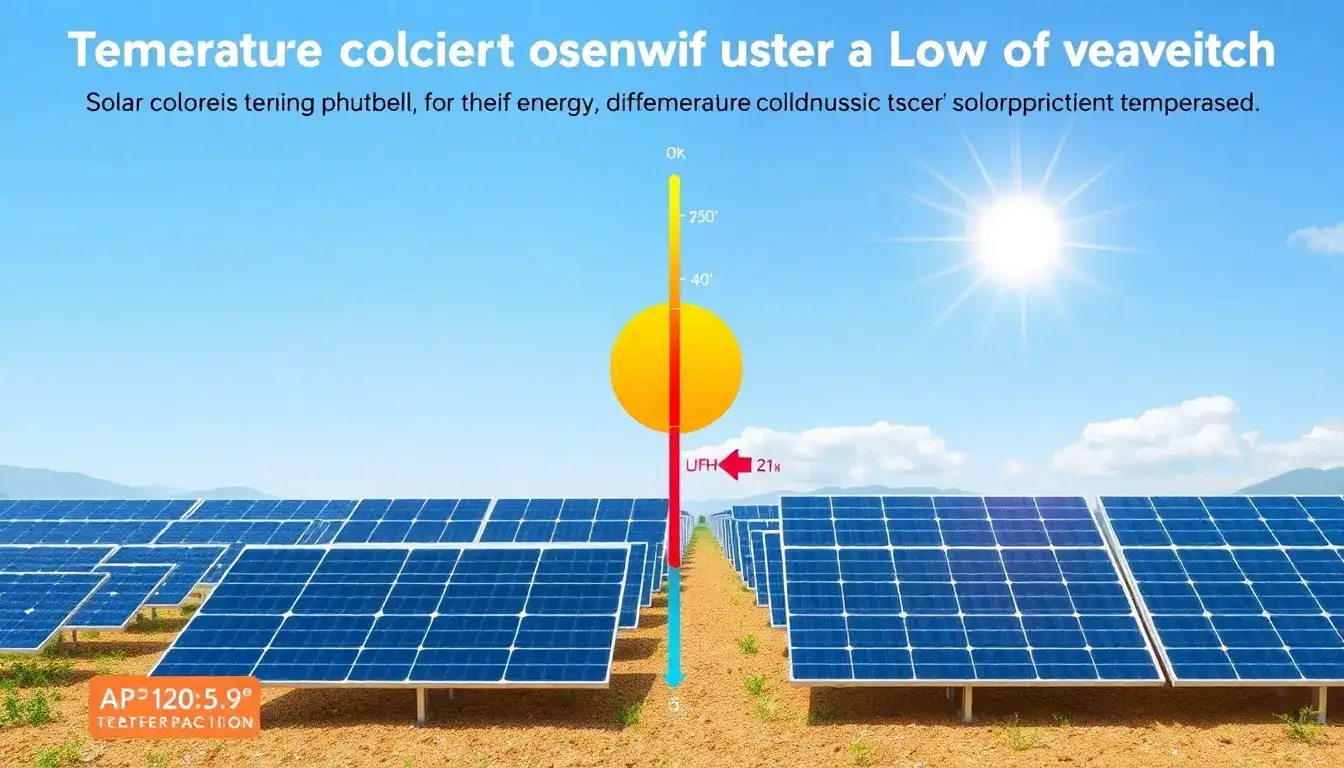
The temperature coefficient of solar panels quantifies how much a panel’s efficiency and power output decrease as its temperature rises above the standard testing temperature of 25°C (77°F). It is typically expressed as a negative percentage per degree Celsius (e.g., -0.3%/°C to -0.5%/°C), indicating that higher temperatures reduce the panel’s performance.
Effect on Long-Term Energy Production
- Decrease in Efficiency with Rising Temperature:
Solar panels are tested at 25°C, and their output power is rated at this temperature. As the panel temperature increases beyond 25°C, the voltage output drops faster than the increase in current, resulting in an overall decrease in power output. For example, a panel with a temperature coefficient of -0.4%/°C will lose 0.4% of its rated power for every degree Celsius rise above 25°C. At operating temperatures common in the field (e.g., 50°C to 65°C), this can mean a 10-16% loss in power output compared to rated conditions. - Impact Adds Up Over Time:
Since solar panels spend many hours exposed to sunlight and elevated temperatures, the cumulative loss in energy production due to temperature can significantly reduce the total lifetime energy yield. Even seemingly small percentage drops per degree Celsius translate into sizable annual production losses, especially in hotter climates. - Variability by Climate and Installation:
The extent of impact depends heavily on the geographic location and installation setup. Panels in hot regions or on dark-colored roofs that absorb more heat tend to have higher operating temperatures, leading to greater efficiency losses. Conversely, cooler climates reduce the effect of the temperature coefficient on energy production, sometimes making it less critical when selecting panels. - Choice of Technology and Design Matters:
Different panel technologies have varying temperature coefficients. For instance, high-quality monocrystalline panels like REC Group’s Alpha Pure or Panasonic’s Evervolt HK2 have low temperature coefficients (~-0.24%/°C), meaning they lose less efficiency at high temperatures. Thin-film solar panels generally perform better in heat, with coefficients closer to -0.2%/°C. Choosing panels with a lower temperature coefficient improves long-term energy yield, especially important in hot climates. - Thermal Management Strategies Help:
Mounting panels with adequate airflow underneath and using thermally conductive substrates help reduce operating temperature. Roof material also influences solar panel temperature; reflective or metal roofs can keep panels cooler than asphalt shingle roofs, mitigating losses due to temperature.
Summary Table of Key Points
| Aspect | Impact on Long-Term Energy Production |
|---|---|
| Temperature coefficient value | Higher (more negative) values cause greater efficiency loss with heat |
| Typical operating temperature | Often 20-30°C above ambient, can reach 60-70°C, increasing losses |
| Power loss example | -0.4%/°C × 40°C rise = ~16% reduction in power output |
| Panel technology influence | Thin-film < High-quality monocrystalline < Lower-quality panels |
| Climate dependence | Hot climates amplify losses; cooler climates reduce impact |
| Installation factors | Roof color/material and mounting affect panel temperature |
In conclusion, the temperature coefficient directly affects the long-term energy production of solar panels by reducing their efficiency as temperatures rise above standard testing conditions. Selecting panels with a low temperature coefficient and optimizing installation to reduce heat buildup can significantly improve cumulative energy yield, particularly in hot and sunny locations.
Original article by NenPower, If reposted, please credit the source: https://nenpower.com/blog/how-does-the-temperature-coefficient-affect-the-long-term-energy-production-of-solar-panels/

