

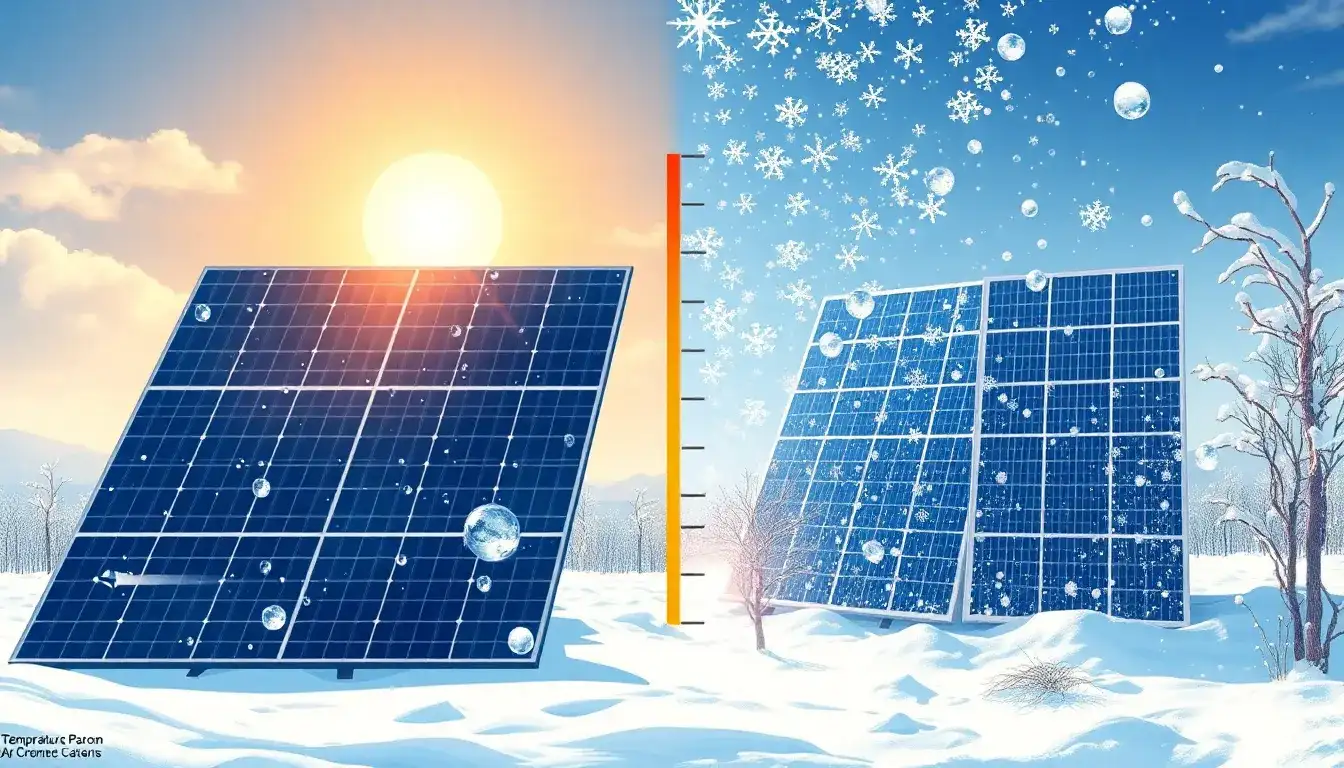
The temperature coefficient of a solar panel is a key metric that quantifies how much the panel’s energy output decreases as its temperature rises above the standard testing condition of 25°C (77°F). It is usually expressed as a percentage loss in power per degree Celsius increase in temperature (e.g., -0.3% /°C). This coefficient directly affects the energy output of solar panels, especially in extreme weather conditions where panel temperatures can get significantly higher than 25°C.
How Temperature Coefficient Affects Energy Output
- Negative Impact with Increasing Temperature: Solar panels generally become less efficient as they heat up. For every 1°C rise above 25°C, the energy output typically decreases by a fraction defined by the temperature coefficient. For example, if a panel has a temperature coefficient of -0.4%/°C and the panel temperature rises to 65°C (which is 40°C above 25°C), the panel’s power output could decrease by about 16% (40°C × 0.4%) compared to its rated power at 25°C.
- Efficiency Loss is Non-Trivial in Hot Conditions: Although a loss rate of a few tenths of a percent per degree might seem small, in hot climates or under intense sunlight where panel temperatures can reach 65°C or higher, this can result in significant efficiency reductions. For instance, a 260W panel with a -0.41%/°C coefficient might lose over 40W at these temperatures.
- Voltage and Current Effects: The decrease in power output mainly occurs because the panel’s voltage decreases as temperature increases, and this drop in voltage outweighs any slight increase in current, resulting in overall power loss.
Typical Temperature Coefficient Ranges by Panel Technology
- Monocrystalline and Polycrystalline Panels: These commonly have temperature coefficients ranging between approximately -0.29% to -0.5% per degree Celsius. For example, high-quality panels like REC Group and Panasonic have lower coefficients around -0.24% to -0.29%/°C, which means they lose less efficiency in heat.
- Thin-Film Panels: Tend to have better temperature coefficients (closer to -0.2%/°C), making them more efficient in hot climates but typically have lower overall efficiency.
Implications in Extreme Weather Conditions
- High Temperatures Reduce Output: In extreme heat (e.g., summer sunlight in desert areas where panels can hit 65°C or more), panels with higher (more negative) temperature coefficients will suffer more significant losses in energy output.
- Design and Installation Mitigate Effects: Techniques such as mounting panels with airflow beneath them, using thermally conductive substrates, and selecting panels with better temperature coefficients help reduce heat-related losses.
- Roof Material Matters: Roofing materials that absorb and retain heat (e.g., dark asphalt shingles) can raise panel temperatures further, exacerbating efficiency losses. Conversely, reflective or lighter-colored roofing can help keep panel temperatures lower.
- Cooler Climates Are Advantageous: Solar panels perform best on cool, sunny days. In cooler weather, efficiency is higher, which can offset losses during hot periods.
Summary Table of Temperature Coefficients and Effects
| Feature | Effect/Value |
|---|---|
| Reference temperature | 25°C (77°F) |
| Typical operating temperature | Often 20-30°C above ambient; can reach 60-70°C+ |
| Temperature coefficient range | -0.29% to -0.5% / °C (crystalline panels) |
| Thin-film panels | ~ -0.2% / °C |
| Example loss at 65°C | ~16% reduction for -0.4%/°C coefficient |
| Mitigation | Panel technology, mounting methods, roof material |
In conclusion, the temperature coefficient is a crucial factor determining how much solar panels’ energy output diminishes in extreme heat. Panels with a lower (less negative) temperature coefficient maintain higher efficiencies under high temperatures. Therefore, in extreme weather conditions, selecting panels with better temperature coefficients and employing installation strategies that reduce operating temperatures can substantially improve overall energy production from solar systems.
Original article by NenPower, If reposted, please credit the source: https://nenpower.com/blog/how-does-the-temperature-coefficient-affect-the-energy-output-of-solar-panels-in-extreme-weather-conditions/

