

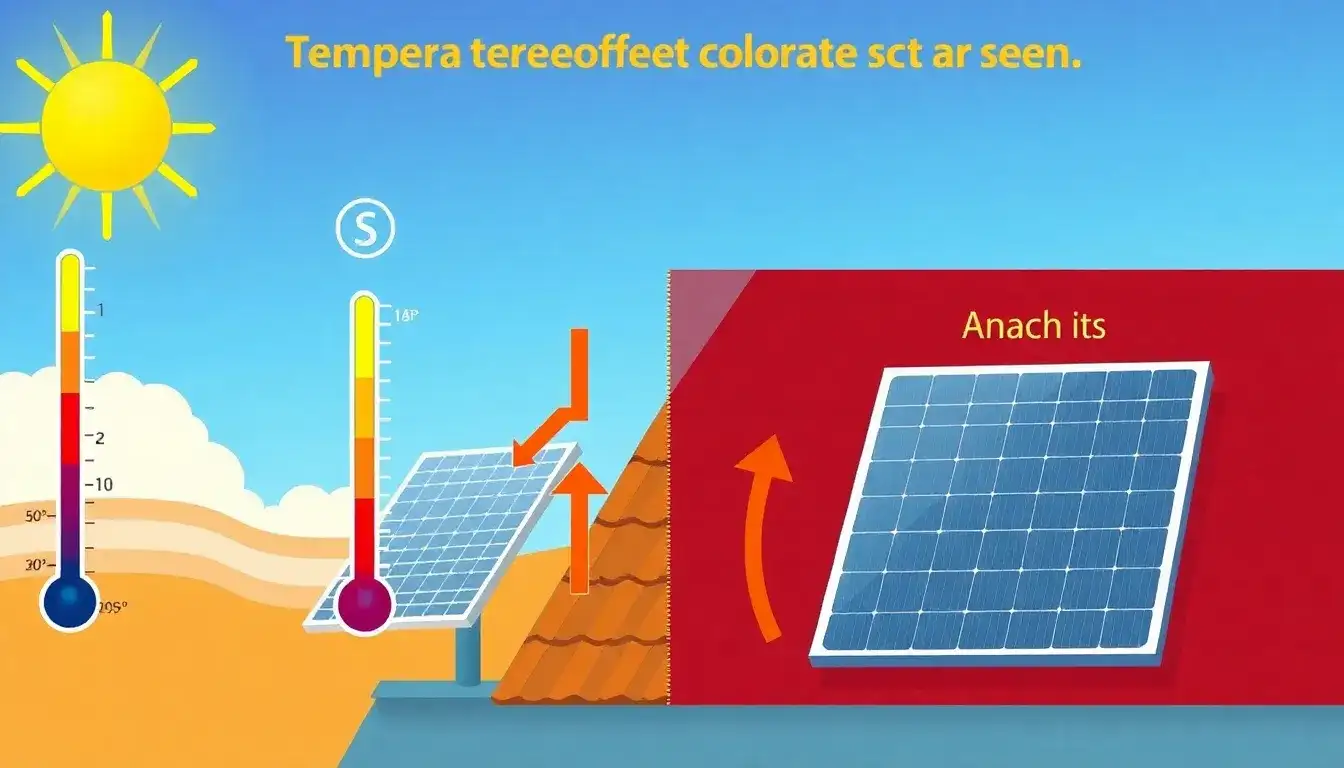
The temperature coefficient of solar panels significantly affects their efficiency in hot climates by quantifying how much the panel’s power output decreases as the temperature rises above the standard testing temperature of 25°C (77°F). This coefficient is typically expressed as a negative percentage per degree Celsius, reflecting the loss of efficiency for each degree above 25°C.
How Temperature Coefficient Influences Solar Panel Efficiency
- Definition: The temperature coefficient indicates the percentage decrease in power output for every 1°C increase in panel temperature above 25°C. For example, a coefficient of -0.4%/°C means the solar panel loses 0.4% of its efficiency for each degree Celsius above 25°C.
- Typical Range: Most crystalline silicon solar panels have temperature coefficients ranging from about -0.3% to -0.5% per °C. Thin-film solar panels generally have a lower (better) temperature coefficient, closer to -0.2% per °C.
- Effect in Hot Climates: In hot climates, solar panels can reach surface temperatures significantly above 25°C, often up to 60°C or more. At 60°C, a panel with a -0.4%/°C coefficient can experience a 14% drop in power output compared to its rated efficiency at 25°C. This decrease is mainly due to physical changes in the semiconductor material, such as reduced open-circuit voltage and increased internal resistance.
- Efficiency Loss Breakdown:
- The open-circuit voltage decreases notably with higher temperature.
- Short-circuit current tends to increase slightly, but this is insufficient to offset voltage losses.
- Increased recombination rates and resistance further reduce power output.
Practical Implications for Hot Climates
- While higher temperatures reduce panel efficiency, panels still generally produce more energy on hot sunny days than on cool cloudy days because of increased sunlight intensity.
- Panels with lower (less negative) temperature coefficients are preferable in hot climates, as they retain more efficiency at elevated temperatures. For instance, LG’s NeON® R panels have a temperature coefficient as low as -0.3%/°C, providing better performance in heat.
- Installation factors such as panel angle, roof material, and ventilation affect panel temperature and therefore overall efficiency. Lighter-colored and reflective roofing materials can help keep panel temperatures down.
- Shade has a more drastic impact on output than temperature; however, the temperature coefficient remains an important factor in overall energy yield calculations.
Summary Table of Temperature Coefficients for Common Panel Types
| Panel Type | Typical Temperature Coefficient (% / °C) |
|---|---|
| Monocrystalline Silicon | -0.3 to -0.5 |
| Polycrystalline Silicon | -0.4 to -0.5 |
| Thin-Film Solar Panels | ~ -0.2 |
| High-efficiency panels (e.g., LG NeON® R) | ~ -0.3 |
Conclusion
In hot climates, the temperature coefficient critically determines how much solar panel efficiency declines due to heat. Panels with lower negative temperature coefficients will perform better under high temperatures, maintaining more of their rated capacity. This makes the temperature coefficient a key consideration when selecting solar panels for regions with high ambient temperatures. Proper installation and roof material choice also help minimize panel temperature and maximize energy yield despite heat-related efficiency losses.
Original article by NenPower, If reposted, please credit the source: https://nenpower.com/blog/how-does-the-temperature-coefficient-affect-the-efficiency-of-solar-panels-in-hot-climates/

