

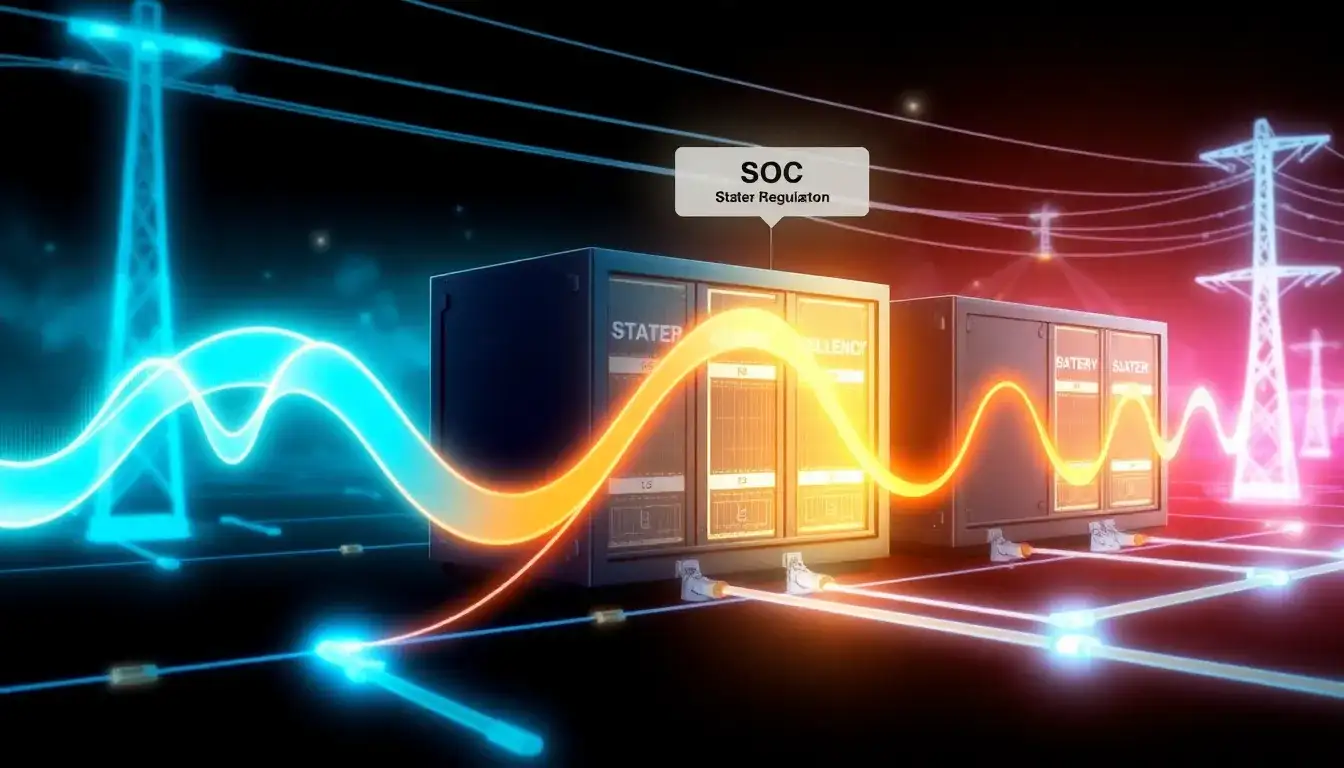
The state of charge (SOC) of a Battery Energy Storage System (BESS) plays a crucial role in its ability to provide frequency regulation services. Frequency regulation is vital for maintaining grid stability by ensuring that the supply and demand of power are balanced, usually within a narrow frequency band (e.g., around 50 Hz).
Influence of SOC on Frequency Regulation Capabilities
- Operational Range: The SOC must be maintained within a specified range (e.g., 73% to 92%) to ensure that the BESS can effectively absorb or release power during frequency deviations. Operating too close to either extreme (full charge or full discharge) limits the system’s ability to respond to frequency changes, as running at full capacity leaves little room for absorbing additional power, and running too low can leave insufficient power to release during a frequency drop.
- Response Speed and Accuracy: The speed and accuracy of a BESS in responding to frequency deviations are critical to effective frequency regulation. A well-managed SOC allows for quick and precise adjustments to power output, which is particularly valuable due to BESS’s ability to respond rapidly compared to conventional generators.
- Reducing Aging: Maintaining a balanced SOC helps reduce the risk of deep discharges or overcharges, both of which contribute to premature aging of the batteries. By operating within a defined range, the system ensures that batteries are not frequently cycled to extreme conditions.
- Economic Optimization: Managing SOC effectively allows BESS operators to optimize their economic performance by participating in wholesale markets, arbitrage, or other services. Proper SOC management ensures that the system can take advantage of high-demand periods for revenue while maintaining its ability to regulate frequency.
Operational Strategy for Effective SOC Management
- Operating within Defined Limits: Keep SOC between predefined minimum and maximum levels to maintain flexibility for frequency regulation.
- Strategic Charging/Discharging: Manage charging and discharging based on forecasted demand or grid conditions to ensure readiness for frequency regulation services.
- Avoiding Deep Cycles: Prevent deep discharges to prolong battery life and maintain performance.
In summary, a well-managed SOC is essential for maximizing the frequency regulation capabilities of a BESS, ensuring both operational efficiency and longevity of the system.
Original article by NenPower, If reposted, please credit the source: https://nenpower.com/blog/how-does-the-state-of-charge-soc-influence-the-frequency-regulation-capabilities-of-bess/

