

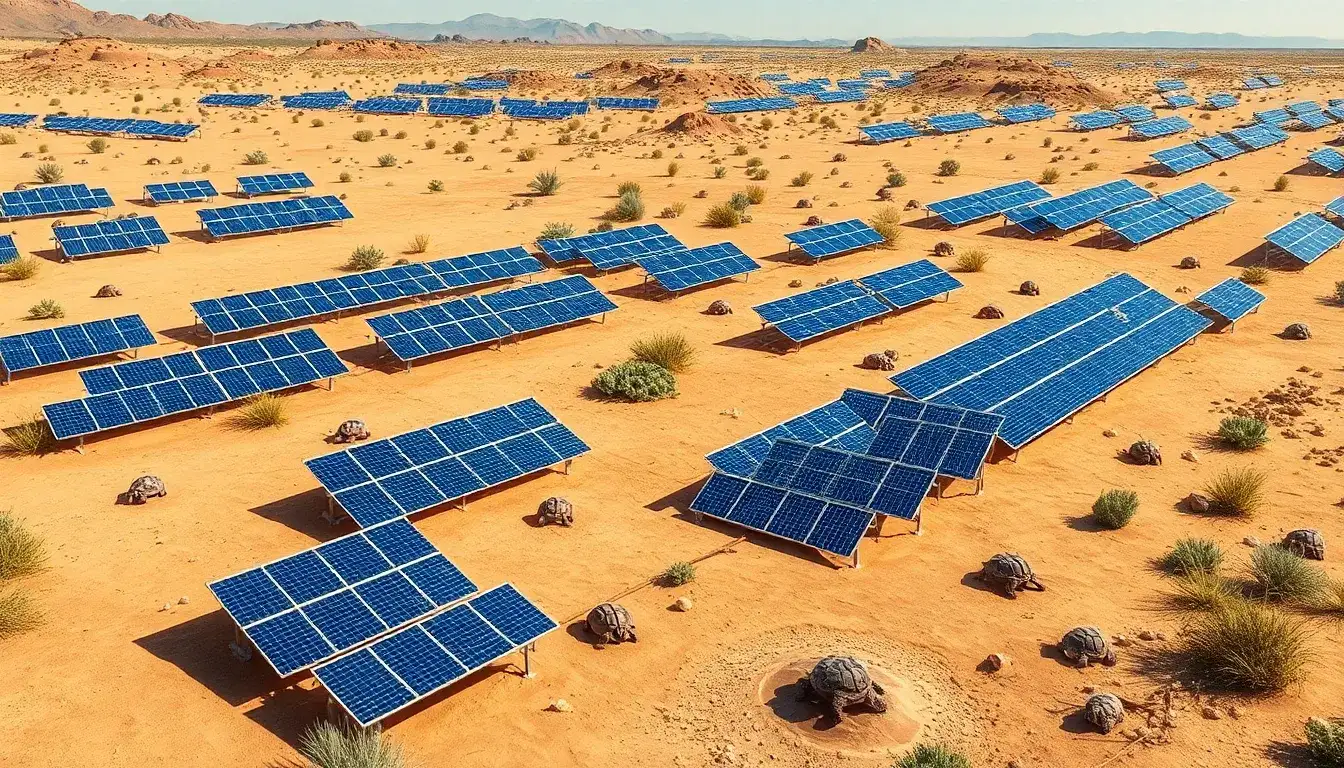
The spacing of solar panels plays a significant role in mitigating impacts on desert tortoise habitats, primarily by maintaining habitat connectivity and minimizing disruption to vegetation and wildlife movement.
Effects of Panel Spacing on Desert Tortoise Habitat:
- Increased Spacing to Maintain Vegetation and Habitat: In wildlife-friendly solar projects, such as one in the Mojave Desert, the spacing between solar panel arrays was increased from the industry standard of 14 feet to 20 feet. This wider spacing reduces the illusion of a water body that can attract predators and also allows more light to reach the ground, helping preserve native vegetation underneath and around the arrays. Maintaining existing plants and topography is crucial because it sustains the natural habitat desert tortoises rely on for shelter and food.
- Vertical Clearance of Panels: Raising the lower edge of solar panels to 42 inches above the ground (18 inches higher than standard) provides more space for vegetation growth and movement of small wildlife beneath the panels, supporting habitat integrity and tortoise mobility.
- Maintaining Connectivity: Habitat fragmentation and loss of connectivity are major threats to desert tortoise populations because they interrupt breeding and social interactions essential for genetic diversity and population health. Solar projects designed with increased spacing and wildlife passages, such as openings in perimeter fences, help maintain essential movement corridors for tortoises. This reduces isolation of populations caused by dense development or solar installations.
- Minimizing Direct Mortality and Disturbance: Proper spacing and design, along with measures such as restricting maintenance vehicle speed and educating staff, reduce inadvertent harm to tortoises.
In summary, increasing the spacing between solar panels and raising their height above ground level helps conserve desert tortoise habitats by preserving vegetation, allowing wildlife movement under and through solar arrays, and maintaining habitat connectivity essential for tortoise survival and reproduction. These design strategies are part of an emerging approach to balance renewable energy development with conservation of sensitive desert ecosystems.
Original article by NenPower, If reposted, please credit the source: https://nenpower.com/blog/how-does-the-spacing-of-solar-panels-affect-desert-tortoise-habitats/

