

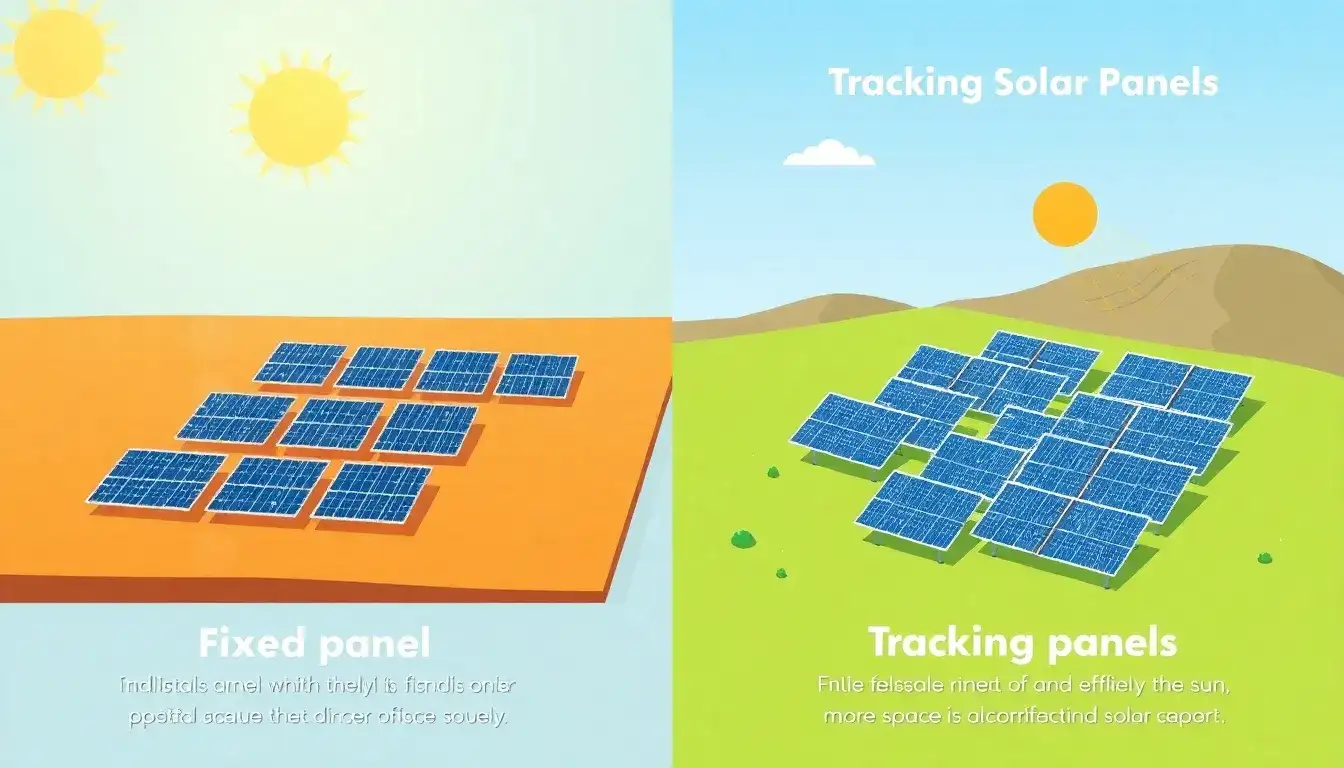
The space requirement between fixed and tracking solar panels differs primarily due to the movement and shading considerations of tracking systems.
Fixed Solar Panels:
- Fixed-tilt solar panels are mounted at a set angle and remain stationary. This allows designers to install panels more densely, as the rows can be placed closer together with less concern about shading caused by panel movement.
- Typically, fixed-tilt systems require less land area. On average, they need about 4 to 5 acres per megawatt (MW) of installed capacity.
- Since the panels do not move, fixed systems can maximize the use of the available area by reducing row spacing and increasing the number of panels installed within a given footprint.
Tracking Solar Panels:
- Tracking solar panels, such as single-axis trackers, rotate during the day to follow the sun’s movement, optimizing energy capture.
- To avoid shading, tracking systems must have more space between rows because panels tilt and rotate, which increases their footprint.
- This expanded spacing means that tracking systems generally require more land area—about 4 to 7 acres per MW.
- Although trackers need more space, they produce higher energy yields, often 15% to 25% more than fixed systems, potentially allowing fewer panels to meet the same energy demand, which can partially offset the increased land use.
- Trackers also require flat terrain and appropriate soil conditions to accommodate their foundations, which further impacts site selection and usable area.
Summary Comparison:
| Aspect | Fixed Solar Panels | Tracking Solar Panels |
|---|---|---|
| Space per MW | ~4-5 acres | ~4-7 acres |
| Panel spacing | Closer spacing possible | Larger spacing required to avoid shading during movement |
| Land efficiency | More peak power installed per area | Less peak power per area but higher energy yield |
| Terrain suitability | More flexible (slopes, terrain) | Best on flat, stable land |
| Installation & maintenance | Lower complexity and cost | Higher complexity, cost, and maintenance |
In conclusion, fixed solar panels need less space due to stationary positioning allowing tighter panel packing, while tracking solar panels require more space to prevent shading caused by their movement, despite their higher energy output. The choice depends on land availability, terrain, and balancing energy yield against installation and maintenance costs.
Original article by NenPower, If reposted, please credit the source: https://nenpower.com/blog/how-does-the-space-requirement-differ-between-fixed-and-tracking-solar-panels/

