

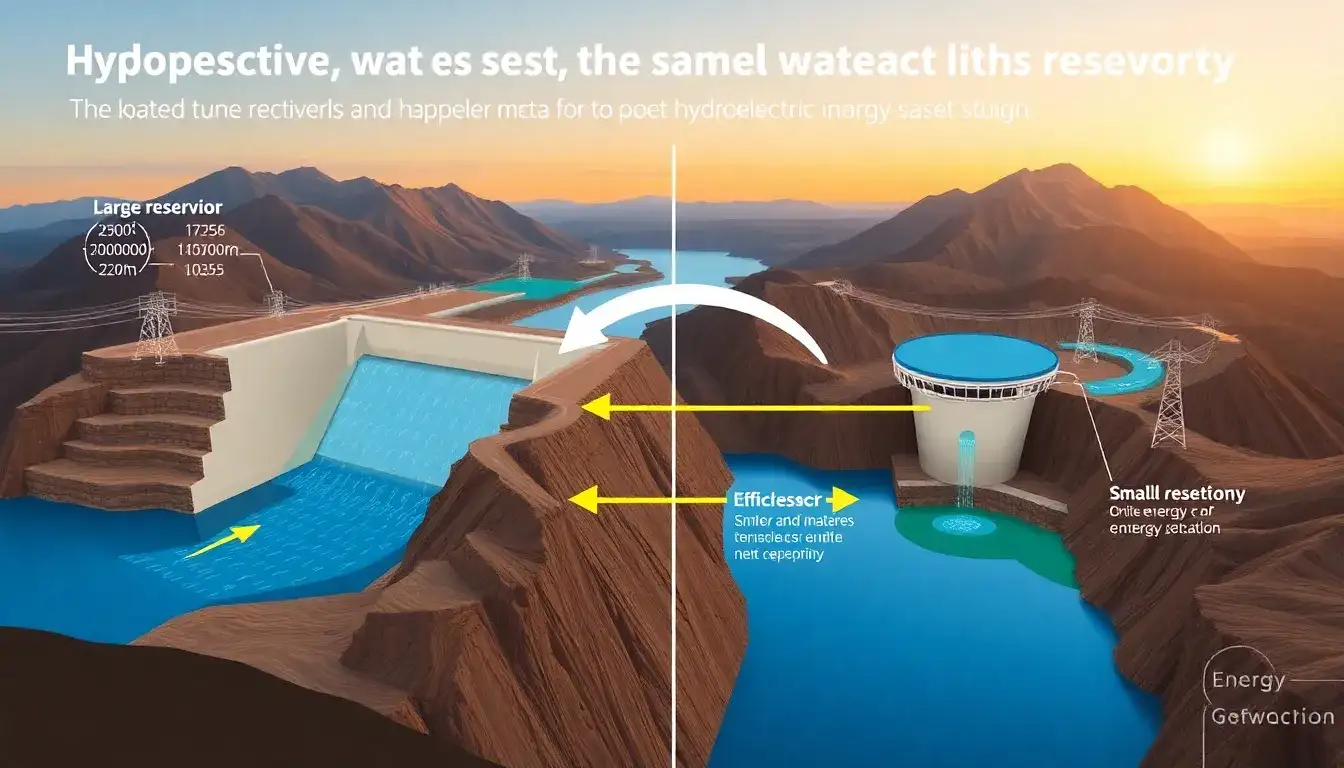
The size of the reservoirs in pumped hydroelectric energy storage (PHES) directly affects the overall energy storage capacity and thus the system’s efficiency in practical terms.
How Reservoir Size Influences Efficiency:
- Energy Storage Capacity: The total energy that can be stored depends on the volume of water in the upper reservoir (reservoir size) and the height difference (head) between the two reservoirs. Larger reservoirs can hold more water, which means more potential energy can be stored and subsequently converted to electricity.
- Duration of Energy Supply: Reservoir size determines how long the plant can generate electricity at maximum power. Typically, reservoir sizes are designed to provide 5-20 hours of electricity generation at peak capacity, enabling meaningful grid load balancing and energy shifting.
- Round-trip Efficiency: While the round-trip efficiency (the ratio of energy output to energy input) usually lies between 70-80%, this efficiency is generally more influenced by losses in pumping, generation, and evaporation rather than reservoir size alone. However, larger reservoirs can reduce relative losses due to less frequent cycling and can optimize operational effectiveness.
- Economic and Practical Implications: Larger reservoirs require more infrastructure and capital but offer longer service life and better smoothing of load variations on the grid, enhancing overall system effectiveness. Large water volumes combined with suitable head height maximize energy output efficiently.
Summary:
| Factor | Effect of Larger Reservoirs |
|---|---|
| Energy Storage | Increases total storable energy (more water mass) |
| Generation Duration | Allows longer continuous power generation |
| Efficiency (Round-trip) | Remains mostly stable but operational efficiency improves due to system scale and reduced relative losses |
| Economic Aspect | Higher upfront cost but cost-effective over long-term with better grid balancing capability |
In essence, the size of the reservoirs primarily determines how much energy can be stored and for how long it can be supplied, which translates into the practical efficiency of the pumped hydro system in meeting electricity demand and grid balancing. Larger reservoirs with appropriate head heights improve the system’s operational and economic efficiency despite round-trip energy conversion efficiencies being largely governed by mechanical and hydraulic losses.
Original article by NenPower, If reposted, please credit the source: https://nenpower.com/blog/how-does-the-size-of-the-reservoirs-affect-the-overall-efficiency-of-pumped-hydroelectric-energy-storage/

