

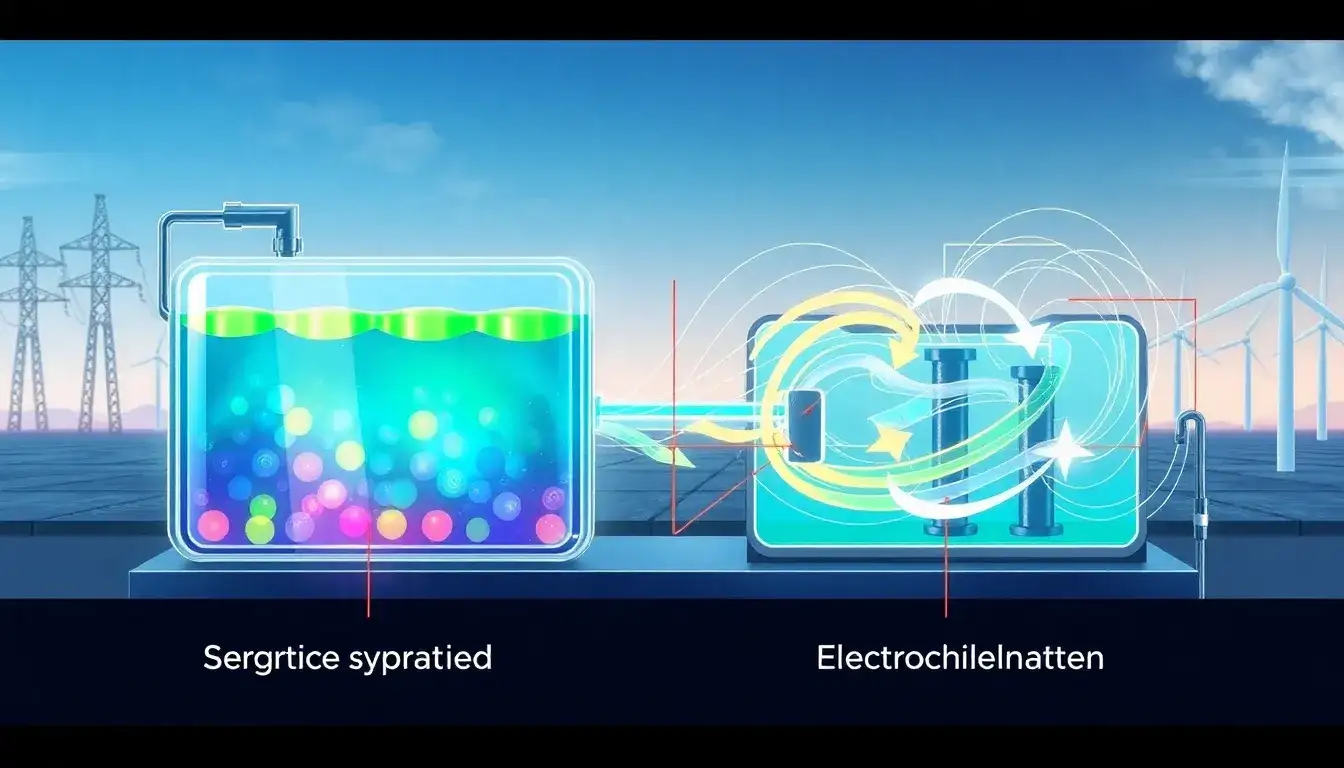
The separation of energy storage (in tanks) and electrochemical reactions (in the reactor) provides flow batteries with critical advantages:
Scalability and flexibility
The capacity (energy stored) depends on electrolyte volume in the tanks, while power output (charge/discharge rate) hinges on reactor size. This allows independent scaling: larger tanks increase energy storage without altering power, and vice versa. For example, doubling energy capacity might only require enlarging tanks rather than replacing the entire system, reducing cost per kWh.
Cost efficiency
Scaling energy storage by expanding tank volume avoids the linear cost increases seen in lithium-ion systems. Flow batteries achieve economies of scale for long-duration storage because electrolyte costs dominate over reactor costs. This makes them economically viable for grid-scale renewable integration, where discharge durations often exceed 4-6 hours.
Operational stability
The large electrolyte volume insulates the system from rapid temperature fluctuations, as thermal mass moderates daily ambient temperature swings. Heat generated in the reactor can also be repurposed for combined heat/power applications without destabilizing the energy storage medium.
Dynamic performance
Despite using pumps, flow batteries achieve immediate step-function responses during charge/discharge cycles when operational, as electrochemical reactions in the reactor are inherently fast once activated. This enables rapid adjustments to grid demands.
Original article by NenPower, If reposted, please credit the source: https://nenpower.com/blog/how-does-the-separation-of-energy-storage-and-electrochemical-reactions-benefit-flow-batteries/

