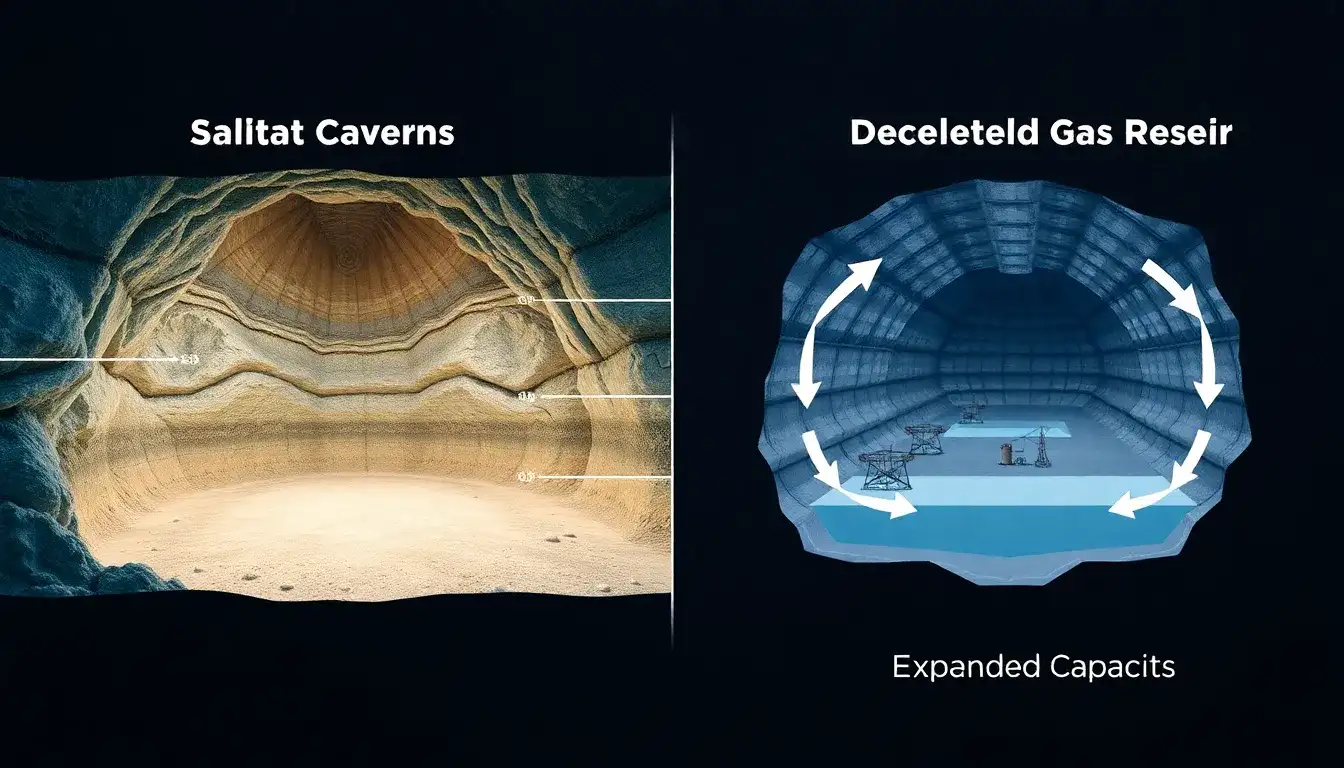
Scalability Comparison: Salt Caverns vs. Depleted Gas Reservoirs
Introduction
Both salt caverns and depleted gas reservoirs are used for large-scale storage of various substances, including hydrogen and natural gas. The scalability of these storage solutions is crucial for meeting increasing energy demands.
Scalability of Salt Caverns
- Adaptability and Flexibility: Salt caverns offer excellent scalability due to their adaptability in storing different amounts of substances according to need. They can be engineered to various capacities and are highly flexible in accommodating fluctuating storage demands.
- Geological Properties: Salt forms a leak-proof barrier, making salt caverns suitable for storing gases like hydrogen without significant risk of leakage. This property also enhances scalability by ensuring safety and containment.
- Development Potential: Salt caverns can be developable over large areas, especially in regions with extensive salt formations, allowing for significant storage capacity expansion.
Scalability of Depleted Gas Reservoirs
- Existing Infrastructure: Depleted gas reservoirs benefit from pre-existing infrastructure, such as wells and pipelines. This reduces the cost and time needed to establish new storage facilities, potentially increasing scalability by leveraging these assets.
- Capacity Limitations: However, the scalability of depleted gas reservoirs is often limited by the original reservoir’s size and geological properties. The capacity may be fixed by the reservoir’s existing characteristics rather than being easily expandable like salt caverns.
- Geological Variability: The effectiveness and scalability of depleted gas reservoirs can vary significantly based on the reservoir’s geology. Factors such as permeability, porosity, and residual pressure influence the storage capacity and operational feasibility.
Comparison
| Feature | Salt Caverns | Depleted Gas Reservoirs |
|---|---|---|
| Scalability | Highly scalable due to flexibility and adaptability | Scalability is limited by existing infrastructure and geology |
| Infrastructure Costs | Higher upfront costs for development | Lower costs due to existing infrastructure |
| Geological Flexibility | Can be developed in various salt formations | Dependent on original reservoir characteristics |
| Leakage Risk | Low risk due to impermeable salt | Higher risk if not properly sealed |
| Capacity Expansion | Can be expanded as needed with new caverns | Expansion is generally limited by existing reservoir size and geology |
In summary, while both options offer significant storage potential, salt caverns generally provide better scalability due to their adaptability and flexibility in various geological conditions. However, depleted gas reservoirs can be more cost-effective by utilizing existing infrastructure, albeit with limitations based on their original capacity and geology.
Original article by NenPower, If reposted, please credit the source: https://nenpower.com/blog/how-does-the-scalability-of-salt-caverns-compare-to-that-of-depleted-gas-reservoirs/