

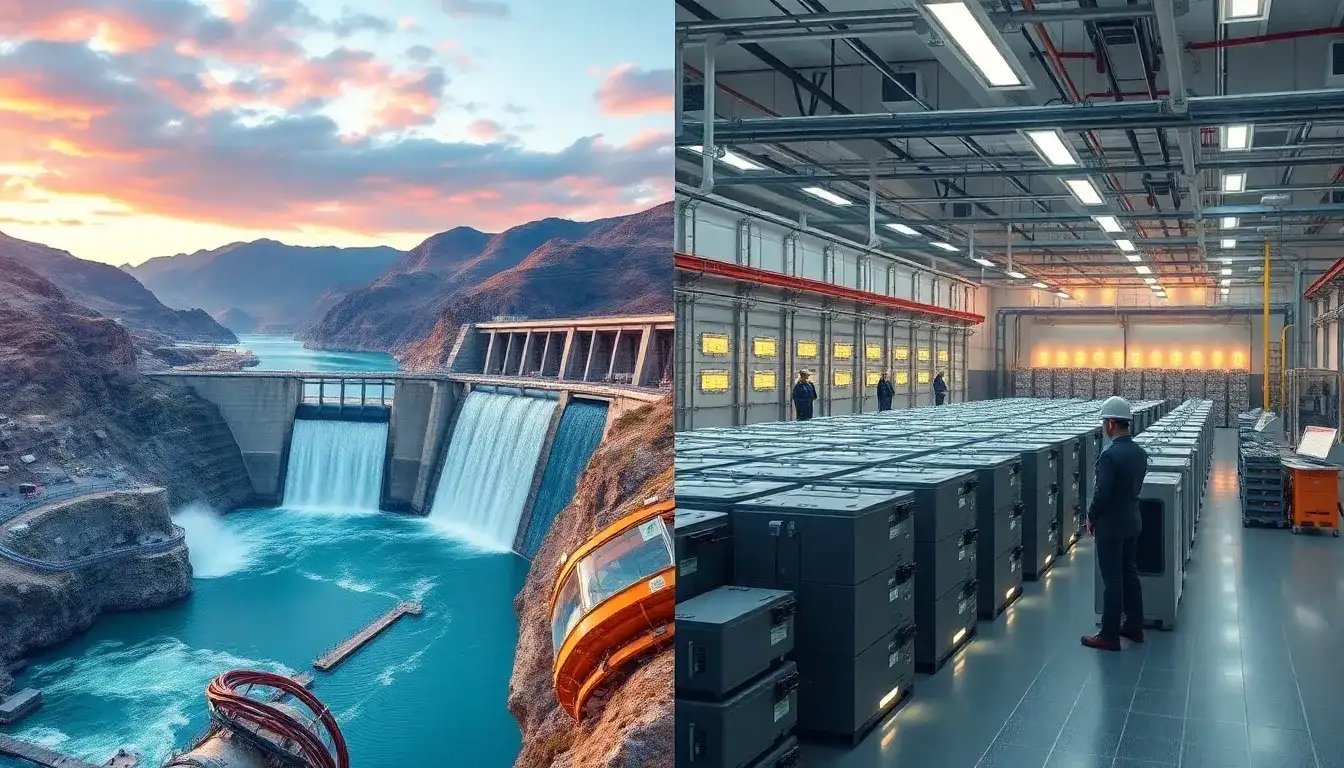
The scalability of pumped hydroelectric energy storage (PHES) far exceeds that of lithium-ion batteries, especially when considering large-scale, long-duration grid energy storage needs.
Pumped Hydroelectric Storage Scalability:
- Pumped storage is currently the largest-capacity form of grid energy storage worldwide, representing over 94-96% of all utility-scale energy storage capacity in the U.S. and globally.
- It has a massive total installed throughput capacity exceeding 181 GW and storage capacity over 1.6 TWh as of 2020, far surpassing battery storage capacities.
- The scalability of pumped hydro is largely site-dependent but can be substantial, especially when integrated with existing hydropower systems by adding upper reservoirs, allowing expansion without entirely new infrastructure.
- Typically designed for 6 to 20 hours of storage, pumped hydro plants can match large-scale demand peaks, providing energy-balancing and grid stability services.
- The round-trip efficiency of pumped hydro storage systems ranges between 70% and 80%, which is competitive with lithium-ion batteries.
Lithium-Ion Battery Scalability:
- Lithium-ion batteries generally have round-trip efficiencies above 80%, slightly higher than pumped hydro in some cases, but their scalability for long-duration, utility-scale energy storage is more limited by cost, land use, and material constraints.
- While lithium-ion solutions excel in short-duration, modular deployments and fast response, their current technology and economics pose challenges when scaling up to multiple gigawatt-hours at the scale of pumped hydro.
Comparison Summary:
| Aspect | Pumped Hydroelectric Storage | Lithium-Ion Batteries |
|---|---|---|
| Installed Storage Capacity | Over 1.6 TWh globally, dominant in utility-scale | Generally smaller, modular, limited for multi-hour large-scale storage |
| Scalability | Very high, site-dependent, can integrate with existing dams or closed-loop reservoirs | Moderate, constrained by cost, resources, and land |
| Round-Trip Efficiency | 70-80%, well-proven over nearly a century | Typically 80+%, somewhat higher |
| Duration | 6-20 hours typical, suitable for long-duration storage | Usually better for short-duration applications |
| Grid Services | Provides energy balancing, frequency control, reserves | Provides fast response, but less suited for long-term bulk storage |
In summary, pumped hydroelectric energy storage is far more scalable for large, long-duration, utility-scale energy storage compared to lithium-ion batteries, which are better suited for smaller scale or short-term storage despite slightly higher efficiency. Pumped hydro’s dominance in installed capacity and proven track record underscore its key role in grid-scale energy storage.
Original article by NenPower, If reposted, please credit the source: https://nenpower.com/blog/how-does-the-scalability-of-pumped-hydroelectric-energy-storage-compare-to-lithium-ion-batteries/

