

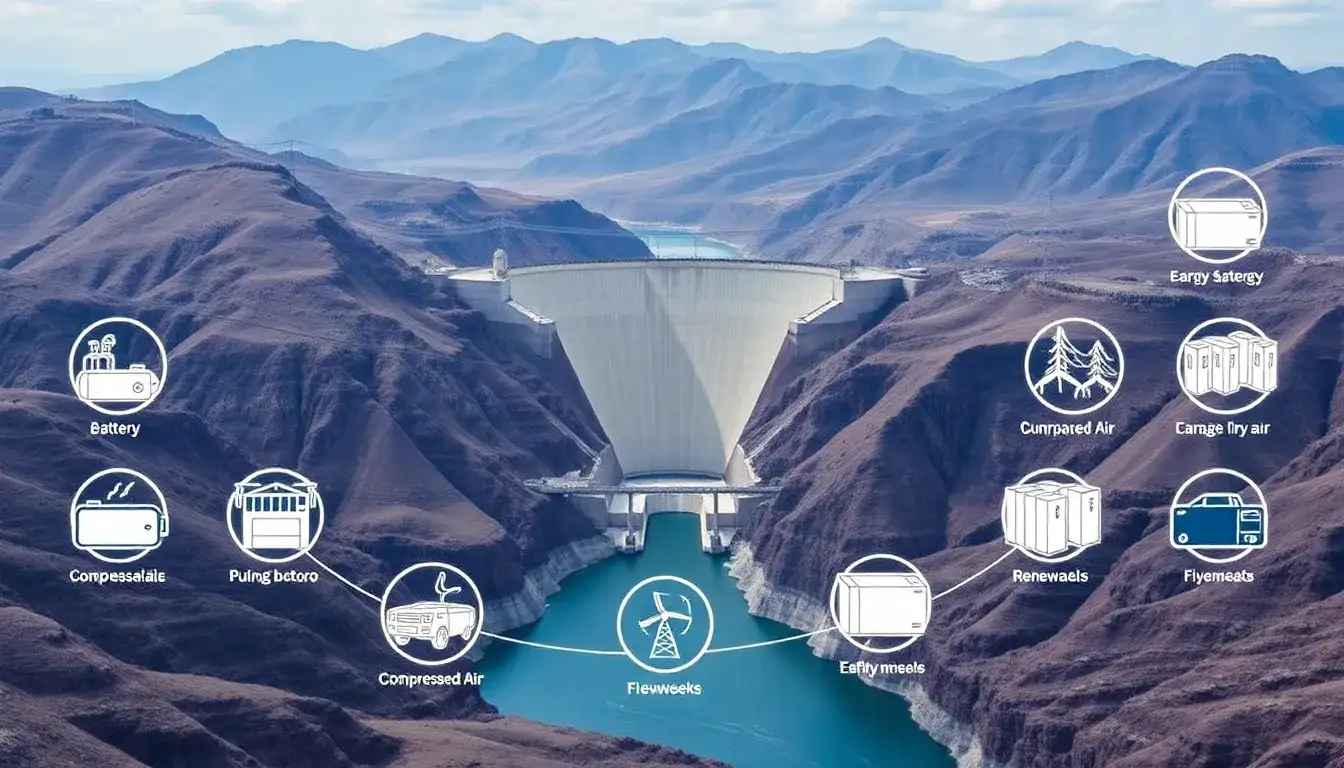
Pumped hydro storage (PHS) is the largest form of energy storage globally, offering several advantages over other systems. Here’s a comparison of its scalability with other energy storage technologies:
Scalability Overview
- Pumped Hydro Storage (PHS): PHS is considered the most scalable energy storage technology, capable of storing vast amounts of energy. It typically operates at scales ranging from hundreds to thousands of megawatts (MW). PHS can support daily or even weekly energy storage applications, making it ideal for grid-scale use. However, its scalability is limited by the availability of suitable geography (e.g., height differences and water availability) and can have high upfront costs.
- Battery Energy Storage Systems (BESS): BESS, particularly lithium-ion batteries, offer modular scalability. They can range from small-scale residential systems to large utility-scale installations. While they are less expensive and faster to deploy than PHS, their energy storage capacity is generally smaller than that of PHS. Modular designs allow for easier expansion and upgrading, making BESS highly flexible for various applications.
- Other Storage Technologies: Technologies like compressed air energy storage and hydrogen storage are still in development stages or less commonly used. These alternatives also face site-specific limitations similar to PHS but have the potential for future scalability improvements.
Comparison Summary
| Technology | Scalability | Cost | Deployment Speed |
|---|---|---|---|
| Pumped Hydro Storage (PHS) | Large-scale, location-dependent | High upfront, low operating | Slow, site-specific |
| Battery Energy Storage Systems (BESS) | Modular, highly scalable | Lower upfront, increasing demand | Fast, flexible deployment |
| Other Technologies (e.g., CAES, Hydrogen) | Less scalable, developing | Varied, generally high upfront | Varies, often slower deployment |
Conclusion
Pumped hydro storage offers the largest capacity in terms of utility-scale energy storage but faces limitations in geographical suitability and high initial costs, making it challenging to expand rapidly. In contrast, battery systems provide more flexibility and faster deployment but with lower storage capacity per installation. The choice between these technologies often depends on specific geographic conditions and grid requirements.
Original article by NenPower, If reposted, please credit the source: https://nenpower.com/blog/how-does-the-scalability-of-pumped-hydro-storage-compare-to-other-energy-storage-systems/

