

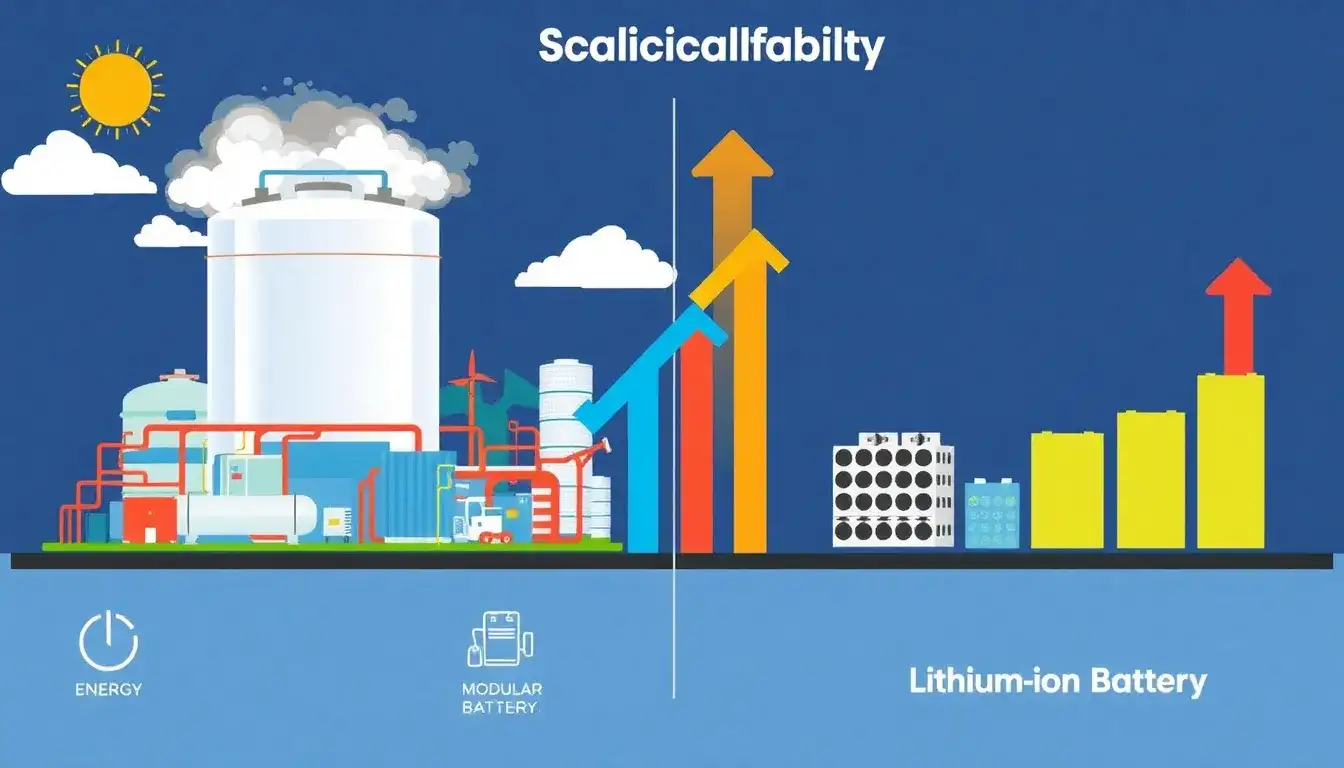
The scalability of liquid air energy storage (LAES) compares favorably to lithium-ion batteries, especially for large-scale and long-duration applications.
Scalability of Liquid Air Energy Storage:
- LAES systems are highly scalable and can be designed to meet a wide range of energy storage capacities, from smaller-scale uses to large utility-scale installations. This makes LAES adaptable to diverse energy demands and grid requirements without significant geographic limitations.
- LAES is particularly well-suited for long-duration energy storage (hours to days), making it valuable for balancing intermittent renewable energy sources such as wind and solar. This contrasts with lithium-ion batteries, which typically serve shorter-duration storage needs.
- The ability to store energy in liquid air tanks under low pressure and recover it flexibly allows LAES to be deployed in various locations, including urban, remote, and industrial areas, adding to its scalability and versatility.
Comparison to Lithium-Ion Batteries:
- Lithium-ion batteries have been the dominant technology for energy storage but are generally less scalable to extremely large or long-duration storage projects due to cost, material constraints (reliance on rare-earth and hazardous materials), and lifespan issues.
- A recent MIT-led study found the levelized cost of storage (LCOS) for LAES to be about $60 per megawatt-hour, roughly one-third the LCOS of lithium-ion batteries. This cost advantage improves the economic scalability of LAES for grid-scale applications.
- Unlike lithium-ion batteries, LAES uses abundant atmospheric air and commercially available components, avoiding dependence on expensive or rare materials, which supports more sustainable and potentially larger-scale deployment.
Summary Table:
| Feature | Liquid Air Energy Storage (LAES) | Lithium-Ion Batteries |
|---|---|---|
| Scalability | Highly scalable from small to large utility-scale | Scalable but costly and material-dependent at very large scales |
| Duration | Long-duration storage (hours to days) | Typically short to medium duration (minutes to a few hours) |
| Cost (LCOS) | ~$60/MWh, about 1/3 of lithium-ion | Higher ($180/MWh approximate) |
| Materials | Uses abundant air, no rare or hazardous materials | Requires rare metals, chemical components |
| Geographic Flexibility | Can be deployed in diverse locations without restrictions | Deployment spatially flexible but limited by transport/costs |
| Environmental Impact | Low emissions, environmentally friendly | Concerns about resource mining and disposal |
In conclusion, LAES offers superior scalability particularly for large-scale and long-duration energy storage, with a potentially lower cost and more sustainable material use compared to lithium-ion batteries. This makes LAES a promising complementary technology for future grid storage needs where scalable, cost-effective, and long-term storage is critical.
Original article by NenPower, If reposted, please credit the source: https://nenpower.com/blog/how-does-the-scalability-of-liquid-air-energy-storage-compare-to-lithium-ion-batteries/

