

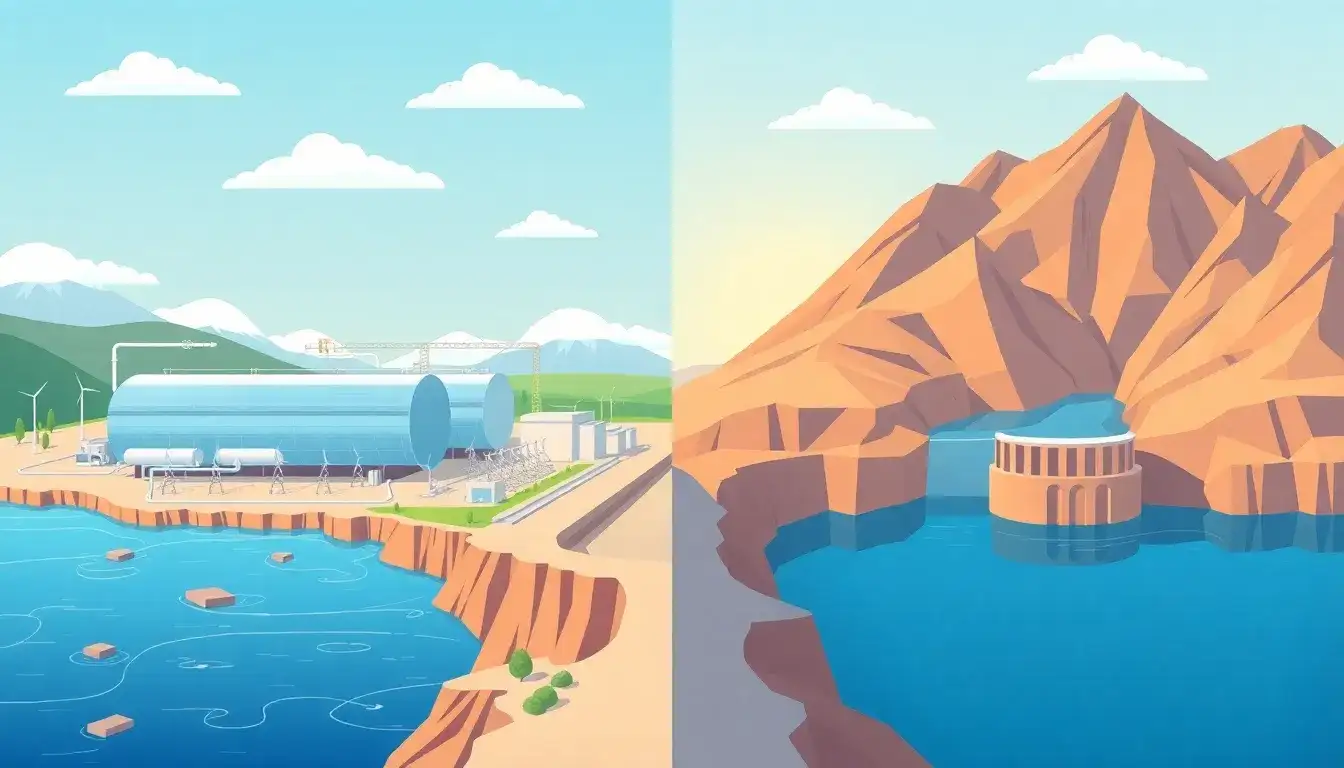
Scalability Comparison
- Geographical Constraints
PHS requires specific topography (elevated reservoirs, water availability) and faces environmental permitting challenges. LAES, in contrast, uses modular components (liquefaction/regasification systems) and can be deployed on flat terrain, enabling broader geographic scalability. - Capacity Scaling
- LAES: Designed as modular systems, with Highview Power’s “GigaPlant” achieving 200 MW/1.2 GWh configurations. Its footprint is smaller than PHS for equivalent storage capacity.
- PHS: Typically built as large, single-site installations (often >1 GW), limiting incremental scaling. New projects face multi-year construction timelines and ecological concerns.
- Energy Density
LAES boasts energy density comparable to batteries, allowing compact grid-scale storage. PHS has lower energy density, necessitating large reservoirs.
Economic and Policy Drivers
While PHS has lower levelized costs historically, LAES benefits from subsidies improving NPV (e.g., 40–60% capital subsidies make LAES viable under aggressive decarbonization). Unlike PHS, LAES avoids geological dependencies, enabling faster deployment where renewable penetration demands flexible storage. However, PHS remains a mature technology with widespread existing infrastructure.
| Aspect | LAES | PHS |
|---|---|---|
| Footprint | Compact (modular design) | Large (reservoirs, dams) |
| Deployment | Geographically flexible | Site-specific |
| Scalability | Modular (MW to GW) | Bulk installations (GW-scale) |
Original article by NenPower, If reposted, please credit the source: https://nenpower.com/blog/how-does-the-scalability-of-laes-compare-to-that-of-pumped-hydro-storage/

