

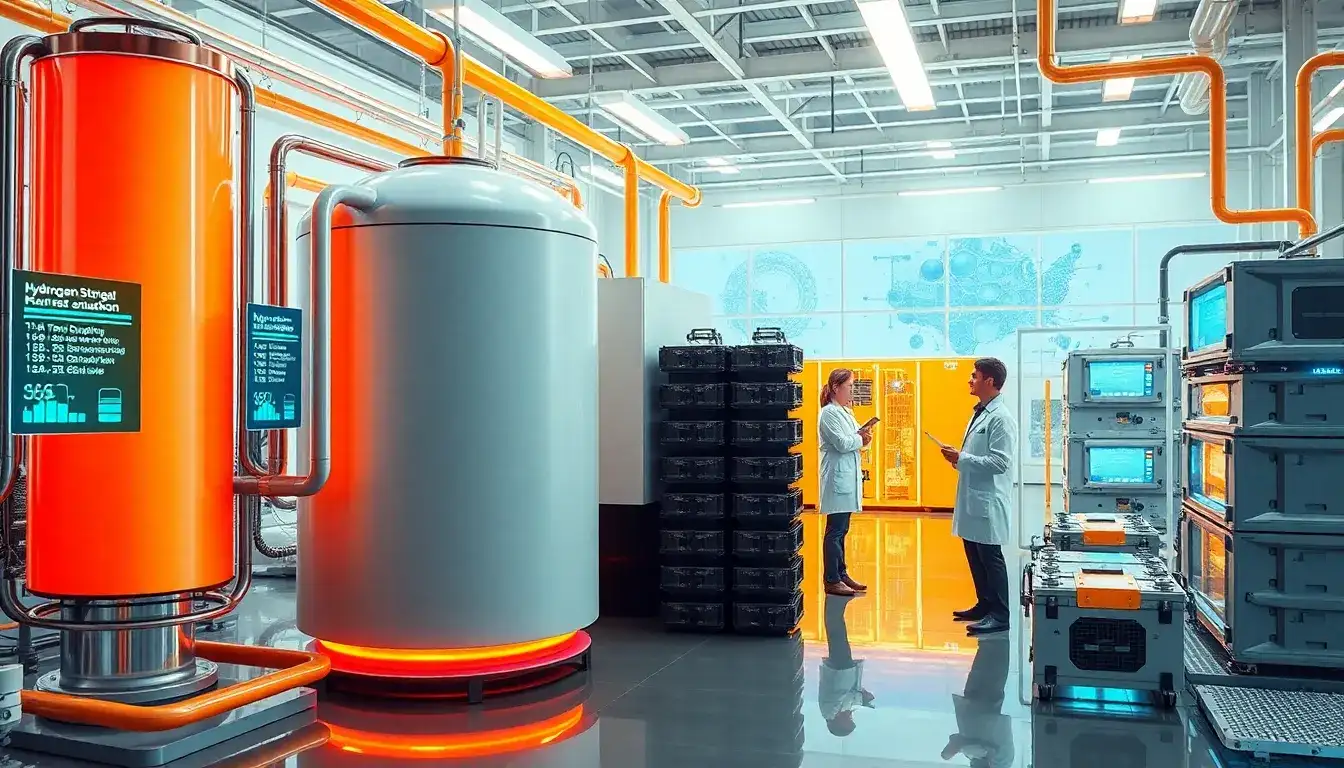
Hydrogen storage systems and battery storage differ significantly in scalability characteristics, particularly regarding capacity scaling, application flexibility, and infrastructure demands:
Capacity Scaling
- Hydrogen:
- 3-5x higher energy density than compressed hydrogen tanks in advanced systems, enabling large-scale storage for long-duration needs (weeks/months).
- Modular designs (e.g., conformable tanks, tank arrays) allow cost-effective scaling from small residential to grid-level applications.
- No cycle-life degradation over 500,000 cycles, maintaining performance for 20+ years, ideal for industrial/utility use.
- Batteries:
- Linear cost scaling with capacity, as adding storage requires proportional increases in battery cells.
- Cycle life limitations (typically 1,000–10,000 cycles) reduce cost-effectiveness for large-scale, long-term storage.
Application Flexibility
- Hydrogen:
- Transportable energy: Systems like “microgrid-in-a-box” or mobile tanks enable energy delivery to remote/underserved areas without permanent infrastructure.
- Multi-use integration: Combines with supercapacitors and energy management for hybrid solutions (e.g., hospitals, EV charging stations).
- Batteries:
- Portability: Superior for small-scale applications (e.g., consumer electronics, short-duration grid support).
- Limited energy density restricts use in heavy industries or long-haul transport without frequent recharging.
Infrastructure Requirements
- Hydrogen:
- Scalable production: Dependent on electrolyzer/fueling infrastructure, but initiatives like H2@Scale aim to standardize cross-sector hydrogen networks.
- Safety advancements: Segmented tanks and lightweight materials minimize leakage/rupture risks during scaling.
- Batteries:
- Grid integration: Easier to deploy at smaller scales but requires extensive power electronics for utility-scale systems.
- Raw material supply: Lithium/cobalt dependencies may constrain large-scale expansion compared to hydrogen’s feedstock versatility.
Cost Considerations
- Hydrogen:
- High upfront CAPEX for electrolysis and storage, but economies of scale and government incentives (e.g., U.S. tax credits) are reducing costs.
- Batteries:
- Lower initial costs for short-duration storage but higher lifetime costs for multi-day/seasonal storage due to cycle-life limitations.
In summary, hydrogen storage outperforms batteries in long-duration, high-capacity scaling but requires dedicated infrastructure, while batteries remain more practical for short-term, distributed applications.
Original article by NenPower, If reposted, please credit the source: https://nenpower.com/blog/how-does-the-scalability-of-hydrogen-storage-systems-compare-to-battery-storage/

