

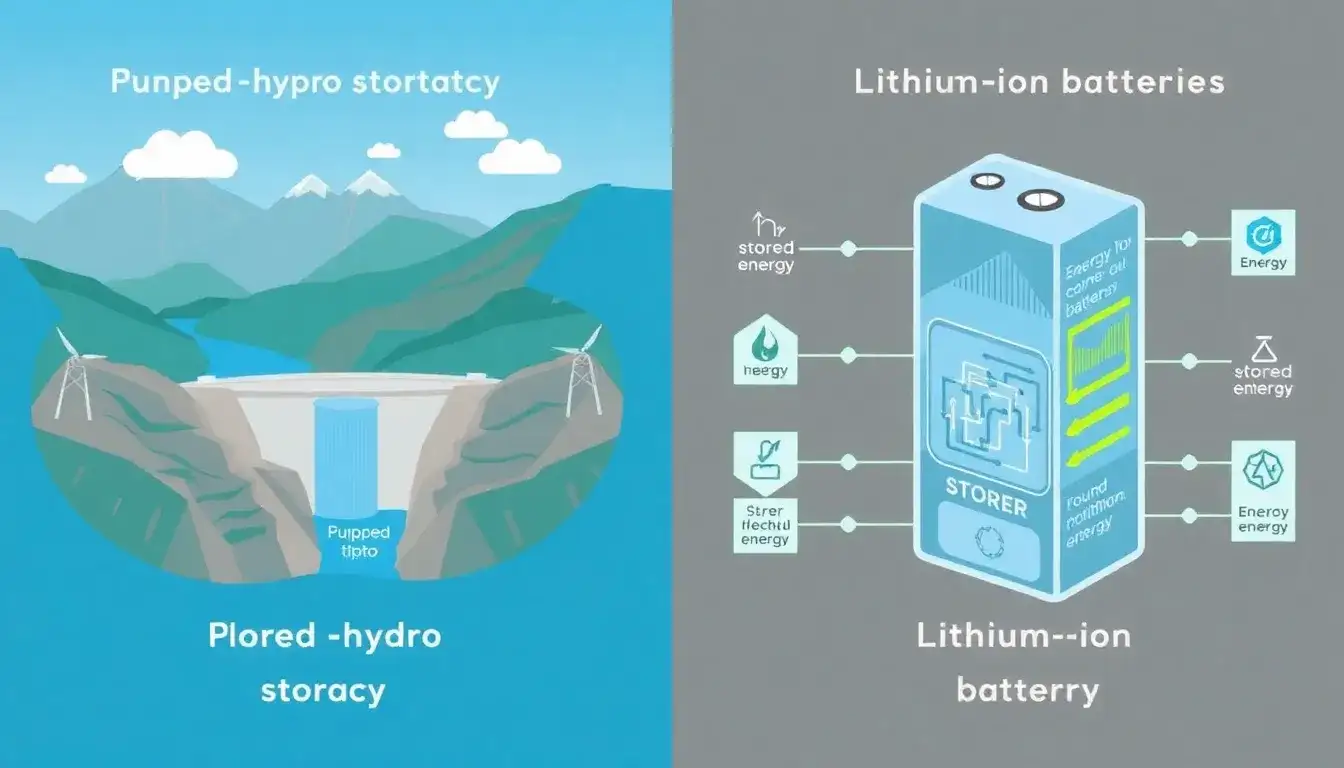
The round-trip efficiency of pumped-storage hydroelectricity (PSH) and lithium-ion batteries can be compared as follows:
- Pumped-Storage Hydroelectricity (PSH): The round-trip efficiency for PSH typically ranges between 70% and 80%. This means that of the electricity used to pump water to the upper reservoir, between 70% and 80% can be recovered when the water is released back through the turbines to generate electricity.
- Lithium-Ion Batteries: Utility-scale lithium-ion batteries have shown average round-trip efficiencies ranging around 82%, with some instances reporting even higher efficiencies. This indicates that for every unit of electricity stored, about 82% can be retrieved when needed.
In general, lithium-ion batteries tend to have a slightly higher round-trip efficiency compared to pumped hydro storage. However, PSH remains a crucial large-scale energy storage solution due to its capacity, long service life, and ability to provide grid stability over extended periods.
Original article by NenPower, If reposted, please credit the source: https://nenpower.com/blog/how-does-the-round-trip-efficiency-of-pumped-hydro-storage-compare-to-lithium-ion-batteries/

