

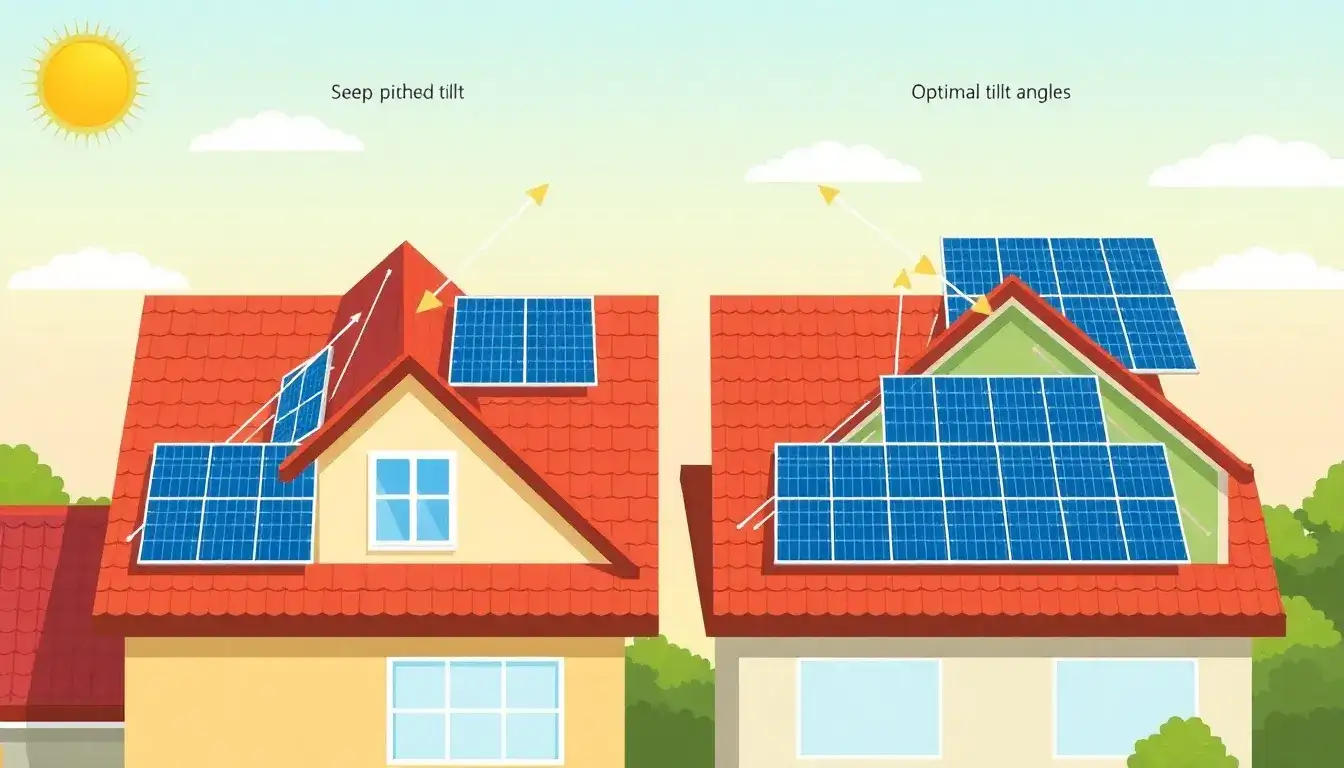
The roof pitch significantly influences the optimal tilt angle for solar panels because it sets the baseline angle at which panels can be installed, impacting how directly they face the sun.
How Roof Pitch Affects Solar Panel Tilt
- Initial tilt foundation: The roof pitch, or slope, determines the initial angle of the solar panels as they are typically mounted flush on the roof surface. This initial tilt influences how close the panels’ angle is to the sun’s path across the sky, thereby affecting solar exposure.
- Adjustment considerations: While the ideal tilt angle for maximizing solar energy is often close to the latitude of the installation site, the roof pitch usually requires adjustment to better align panels with the sun’s position. Some methods of calculating optimal tilt involve subtracting or considering the roof pitch from or relative to the latitude.
- Seasonal and geographical impact: Since the sun’s altitude varies by season and latitude, the roof pitch can either help approach or deviate from the optimal tilt needed year-round. For example, in steep roof areas, the tilt angle may naturally be higher than latitude, which can be beneficial or detrimental depending on the season and climate.
- Protection and maintenance: Roof pitch also influences practicality factors like snow and rain runoff. Steeper pitches allow snow and water to slide off easier, which can reduce shading or dirt buildup on panels and improve overall performance during winter or rainy seasons.
Relationship Between Latitude, Roof Pitch, and Optimal Tilt
- Latitude as a baseline: A common rule of thumb is that the optimal tilt equals the latitude at the installation site. For instance, if a location is at 40° latitude, the optimal panel tilt is roughly 40° for maximum annual solar gain.
- Roof pitch adjustment: To optimize panel performance on pitched roofs, installers adjust the tilt relative to the roof slope. For example, a home with a 4/12 pitch (about 18°) in Miami might have an optimal panel tilt near 12°, derived by subtracting or factoring roof pitch from latitude considerations.
- Fixed vs adjustable tilt: Roof-installed systems are often fixed, meaning the roof pitch limits tilt adjustment. Some installations use adjustable mounts to change tilt seasonally (increasing tilt by about 15° in winter and decreasing it similarly in summer) to better capture sunlight.
Practical Effects of Roof Pitch on Solar Panel Efficiency
- Panels installed flush on a roof with a pitch close to latitude will perform nearly optimally without additional mounting adjustments.
- If roof pitch significantly deviates from latitude, panel angle adjustment or mounting systems can be used to improve orientation.
- Steeper roof pitches may increase installation complexity and costs, but can aid in snow shedding and reducing dirt accumulation on panels.
- On flat roofs or low-pitch roofs, adjustable racks or tilted mounts are used to set panels at optimal angles close to latitude for better solar gain.
Summary: Roof pitch sets the baseline tilt angle for solar panels, influencing how well they align with the sun’s path tracked for maximum energy production. Optimal tilt angles usually approximate the site’s latitude but need to be adjusted considering roof pitch and seasonal sun height changes. Steeper roofs facilitate runoff and reduce soiling but may require more complex or costly installation. Adjustable mounting can optimize tilt beyond the roof pitch, improving yearly solar output.
All details above are based on solar panel installation guides and expert recommendations from Renogy, Sunrun, Modernize, EnergySage, and RatedPower.
Original article by NenPower, If reposted, please credit the source: https://nenpower.com/blog/how-does-the-roof-pitch-influence-the-optimal-tilt-angle-for-solar-panels/

