

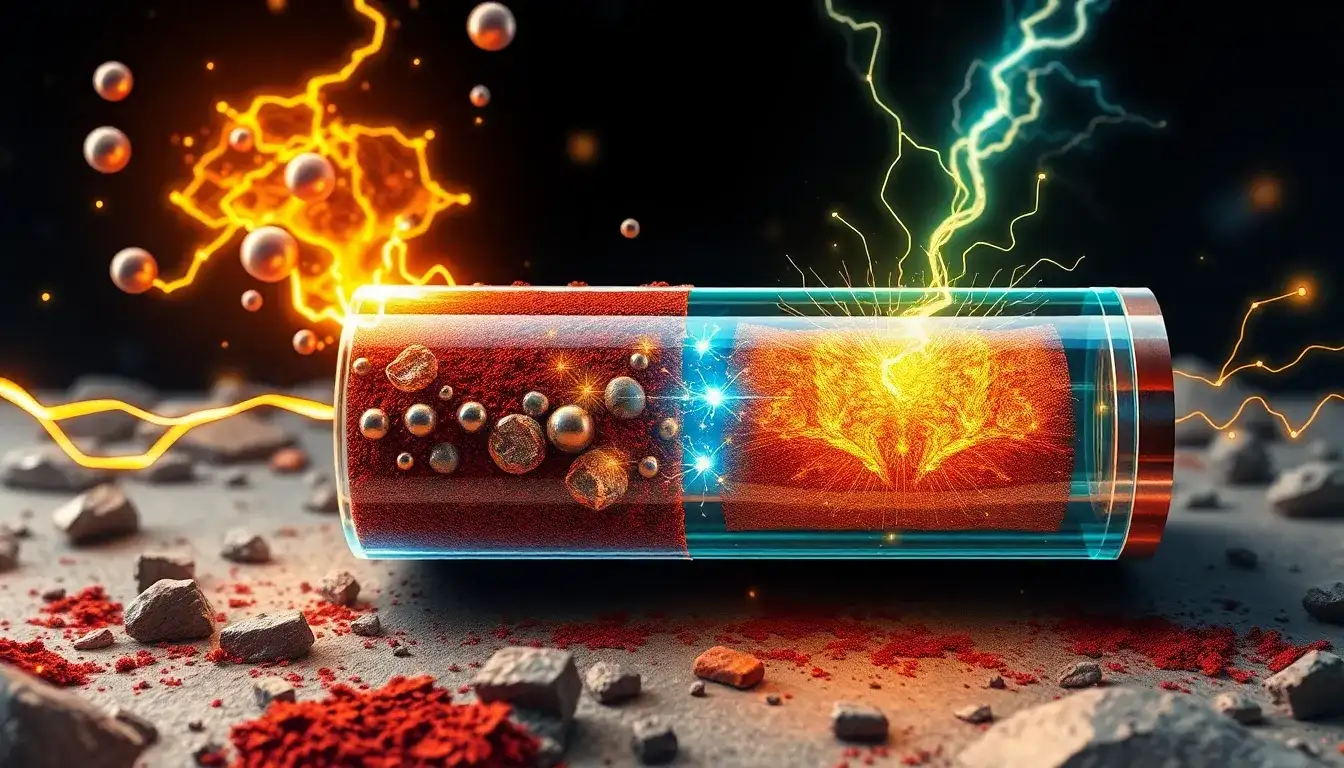
How “Reverse Rusting” Works in Iron-Air Batteries
Iron-air batteries utilize a unique process called “reverse rusting,” which is a form of reversible oxidation-reduction reaction. This process allows the battery to store energy for extended periods, making it ideal for long-duration energy storage needs.
Discharge Cycle
During discharging, the battery “breathes in” oxygen from the air, which reacts with iron metal in the anode (negative electrode) to form iron oxide (Fe2O3), commonly known as rust. This reaction releases electrons, generating electricity. The process can be summarized as follows:
- Reaction: Oxygen (O2) from the air reacts with iron (Fe) to form iron oxide (Fe2O3, or rust) and release electrons.
- Electrical Output: The released electrons flow through an external circuit to provide power.
Charge Cycle
To charge the battery, an external electrical current is applied, reversing the rusting process. The rust (iron oxide) is converted back into metallic iron (Fe) and oxygen is released into the air. The key steps include:
- Reversal: The applied electrical current converts the rust (Fe2O3) back into iron metal.
- Oxygen Release: Oxygen is liberated and expelled into the air, completing the cycle.
Key Components and Advantages
- Materials: Iron-air batteries use abundant, low-cost materials—iron, air, and water—making them environmentally friendly and cost-effective compared to lithium-ion batteries.
- Scalability and Safety: These batteries are modular and can be scaled for large energy storage needs. They also eliminate the risk of overheating or explosion due to their non-flammable water-based electrolyte.
- Long-Term Storage: Iron-air batteries can store energy for up to 100 hours, significantly longer than lithium-ion batteries, which typically last 4 to 8 hours per cycle.
Conclusion
The reverse rusting process in iron-air batteries offers a promising solution for long-duration energy storage, leveraging abundant materials and providing a cost-effective alternative to traditional battery technologies.
Original article by NenPower, If reposted, please credit the source: https://nenpower.com/blog/how-does-the-reverse-rusting-process-work-in-iron-air-batteries/

