

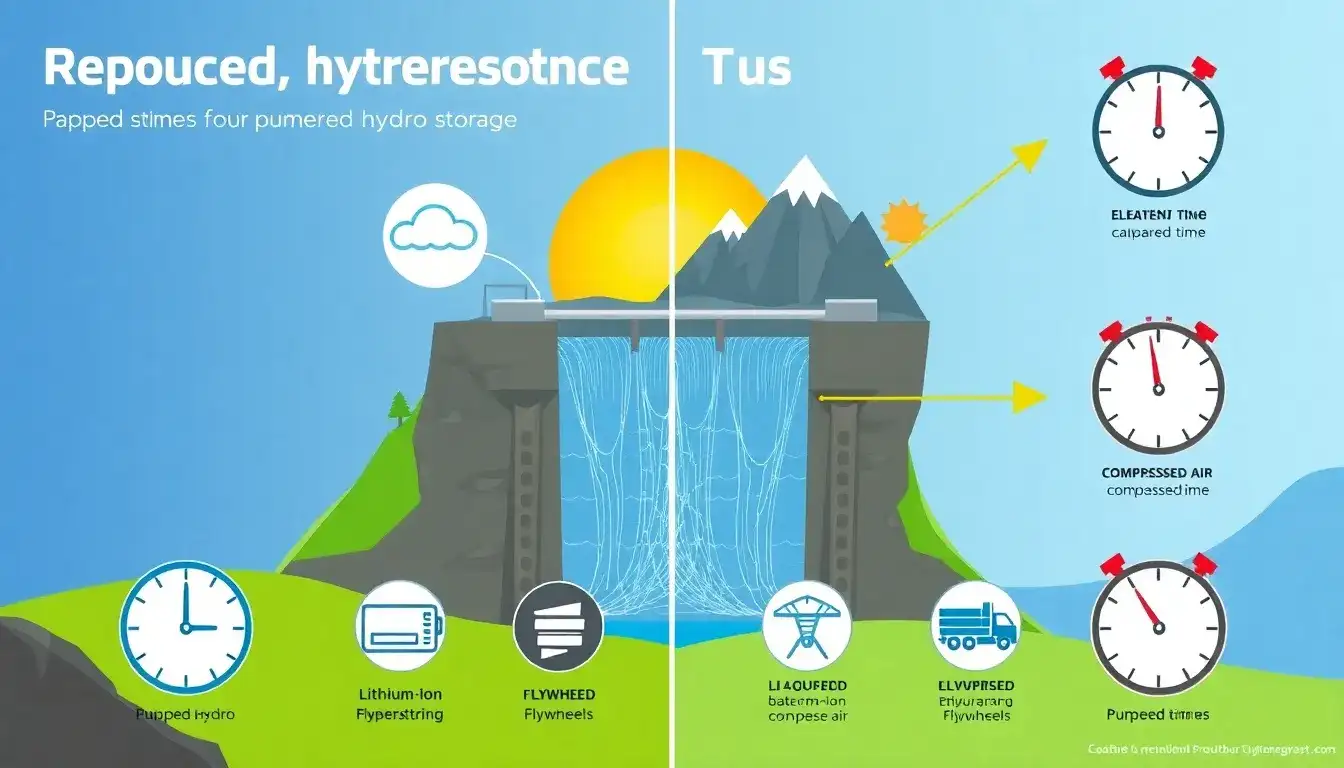
The response time of pumped hydro storage (PHS) is highly competitive compared to other energy storage methods, making it an essential tool for grid stability. Here’s a comparison of response times for different storage technologies:
Response Times for Different Energy Storage Technologies
| Technology | Response Time |
|---|---|
| Pumped Hydro Storage (PHS) | Less than 1 second in turbine operation, while reaching full load from standstill takes around 65 seconds to 2 minutes. |
| Lithium-Ion Batteries (LFP) | Typically in milliseconds to seconds due to their electronic nature. |
| Lead Acid Batteries | Similar to lithium-ion, in milliseconds to seconds. |
| Vanadium Redox Flow Batteries | Also fast, responding in milliseconds to seconds. |
| Compressed Air Energy Storage (CAES) | Response times can be slower compared to PHS or chemical batteries, typically several minutes. |
| Hydrogen Fuel Cells with Bidirectional Conversion | Response times can vary but are generally slower than instantaneous battery or PHS response. |
Key Considerations
- Pumped Hydro Storage offers rapid response capabilities, especially beneficial for grid stability and peak demand management. Its large-scale energy storage capacity and long lifespan make it crucial for integrating renewable energy sources.
- Chemical Batteries like lithium-ion and lead acid provide quicker response times but are typically smaller in scale and have shorter lifetimes compared to PHS.
- Compressed Air Energy Storage (CAES) and Hydrogen Storage offer different advantages like durability and potential for long-term storage but often require longer times to start generating power.
Overall, while PHS may not offer the quickest response time in absolute terms compared to some battery technologies, its unique ability to provide large-scale, long-duration energy storage and stability services makes it indispensable for supporting grid operations.
Original article by NenPower, If reposted, please credit the source: https://nenpower.com/blog/how-does-the-response-time-of-pumped-hydro-storage-compare-to-other-energy-storage-methods/

