

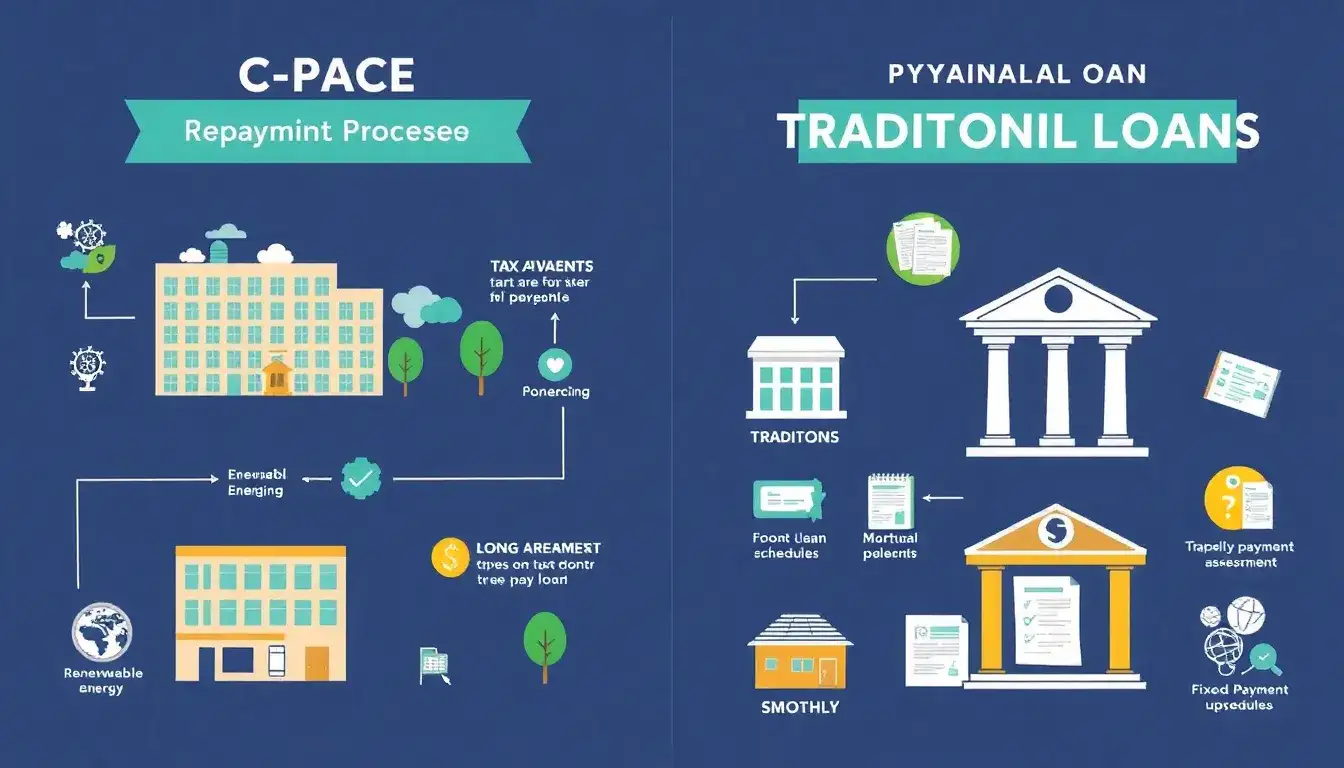
The repayment process for Commercial Property Assessed Clean Energy (C-PACE) financing differs significantly from traditional loans in several key ways:
Repayment Structure
- C-PACE Repayment: The repayment for C-PACE financing is made through a special property tax assessment invoiced on the property tax bill. This assessment is typically paid annually or semi-annually, and the repayment term matches the useful life of the improvements, often ranging from 10 to 30 years.
- Traditional Loans: Repayment for traditional loans is usually made directly to the lender through monthly or quarterly payments, not tied to property taxes.
Security and Lien
- C-PACE: The financing is secured by a senior lien on the property, which takes priority over most other liens except for property taxes. This means that if the property is sold, the new owner assumes the repayment obligation.
- Traditional Loans: Traditional loans are more commonly secured by personal or business assets and do not necessarily tie a lien to the property taxes.
Non-Recourse Nature
- C-PACE: C-PACE financing is non-recourse, meaning the borrower is not personally liable for the debt. The repayment obligation is tied to the property rather than the individual owner.
- Traditional Loans: Many traditional loans are recourse loans, where the borrower can be held personally responsible for any unpaid balance.
Interest and Costs
- C-PACE: C-PACE offers low-cost, long-term financing with fixed rates, providing a stable payment structure. It often includes no upfront costs, allowing for 100% financing of eligible projects.
- Traditional Loans: Traditional loans may have higher interest rates and fees, and often require down payments.
Benefits and Risks
- C-PACE: Offers benefits like improved cash flow and reduced credit risk due to its non-recourse nature. However, it may complicate property sales due to the assessment lien.
- Traditional Loans: Provides more flexibility in loan terms and repayment schedules but may increase personal financial risk for borrowers.
Overall, C-PACE financing is designed to encourage sustainable building practices by providing a unique repayment structure tied to property taxes, which differs significantly from the typical repayment and security mechanisms of traditional loans.
Original article by NenPower, If reposted, please credit the source: https://nenpower.com/blog/how-does-the-repayment-process-for-c-pace-differ-from-traditional-loans/

