

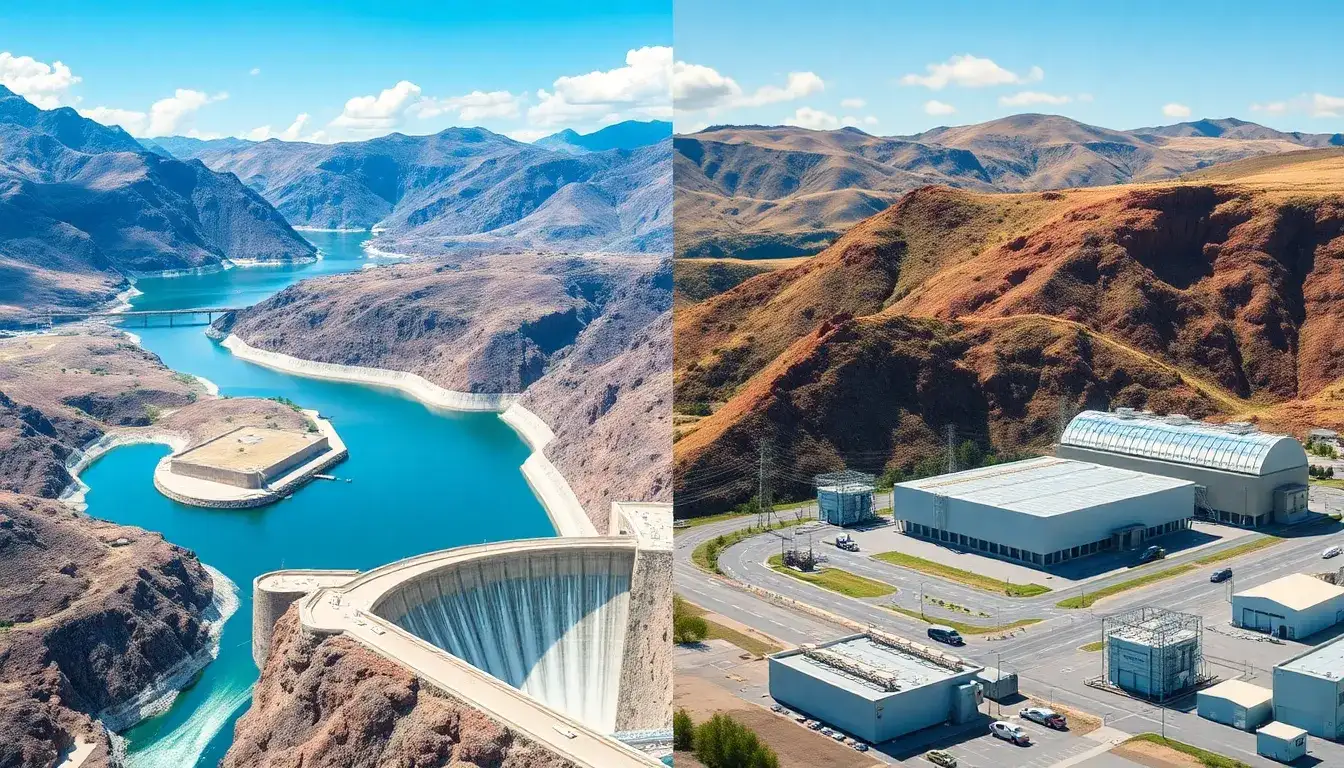
Reliability Factors of Pumped Hydro Storage
- Grid Stability and Efficiency: PHES improves system-wide efficiency and reliability by enabling the time-shifting of electricity — storing energy during periods of low demand (usually at night) by pumping water uphill and releasing it to generate power during peak demand periods. This load balancing capability enhances grid stability significantly.
- Proven Track Record and Dominance: Pumped storage currently accounts for about 96% of all utility-scale energy storage capacity in the United States, underpinning its role as the backbone of grid-scale energy storage due to its proven reliability and scalability.
- Rapid Response and Ancillary Services: PHES systems can respond quickly to fluctuations in electricity demand and supply, providing ancillary services such as frequency regulation, voltage support, and reserve capacity, which are critical for maintaining grid reliability.
- Predictability and Control: Unlike variable renewable sources like wind and solar, pumped hydro storage does not depend on weather conditions and can supply electricity on demand whenever needed, making it more dependable especially during peak load times or renewable generation shortfalls.
Comparison to Other Energy Storage Technologies
| Feature | Pumped Hydro Storage | Battery Storage (e.g., Lithium-ion) | Compressed Air Energy Storage (CAES) | Flywheels |
|---|---|---|---|---|
| Grid-scale deployment | Very large (GW scale) | Growing but smaller scale (MW-GW) | Limited commercial deployment | Mostly short-term, small scale |
| Energy capacity | Very high (multi-GWh possible) | Moderate (limited by battery size) | High but less common | Low |
| Response time | Seconds to minutes | Milliseconds to seconds | Minutes | Milliseconds |
| Operational lifetime | Several decades | 10-15 years (battery degradation) | Decades | Thousands of cycles |
| Dependence on site/location | Requires specific geographic features | Can be installed flexibly | Site-dependent (underground caverns) | Minimal |
| Energy loss (round-trip efficiency) | 70-85% | 80-90% | 40-70% | 85-95% |
| Environmental impact | Reservoir creation affects ecosystems | Chemical materials and disposal concerns | Environmental impact localized | Minimal |
Pumped hydro’s high reliability is bolstered by its longevity and low operational degradation compared to batteries, which lose capacity over time. It also supports large-scale, long-duration storage, unlike batteries that are generally better suited for short to medium durations. While batteries have higher round-trip efficiency, pumped hydro is more durable and has a well-established record in grid applications.
Challenges
While highly reliable, pumped storage faces challenges in siting (requiring suitable topography and water availability), environmental permitting, and long construction lead times. These factors limit rapid deployment compared to more modular technologies like batteries.
Summary: Pumped hydroelectric energy storage is the most established and reliable large-scale energy storage technology, providing critical grid stability, long operational life, and large capacity. Its reliability surpasses that of most other storage forms, especially in duration and predictability, making it indispensable for integrating variable renewables like solar and wind into power grids.
Original article by NenPower, If reposted, please credit the source: https://nenpower.com/blog/how-does-the-reliability-of-pumped-hydroelectric-energy-storage-compare-to-other-energy-storage-technologies/

