

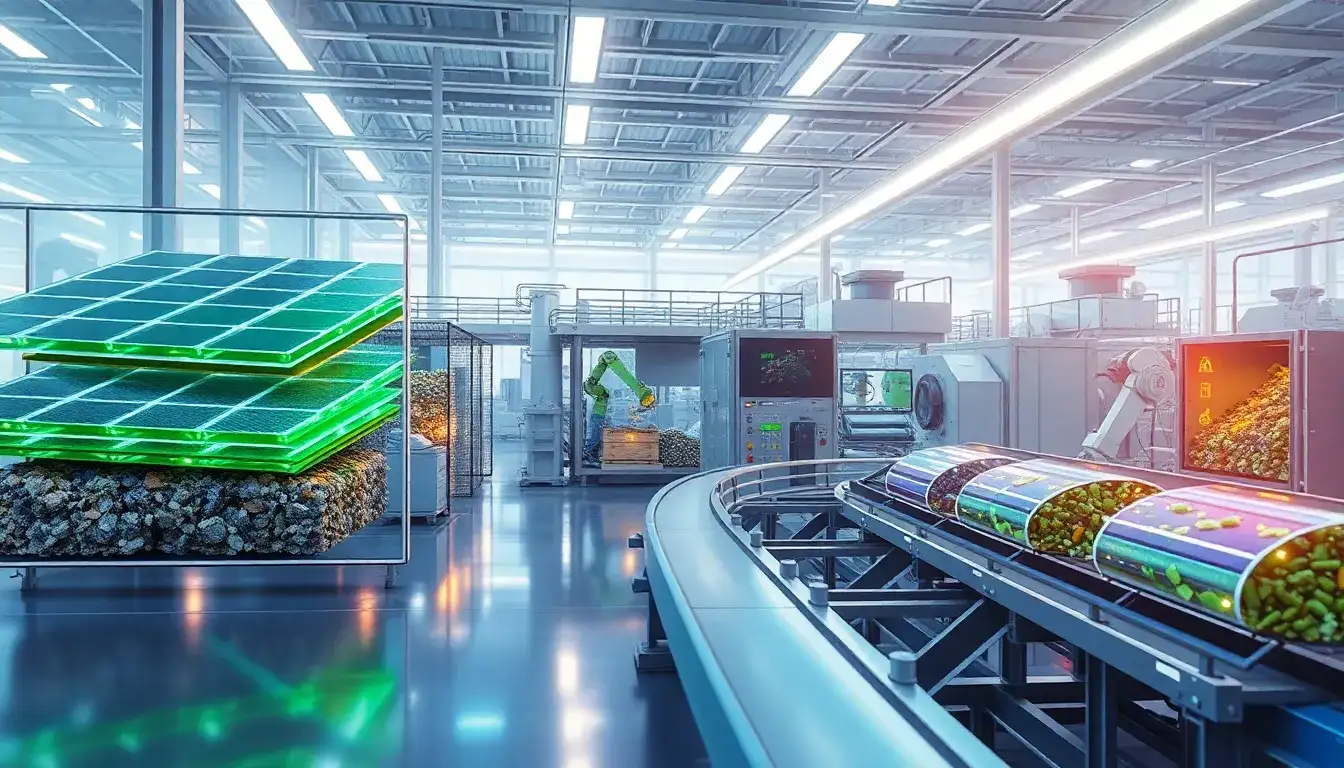
The recycling process for thin-film solar panels differs significantly from that of silicon-based photovoltaic (PV) panels. Here’s a comparison of the two processes:
Silicon-Based PV Panels
- Disassembly: Starts with the disassembly to separate aluminum and glass parts. Almost all (95%) of the glass can be reused, and external metal parts are used for re-molding.
- Thermal Processing: The remaining materials undergo thermal treatment at 500°C, evaporating the encapsulating plastic, which is reused as a heat source. The plastic is not wasted, contributing to energy efficiency.
- Material Separation: Silicon cells are physically separated and refined. Silicon particles (wafers) are etched away using acid, and broken wafers are melted for reuse in new silicon module manufacturing, achieving an 85% recycling rate for silicon.
Thin-Film Solar Panels
- Shredding and Milling: Initially, thin-film solar panels are shredded and then processed using a hammermill to reduce them into particles no larger than 4-5 mm. This breaks the lamination holding the materials together.
- Material Separation: Acid leaching is used to remove metal films from the glass. The mixture contains solid and liquid materials, which are separated using a rotating screw system. The liquid portion is treated to purify the metals via precipitation and dewatering.
- Purification: The collected metals are processed to separate semiconductor materials like cadmium telluride (CdTe) or copper indium gallium selenide (CIGS). The solid materials are further processed on a vibrating surface to remove interlayer materials, and the glass is thoroughly washed.
Differences
- Aggressiveness: The recycling process for thin-film panels is more aggressive, involving shredding and milling, whereas silicon-based panels use thermal processing and chemical etching for separation.
- Material Focus: Thin-film recycling focuses on recovering metals and semiconductor materials, while silicon-based panels focus on silicon and glass recovery.
- Efficiency: Thin-film panels can achieve high metal recovery rates, with some processes allowing for 100% metal recovery.
Original article by NenPower, If reposted, please credit the source: https://nenpower.com/blog/how-does-the-recycling-process-differ-for-thin-film-solar-panels/

