

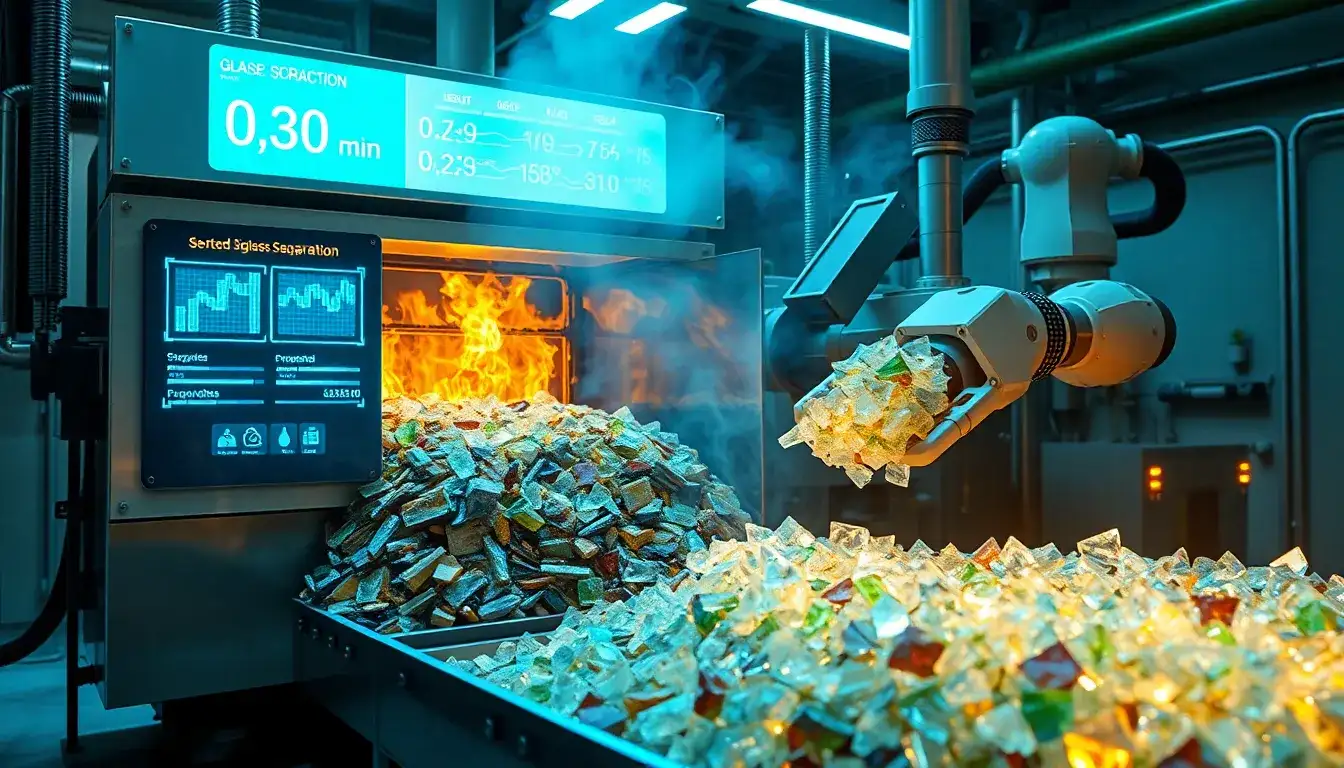
The pyrolysis process improves glass separation efficiency primarily by effectively decomposing the organic and plastic components that bind glass materials, enabling easier and cleaner recovery of glass. Here are the key ways pyrolysis enhances glass separation efficiency:
Efficient Decomposition of Organics and Plastics
- Pyrolysis involves heating waste materials such as composites or mixed waste (including plastics and organic polymers) in an oxygen-free or low-oxygen environment. This thermal treatment breaks down plastics and organic binders nearly completely. For example, nitrogen pyrolysis at around 773 K can achieve almost 100% organic conversion, effectively decomposing plastic components that attach to glass.
- The decomposition of these binders and plastics frees the glass fibers or glass fragments from the matrix, making it simpler to isolate and recover pure glass without contamination or mechanical grinding challenges typical in mixed waste.
Improved Separation of Glass from Residuals
- After pyrolysis, organics are converted to gases or oils, and the remaining solid residue is primarily inorganic glass, which is easier to separate mechanically or by physical means.
- Advanced gas-solid separation technologies such as cyclones enhance the separation phase within pyrolysis plants by efficiently removing particulate impurities from pyrolysis gases, maintaining high purity in recovered materials and smooth continuous operation. Cyclones do not clog like traditional filters, thus improving overall separation performance and product consistency.
Environmental and Economic Benefits Supporting Efficiency
- By converting plastics and organics to useful byproducts and leaving behind clean glass, pyrolysis offers an environmentally friendly alternative to landfilling or incineration. This reduces hazardous waste and enables circular reuse of glass fibers or glass fragments, improving sustainability and resource efficiency in materials recycling.
- The process parameters are optimized to limit harmful byproducts and maximize glass purity, for instance by controlling the pyrolysis temperature below 773 K to avoid toxic emissions while ensuring complete organic decomposition.
Summary Table
| Aspect | How Pyrolysis Improves Glass Separation Efficiency |
|---|---|
| Organic/plastic decomposition | Nearly complete thermal decomposition frees glass from binders |
| Residue composition | Glass remains as solid residue, easier to isolate and recover |
| Gas-solid separation | Use of cyclones avoids filter clogging, improves purity and operational uptime |
| Environmental impact | Limits hazardous waste, promotes circular reuse of glass |
| Process optimization | Controlled temperatures prevent harmful emissions while ensuring efficiency |
In conclusion, pyrolysis increases glass separation efficiency by breaking down plastics and organics that impede mechanical separation, leaving a primarily glass residue that can be recovered more cleanly and consistently. Advanced physical separation equipment like cyclones further enhances the process by maintaining product quality and reducing downtime. This combination supports sustainable recycling practices for glass-containing waste such as composite materials and solar cell modules.
Original article by NenPower, If reposted, please credit the source: https://nenpower.com/blog/how-does-the-pyrolysis-process-improve-glass-separation-efficiency/

