

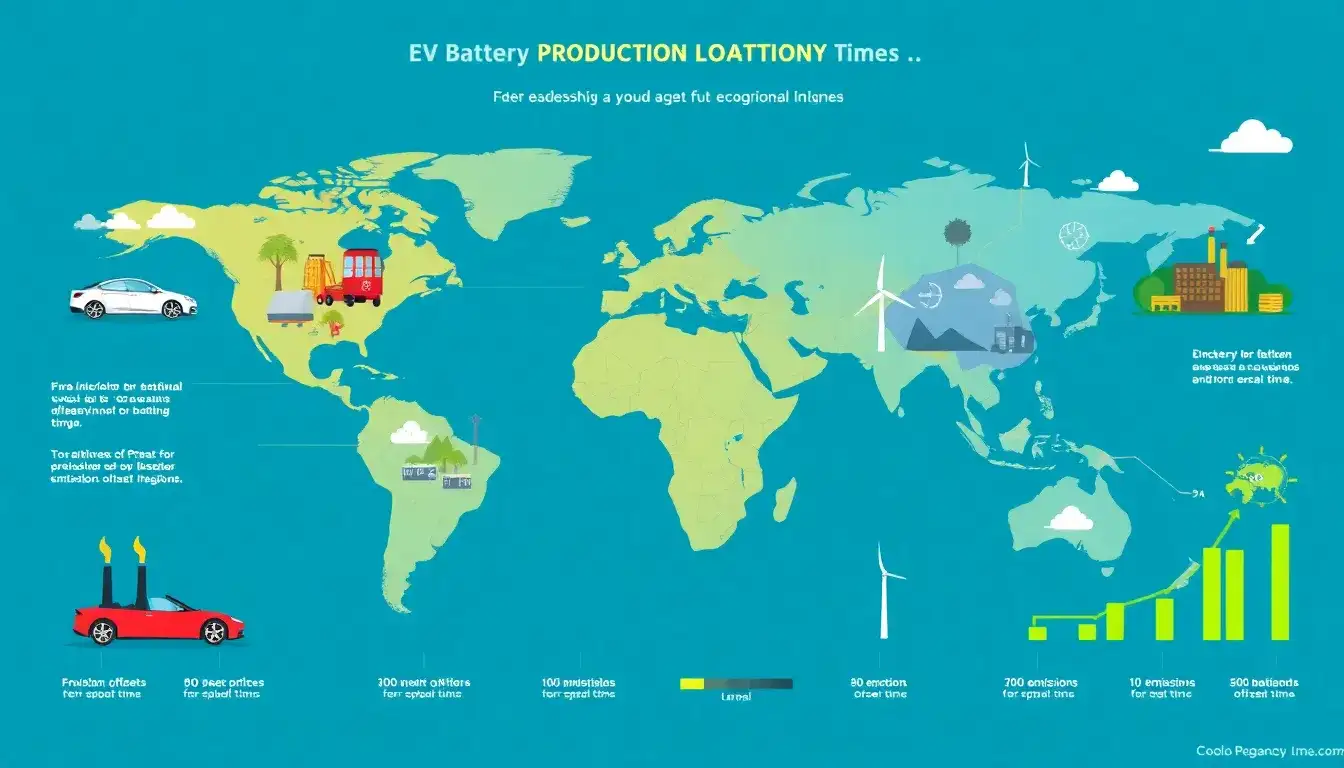
The production location of electric vehicle (EV) batteries significantly impacts their carbon footprint and, consequently, the emissions offset times. This is mainly due to the varying carbon intensity of energy sources used in different regions during the manufacturing process.
Impact of Production Location
- Energy Source Differences: The primary factor influencing battery emissions is the energy source used during production. For instance, China, where about 77% of lithium-ion batteries are manufactured, primarily relies on coal for electricity, resulting in a higher carbon footprint compared to regions that use cleaner energy sources.
- Regional Carbon Footprint Variations:
- China: Batteries produced using the average Chinese grid have a high carbon footprint of around 105 kg CO2e/kWh.
- Europe: The EU grid results in a lower carbon footprint, with examples like Sweden producing batteries with a carbon footprint of about 64 kg CO2e/kWh. Other European countries like Hungary and Poland have footprints closer to 76 and 109 kg CO2e/kWh, respectively, due to differences in their energy mixes.
- Sweden vs. China: Sweden’s cleaner energy sources lead to a significantly lower carbon footprint compared to China.
Effect on Emissions Offset Time
The emissions offset time for an EV is influenced by how quickly the initial production emissions can be compensated by the reduced emissions during operation compared to internal combustion engine vehicles. Batteries produced in regions with higher carbon footprints, such as China, require longer operating periods to offset the initial emissions due to the higher upfront emissions. Conversely, batteries produced in areas with lower carbon footprints, such as Sweden, can offset their initial emissions more quickly. Therefore, locating battery production near low-carbon energy sources can significantly reduce the emissions offset time for electric vehicles.
Future Improvements
Efforts are underway to decarbonize EV battery production through the use of renewable energy sources, improved manufacturing processes, and design optimizations. These advancements are expected to reduce the carbon footprint of batteries over the next five to ten years, further decreasing the emissions offset time.
Original article by NenPower, If reposted, please credit the source: https://nenpower.com/blog/how-does-the-production-location-of-ev-batteries-affect-their-emissions-offset-times/

