

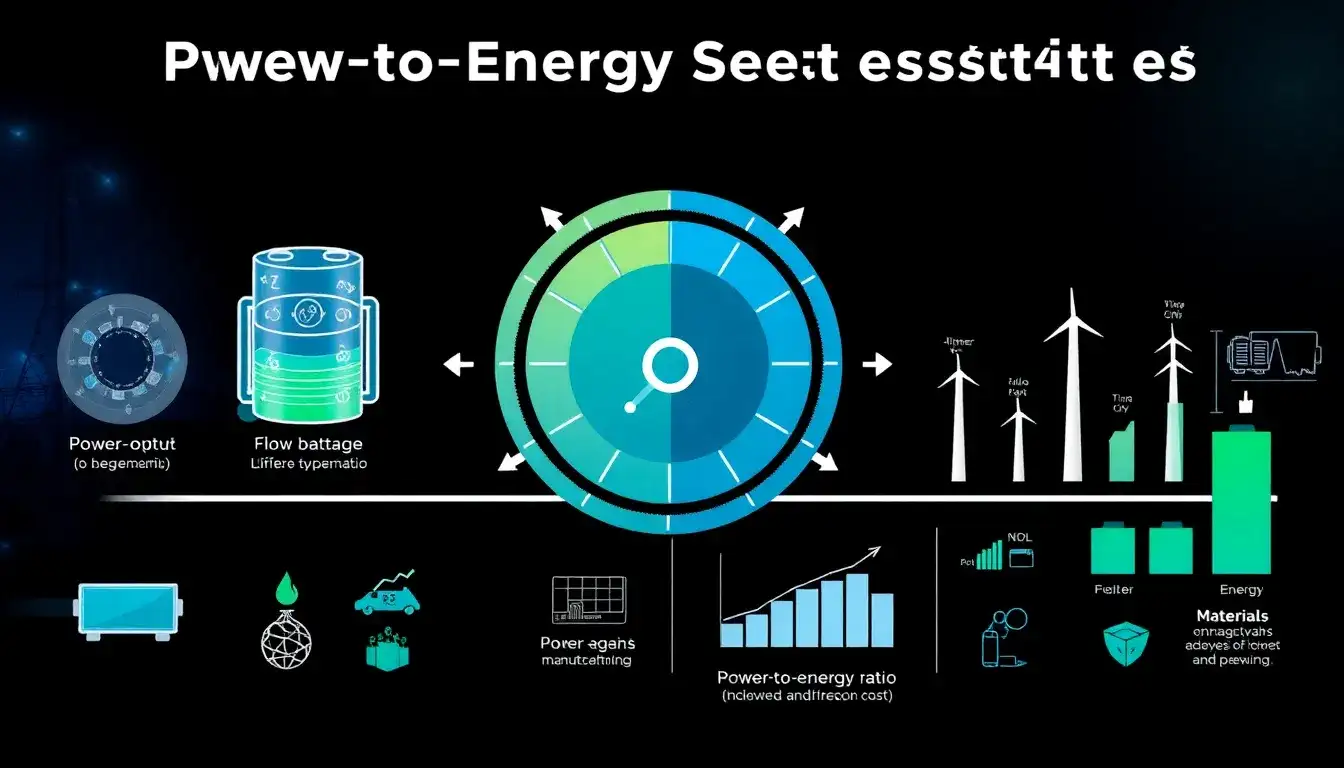
The power-to-energy ratio, also known as the power ratio or energy-to-power (E/P) ratio, significantly influences the cost and performance characteristics of battery storage systems.
Definition and Context
- The power-to-energy ratio is the ratio of the battery’s maximum power output (in MW or kW) to its total energy capacity (in MWh or kWh).
- It also represents the duration (in hours, minutes, or seconds) that the battery can deliver its rated power continuously before fully discharging. For example, a battery with 32 MW power rating and 8 MWh energy capacity has an E/P ratio of 0.25 hours (15 minutes).
Impact on Battery Storage Cost and Design
1. Cost Components
- Battery system costs are usually expressed as cost per unit energy stored ($/kWh) and cost per unit power output ($/kW).
- Systems designed with a higher power-to-energy ratio (high power relative to energy capacity) tend to have higher power-related costs because they must deliver energy quickly, requiring more robust components and potentially more sophisticated control electronics.
2. Application-Specific Requirements
- Applications requiring short bursts of high power (low energy duration) such as frequency regulation or grid stabilization demand a high power-to-energy ratio and thus may favor batteries optimized for power delivery over energy capacity.
- Conversely, applications like peak shifting or backup power need longer duration discharge and thus lower power-to-energy ratios, which prioritize energy capacity and tend to increase the energy-related portion of cost.
3. Operational Efficiency and Battery Life
- Higher power ratios enable faster charging and discharging, improving responsiveness and operational efficiency by reducing energy loss as heat during rapid cycling.
- However, very high power draw can stress battery components, potentially accelerating degradation and shortening cycle life if not properly managed, impacting long-term replacement costs.
- Optimizing power ratio strikes a balance between performance and lifespan, influencing overall lifecycle cost.
4. Cost Optimization
- A higher power-to-energy ratio can reduce upfront system cost by requiring fewer battery cells to meet power demands, but may increase costs related to thermal management, inverter capacity, and control systems.
- Lower ratios, with longer discharge durations, may increase battery size and cost but reduce stress per cycle, affecting replacement frequency and maintenance costs.
- Selecting an appropriate power-to-energy ratio aligned with the specific application is key to minimizing total cost of ownership and maximizing value.
Summary Table of Power-to-Energy Ratio Effects
| Aspect | High Power-to-Energy Ratio | Low Power-to-Energy Ratio |
|---|---|---|
| Typical Use Case | Frequency regulation, quick bursts | Peak shifting, backup power |
| Discharge Duration | Short (minutes or seconds) | Longer (hours) |
| Upfront Cost Focus | Higher $/kW, potentially lower $/kWh | Higher $/kWh due to larger energy capacity |
| Battery Stress & Degradation | Higher stress, possible faster degradation | Lower stress, longer cycle life |
| Efficiency | Higher charging/discharging efficiency | Lower due to longer discharge time |
| System Complexity | More complex power electronics and cooling | Simpler system components |
In conclusion, the power-to-energy ratio critically affects battery storage system costs by dictating the balance between power capacity and stored energy. This ratio must be optimized according to the intended application to balance upfront investment, operational efficiency, battery life, and maintenance costs.
Original article by NenPower, If reposted, please credit the source: https://nenpower.com/blog/how-does-the-power-to-energy-ratio-affect-the-cost-of-battery-storage-systems/

