

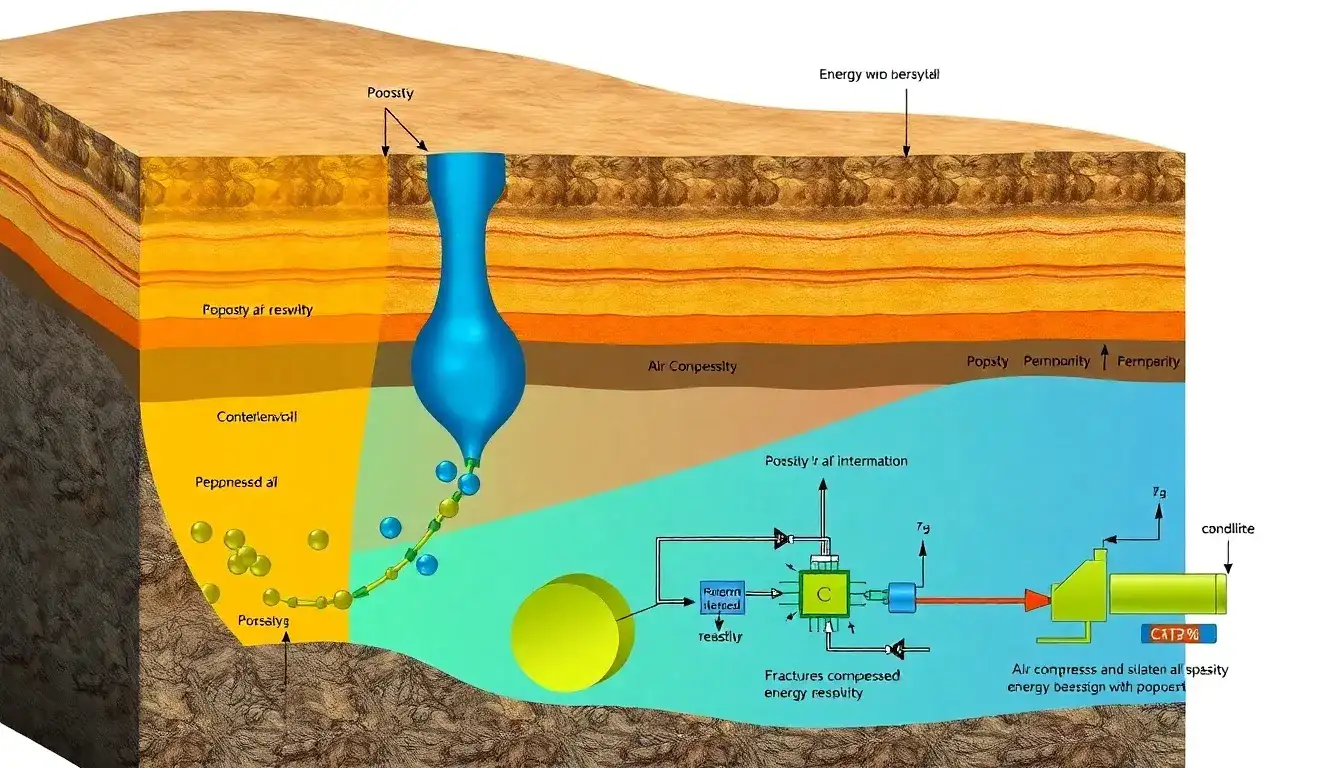
The porosity and permeability of depleted natural gas reservoirs play a critical role in determining their suitability for compressed air energy storage (CAES).
Porosity refers to the fraction of the rock volume that is pore space and can store fluids (or gases). A higher porosity means more available space to store compressed air. Depleted natural gas reservoirs typically have sufficient porosity to have originally accumulated hydrocarbons, indicating they can potentially store compressed air effectively.
Permeability measures how easily fluids or gases can flow through the rock’s pore network. High permeability is essential in CAES reservoirs to allow the injection and withdrawal of compressed air with minimal pressure loss and operational inefficiencies. If permeability is too low, the movement of compressed air will be restricted, leading to poor performance in energy storage and retrieval.
Depleted natural gas reservoirs are often considered suitable for CAES because:
- They have demonstrated adequate porosity and permeability to have held natural gas under pressure for long periods, suggesting good storage and flow capacity.
- They are capped by relatively impermeable layers, which help retain the injected compressed air, minimizing leakage.
- Their geological and petrophysical properties (porosity around 20% and permeability around 500 millidarcies or 5×10-13 m² in studied cases) can support injection rates necessary for CAES operations.
However, the exact suitability depends on the specific porosity and permeability values:
| Parameter | Effect on CAES Suitability |
|---|---|
| Porosity | Determines amount of air that can be stored — higher is better |
| Permeability | Controls rate of air injection and withdrawal — higher ensures efficient cycling and less energy loss |
In summary, depleted natural gas reservoirs with high porosity and permeability are ideal candidates for compressed air energy storage because they can both hold large volumes of compressed air and allow rapid injection and withdrawal cycles with minimal pressure losses. Conversely, reservoirs with low permeability or porosity may not be effective for CAES due to limited storage volume and constrained gas flow.
Original article by NenPower, If reposted, please credit the source: https://nenpower.com/blog/how-does-the-porosity-and-permeability-of-depleted-natural-gas-reservoirs-affect-their-suitability-for-compressed-air-energy-storage/

