

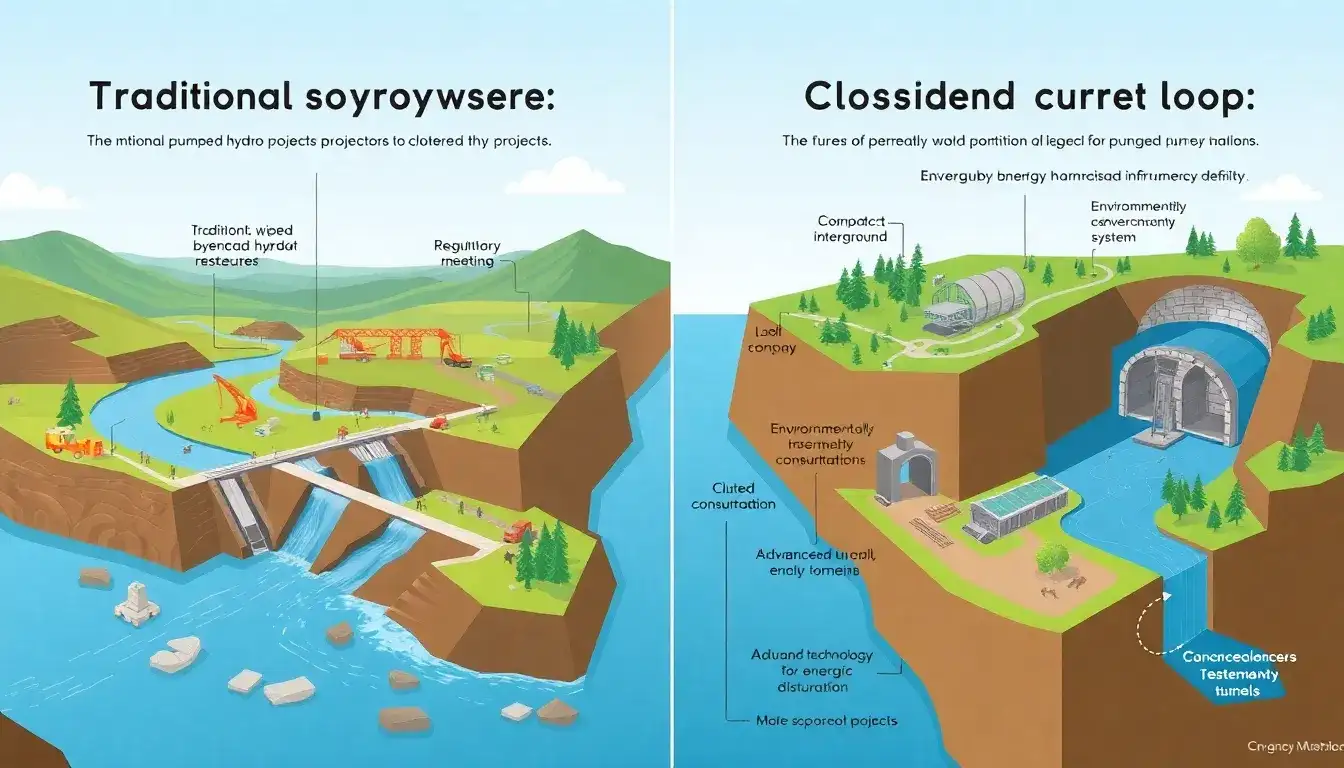
The permitting process for traditional pumped hydro and closed-loop pumped hydro projects shares a foundational framework under Federal Energy Regulatory Commission (FERC) jurisdiction, but there are notable differences due to the unique characteristics and environmental impacts of each type.
Common Permitting Framework
Both traditional and closed-loop pumped hydro projects require a FERC license to construct and operate. This licensing process generally involves two stages:
- Pre-filing stage: The applicant files initial proposals and consults with stakeholders including federal and state agencies, tribal governments, local landowners, and NGOs to identify environmental issues and necessary studies. This stage involves public scoping meetings and development of a study plan to assess impacts such as water quality and recreation.
- Post-filing stage: After the license application is submitted and deemed adequate, FERC solicits comments and completes environmental review under the National Environmental Policy Act (NEPA). The license includes conditions for engineering, environmental protection, and operational monitoring lasting 30 to 50 years.
FERC offers three licensing pathways: the default Integrated Licensing Process (ILP), the Traditional Licensing Process (TLP), and the Alternative Licensing Process (ALP). The ILP is comprehensive but can take about five years, while the TLP can streamline the timeline if early stakeholder engagement is effective.
Differences Between Traditional and Closed-Loop Projects
Traditional Pumped Hydro
- Traditional pumped hydro projects generally involve two natural water bodies with a reservoir at the upper elevation and a river or lake below. Because these projects interact directly with natural waterways, the environmental review is more complex. The process must consider impacts on fish and wildlife habitats, water quality, aquatic resources, and downstream flow regimes.
- Due to these complexities, the licensing process tends to be more intensive and time-consuming, especially given the need to comply with various environmental statutes and stakeholder concerns.
- The default ILP is commonly used but may be challenging for new projects due to the extensive study requirements and timelines, sometimes leading developers to seek the TLP to expedite progress.
Closed-Loop Pumped Hydro
- Closed-loop systems operate in a more controlled environment, typically involving two man-made reservoirs isolated from natural water bodies. This isolation generally reduces the potential impacts on natural aquatic ecosystems.
- Because closed-loop projects have limited or no direct interaction with natural rivers or lakes, the permitting and environmental review can be less complex, potentially reducing the scope of required studies related to fish passage, river flow alteration, or habitat disruption.
- While FERC licensing still applies, the relative simplicity of environmental issues may allow for a more streamlined permitting process, although regulatory timelines and stakeholder engagement are still critical.
- The uncertainty in the FERC licensing process remains a key consideration, but closed-loop projects may face fewer environmental hurdles compared to traditional projects.
Summary Table of Key Differences
| Aspect | Traditional Pumped Hydro | Closed-Loop Pumped Hydro |
|---|---|---|
| Water Body Interaction | Direct interaction with natural rivers/lakes | Uses isolated man-made reservoirs |
| Environmental Impact Scope | Broad, includes aquatic habitat, fish migration, water quality | Limited, mainly confined to reservoir impacts |
| Licensing Complexity | More complex, extensive studies and stakeholder involvement | Potentially simpler, fewer environmental concerns |
| Typical FERC Process Used | ILP dominant; TLP possible to shorten timeline | ILP or TLP, process may be more straightforward |
| Stakeholder Engagement | Critical and often extensive | Important but may be less contentious |
In conclusion, while both traditional and closed-loop pumped hydro projects undergo FERC licensing involving environmental reviews and stakeholder consultation, traditional pumped hydro projects usually face a more complex and lengthy permitting process due to their direct interaction with natural waterways. Closed-loop projects, by virtue of their isolated reservoirs, tend to have fewer environmental complications, potentially expediting permitting, but still must comply with FERC regulations and engage stakeholders appropriately.
Original article by NenPower, If reposted, please credit the source: https://nenpower.com/blog/how-does-the-permitting-process-differ-between-traditional-and-closed-loop-pumped-hydro-projects/

