

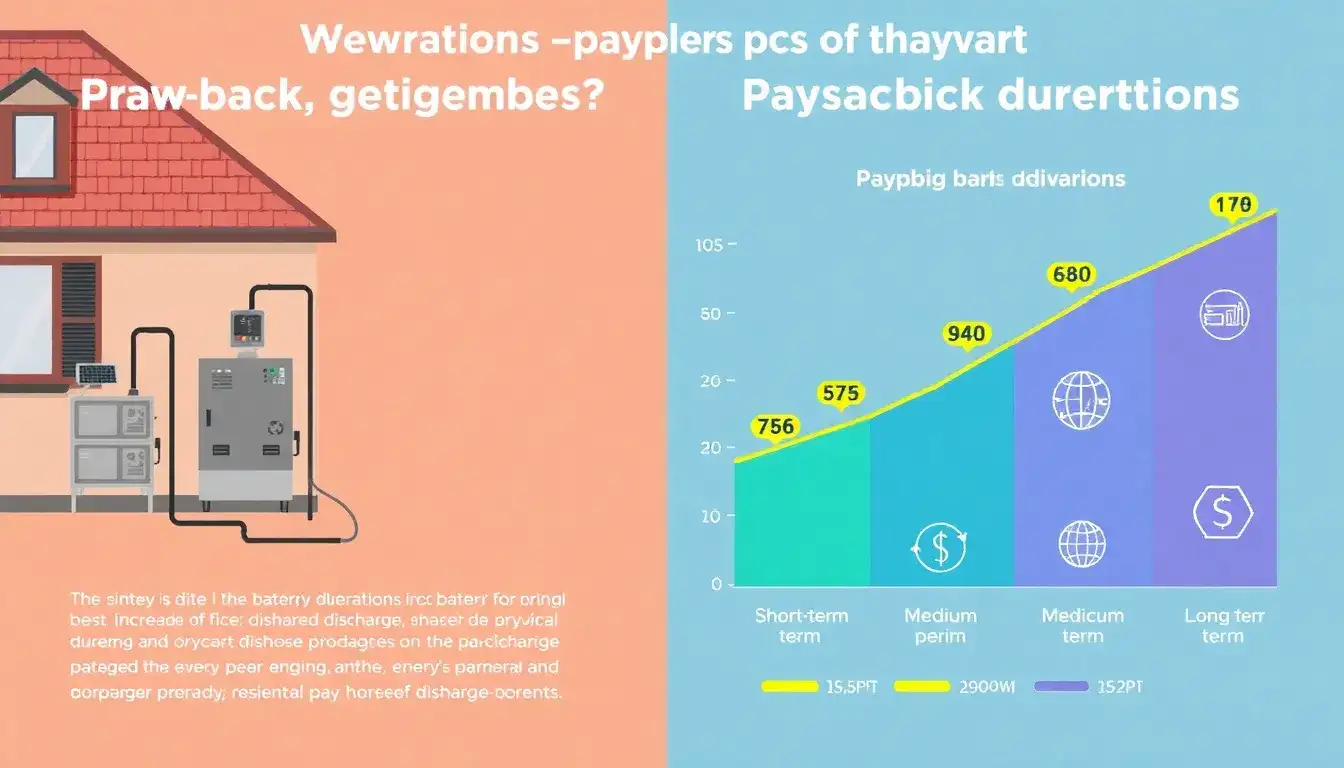
The payback period for battery systems varies significantly depending on the system duration and several other factors such as installation cost, incentives, electricity rates, usage patterns, and battery capacity.
Key Points on Payback Period Variation with Battery Duration
- The payback period represents the time it takes for savings generated by the battery system (mainly through reduced electricity bills and possibly incentives) to fully offset the initial investment cost.
- Battery duration here generally means the storage capacity (how long the battery can supply power) and usage patterns, which influence how much electricity the battery offsets from the grid.
- Typical payback periods for home battery systems paired with solar range from around 5 to 15 years depending on various factors including state incentives and system size.
- For typical solar and battery installations, the payback period is often around 7 years, with solar panels warranted for 25 years and batteries at least 10 years, meaning batteries may require replacement during the lifetime of the solar panels.
- Longer duration batteries (larger capacity, able to supply power for more hours) tend to have higher upfront costs, which can increase the payback period if the additional capacity is underutilized or energy savings are not proportionally higher.
- Conversely, optimizing battery size and duration to match the home’s energy consumption and peak demand times enhances savings and shortens payback periods.
- Financial incentives, like rebates and state-level programs, can reduce net costs significantly and thus shorten payback periods, making batteries with different durations more competitive.
- Electricity rate structures, such as time-of-use pricing, can affect how valuable longer duration batteries are by enabling greater load shifting and savings.
Summary Table of Payback Periods by Duration (Indicative)
| Battery Duration/Capacity | Typical Payback Period Range | Influencing Factors |
|---|---|---|
| Short-duration (2-4 hours) | ~5-10 years | Lower cost, good for daily cycling, suitable for typical solar usage |
| Medium-duration (5-8 hours) | ~7-12 years | More capacity, higher upfront cost, better backup power and load shifting |
| Long-duration (8+ hours) | 10+ years | High cost, valuable for extended backup and peak reduction, payback depends on utilization and incentives |
In essence, the payback period generally increases with longer battery durations due to higher costs, but careful sizing and usage aligned with electricity pricing and incentives can mitigate this effect. Homeowners should calculate their specific payback period by dividing total system cost by annual savings, considering all incentives and local electricity rates to reflect how battery duration impacts financial return.
Original article by NenPower, If reposted, please credit the source: https://nenpower.com/blog/how-does-the-payback-period-for-battery-systems-vary-with-different-durations/

