

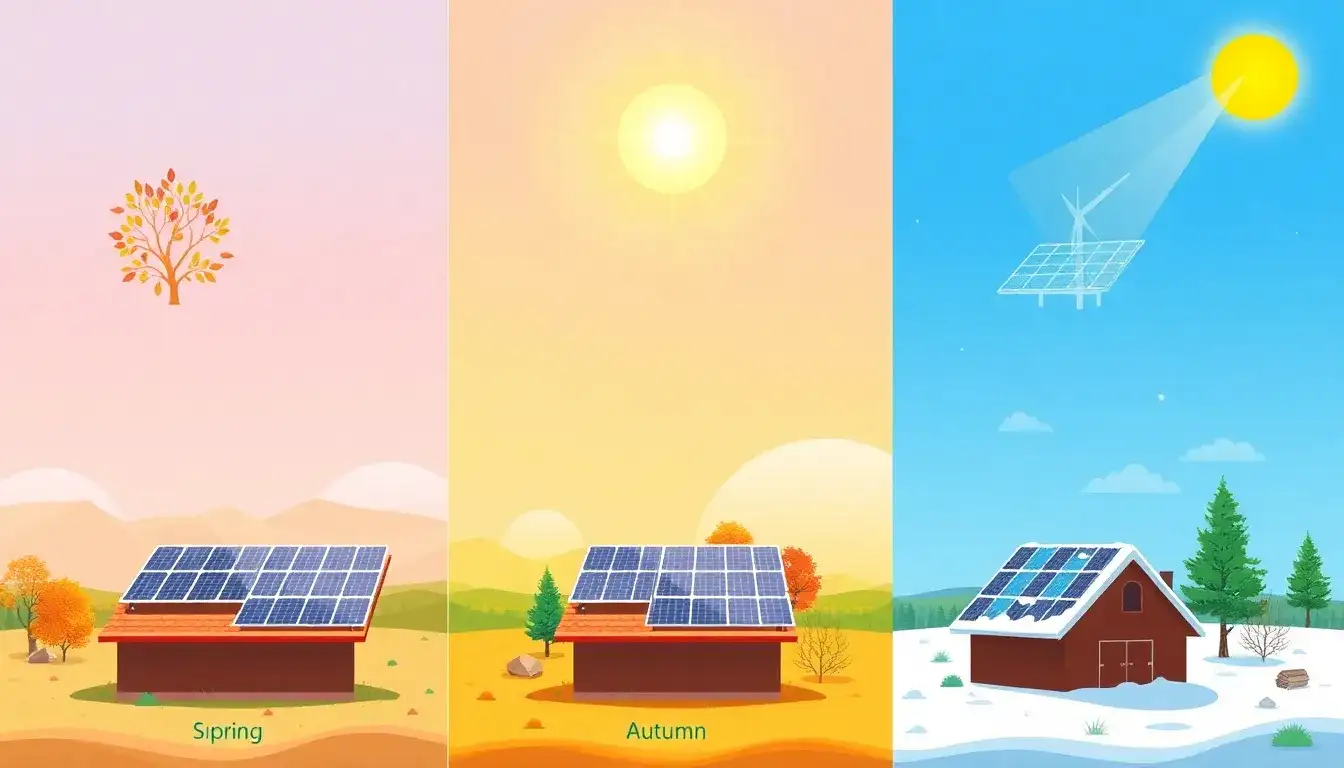
Orientation and Efficiency
- Optimal direction: In the northern hemisphere, south-facing panels capture the most sunlight, as the sun arcs across the southern sky. East- or west-facing panels produce ~20% less energy.
- Seasonal sun path: The sun’s position shifts between summer (higher in the sky) and winter (lower). Panels angled perpendicular to the sun’s rays maximize energy capture.
Seasonal Angle Adjustments
- Summer: A tilt of 20° aligns better with the higher sun, as seen in Cádiz, Spain, where 20° panels generated 210 kWh (July) vs. 195 kWh at 35°.
- Winter: A steeper ~40° tilt matches the lower sun. In the same location, 35° panels outperformed 20° ones in December (132 kWh vs. 111 kWh).
- Year-round fixed angle: For static systems, 30°–35° works best in southern Europe, while the U.S. DOE recommends 15°–40°.
Impact of Adjustments
- Energy gains: Seasonal tilting can boost annual output by 10–25%. For example, Phoenix saw a 14% increase at 30° vs. flat mounts.
- Practical challenges: Adjusting panels twice yearly (at equinoxes) optimizes angles, but most systems remain fixed due to installation constraints.
Additional Factors
- Technology: Bifacial panels with reflective surfaces can increase output by 30% by capturing light on both sides.
- Weather: Winter output drops 40–60% due to shorter days and cloud cover, not temperature.
- Location: Panels in colder climates often perform better due to reduced heat-related efficiency losses.
In summary, south-facing orientation paired with seasonal tilt adjustments maximizes efficiency, while fixed-angle systems prioritize location-specific angles. Advances in panel technology further mitigate seasonal limitations.
Original article by NenPower, If reposted, please credit the source: https://nenpower.com/blog/how-does-the-orientation-of-solar-panels-impact-their-efficiency-in-different-seasons/

