

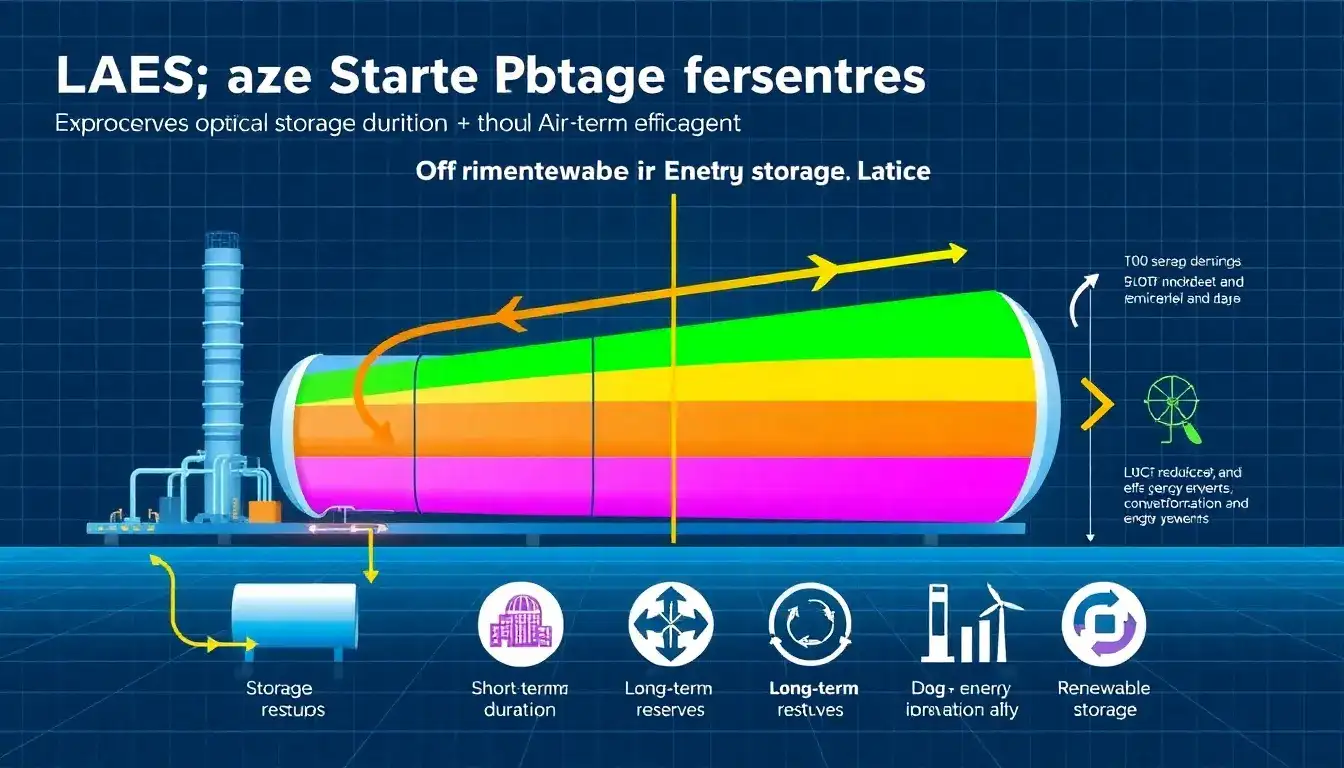
The optimal storage duration significantly influences the economic efficiency of Liquid Air Energy Storage (LAES) systems by balancing costs, efficiency, and revenue opportunities.
Effect of Storage Duration on Economic Efficiency
- Economic Trade-offs: Research comparing weekly versus monthly storage durations for LAES indicates that optimal storage duration impacts economic benefits. Shorter durations like weekly storage may allow more frequent cycling and revenue generation, but can incur higher operational costs and efficiency losses over time. Longer durations reduce cycling frequency, improving component lifespan and reducing degradation costs, but may limit revenue streams tied to frequent energy arbitrage or grid services.
- Levelized Cost of Storage (LCOS): Studies such as those from MIT/NTNU highlight that LAES achieves a competitive LCOS around $60 per MWh, favorable against lithium-ion batteries and pumped hydro under certain scenarios. The LCOS is directly affected by the number of cycles and storage duration, as longer storage durations can reduce cycle frequency, spreading capital and fixed costs over longer retention times, thereby improving economic efficiency if matched to grid demand profiles.
- Storage Losses and Duration: LAES stores energy as liquid air at cryogenic temperatures. The cryogenic storage tanks have very low losses (approximately 0.05% volume loss per day), enabling storage durations of weeks to months with minimal energy loss. This capability makes LAES well-suited for long-duration storage, which supports grid balancing over extended periods and enhances economic efficiency by reducing the need for rapid cycling and allowing for arbitrage over longer price differentials.
- Lifetime and Durability: LAES plants typically have long design lifetimes (30–40 years) with negligible performance degradation. Longer storage durations that reduce cycle counts can extend component life and reduce maintenance costs, positively impacting lifecycle economics.
Summary
| Factor | Impact on Economic Efficiency | Notes |
|---|---|---|
| Shorter storage duration (e.g., weekly) | More frequent cycling, higher revenue potential but increased operational and wear costs | Suitable for fast grid balancing but potentially lower plant longevity |
| Longer storage duration (e.g., monthly) | Lower cycling frequency, reduced operational costs, extended component life, and low energy losses | Aligns with long-term grid balancing needs and enhances LCOS |
| Cryogenic storage losses | Very low energy loss over extended periods | Enables economical long-duration storage |
| Plant lifetime and degradation | Long lifetime supports cost amortization over decades | Improves overall economic feasibility |
In conclusion, the optimal storage duration for LAES tends to favor longer durations (weeks to months) because of low storage losses, durability, and favorable LCOS, which collectively optimize the economic efficiency of the system. However, specific optimal durations depend on market signals and grid needs, as shorter durations can offer more frequent value capture but at higher costs.
Original article by NenPower, If reposted, please credit the source: https://nenpower.com/blog/how-does-the-optimal-storage-duration-affect-the-economic-efficiency-of-laes/

