

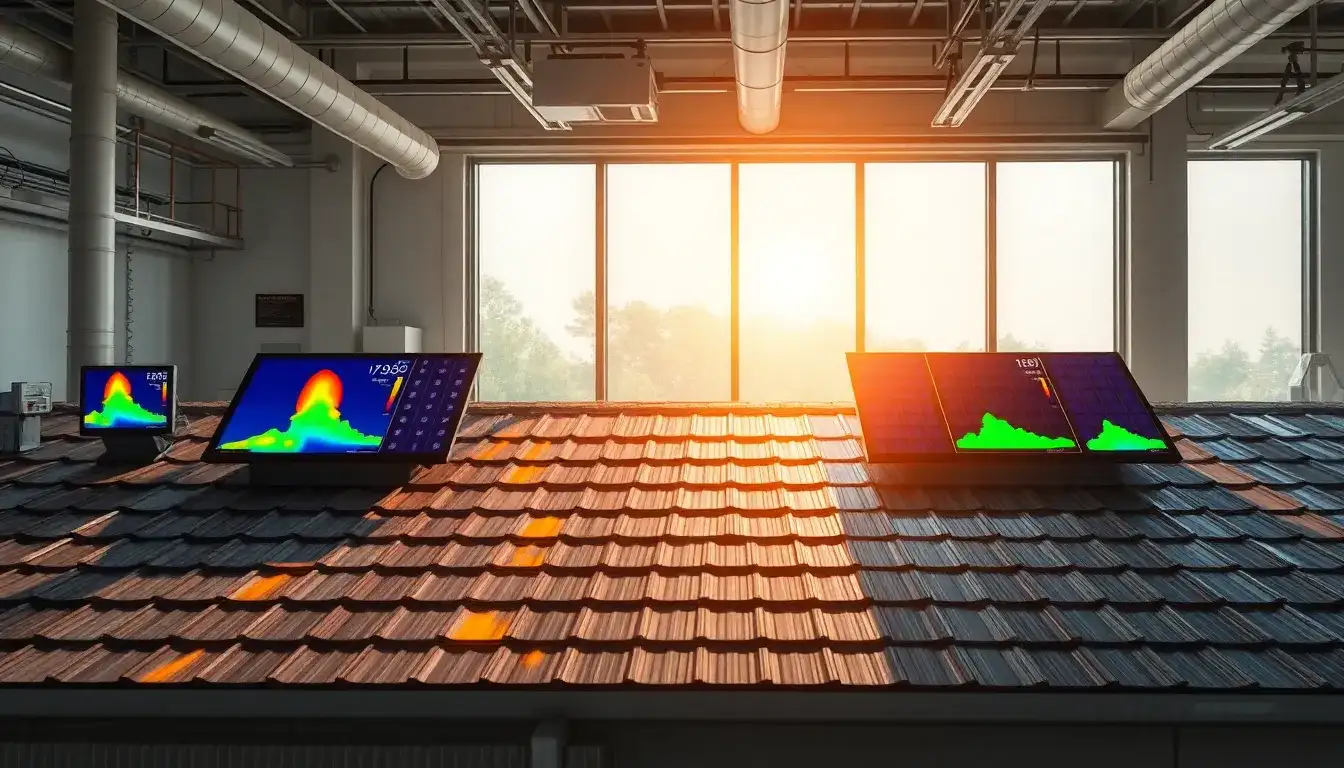
The material of the roof impacts the temperature coefficient of solar panels primarily by influencing the operating temperature of the panels. The temperature coefficient itself is an intrinsic property of the solar panel, indicating how much the panel’s efficiency decreases with each degree Celsius increase in temperature above 25°C (77°F). However, the roof material affects how hot the solar panels get, thereby impacting the real-world effect of the temperature coefficient on panel performance.
How Roof Material Affects Solar Panel Temperature and Efficiency
- Heat Absorption and Reflectance: Different roofing materials absorb and reflect sunlight differently. For example, asphalt shingles tend to absorb more heat, causing the roof surface—and thus the solar panels mounted on it—to become hotter. In contrast, metal roofs reflect more sunlight, keeping the roof and panels cooler. Similarly, light-colored roofing materials generally have higher solar reflectance, reducing heat absorption, while dark roofs absorb more heat.
- Panel Temperature Impact: Since solar panels lose efficiency as they heat up, a roof that gets very hot under sunlight will raise the solar panel temperature more. For every degree Celsius above 25°C, typical crystalline panels lose between 0.3% and 0.5% efficiency. For example, on a roof surface at 35°C (95°F), a panel with a temperature coefficient of -0.37%/°C would have roughly 3.7% lower efficiency than at 25°C.
- Airflow and Installation: How panels are mounted and the ventilation between the roof and panels also affect panel temperature. Roofs that trap more heat without good airflow cause higher panel temperatures. Roof materials that promote cooling, such as reflective metal or lighter colors, help reduce panel temperature and lessen efficiency losses related to the temperature coefficient.
Summary
| Roof Material | Heat Absorption | Effect on Panel Temperature | Impact on Temperature Coefficient |
|---|---|---|---|
| Asphalt Shingles | High | Higher panel temps | Greater efficiency loss |
| Metal Roofing | Reflective | Lower panel temps | Lower efficiency loss |
| Tile, Tar & Gravel | Variable | Moderate panel temps | Moderate impact |
| Light-colored Roofs | High reflectance | Lower panel temps | Reduced efficiency loss |
In sum, while the temperature coefficient value itself is determined by the solar panel technology, the choice of roof material influences the actual temperatures solar panels reach during operation. Roofs that absorb more heat raise panel temperatures and thus exacerbate efficiency losses due to the temperature coefficient. Conversely, reflective or cooler roofing materials help maintain lower panel temperatures, preserving panel efficiency. Proper panel mounting and ventilation also play a critical role in managing these temperature effects.
Original article by NenPower, If reposted, please credit the source: https://nenpower.com/blog/how-does-the-material-of-the-roof-impact-the-temperature-coefficient-of-solar-panels/

