

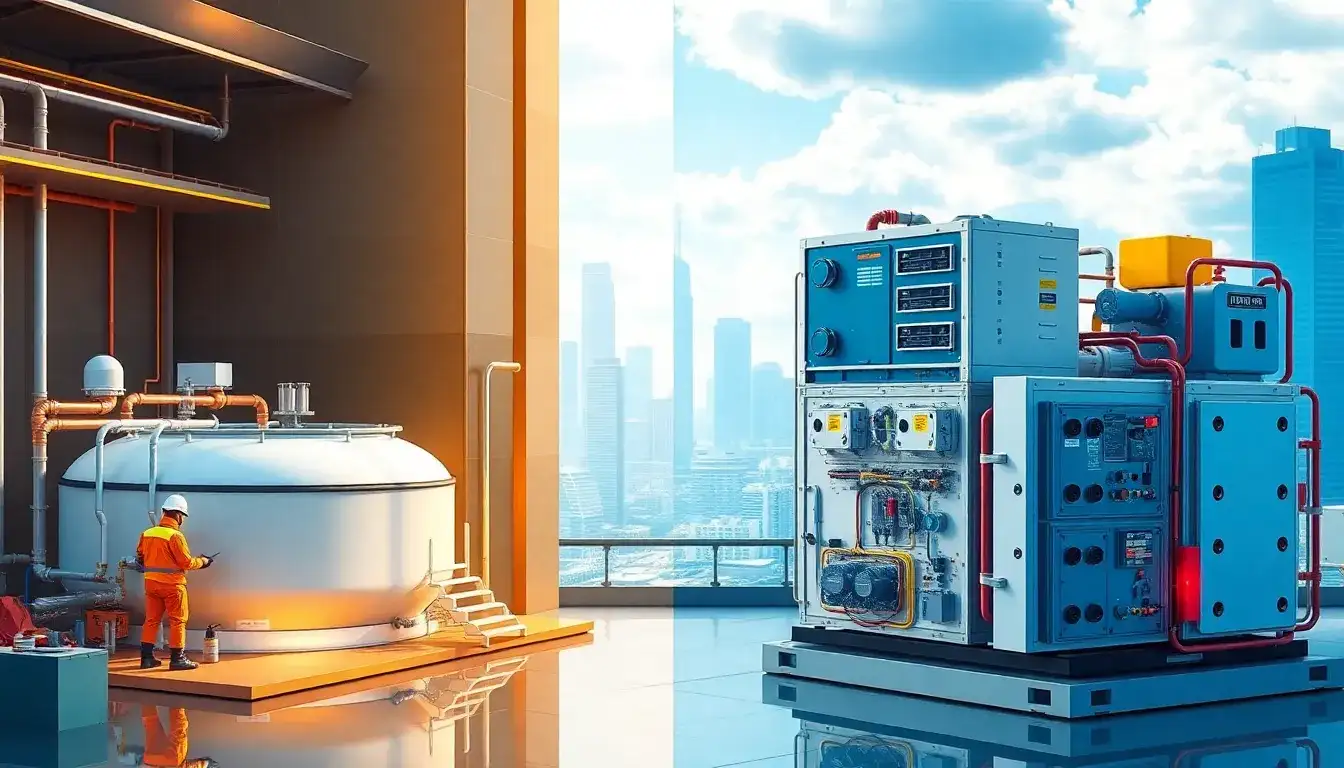
Liquid Air Energy Storage (LAES) systems differ significantly from lithium-ion batteries in terms of maintenance requirements due to their fundamentally different technologies and operational principles.
Maintenance Requirement Comparison
- Liquid Air Energy Storage (LAES):
LAES systems are thermo-mechanical systems that store energy by liquefying air at cryogenic temperatures and then re-gasifying it to generate power. Their operation involves large-scale turbomachinery such as compressors, expanders, heat exchangers, and cryogenic storage vessels. These components, being mechanical and thermal in nature, typically require maintenance focused on mechanical wear and thermal insulation integrity rather than frequent chemical or electrical cell replacements. The system benefits from fewer degradation issues related to cycling compared to electrochemical batteries. LAES is considered reliable for long-duration, large-scale storage and can meet prolonged energy demand with relatively low operational degradation risks, implying potentially lower maintenance frequency and costs over the system lifetime. - Lithium-ion Batteries:
Lithium-ion batteries rely on electrochemical reactions within cells that degrade over time and through cycling, requiring periodic replacements of battery modules or cells. Maintenance includes monitoring battery health, managing thermal conditions actively to prevent overheating, and addressing capacity fading and potential safety issues like thermal runaway. This results in ongoing maintenance and replacement costs, especially for grid-scale storage with frequent cycling.
Summary Table
| Aspect | Liquid Air Energy Storage (LAES) | Lithium-ion Batteries |
|---|---|---|
| Maintenance type | Mechanical and thermal system upkeep | Electrochemical cell monitoring and replacement |
| Frequency of major upkeep | Lower due to robust mechanical components | Higher due to battery degradation and cycling |
| Common issues | Mechanical wear, insulation integrity | Capacity loss, thermal management, safety risks |
| Lifecycle impact | Longer-lasting with minor performance degradation | Limited cycle life necessitating replacements |
| Operational complexity | Turbomachinery and cryogenics maintenance | Battery management system and cooling maintenance |
From an overall perspective, LAES systems tend to require less frequent and less costly maintenance compared to lithium-ion batteries, which have higher ongoing maintenance demands due to chemical degradation and thermal management needs. This difference is one factor contributing to the lower levelized cost of storage (LCOS) for LAES compared to lithium-ion batteries in grid-scale applications.
In conclusion, liquid air energy storage offers the advantage of lower maintenance intensity and longer operational life, making it a promising alternative for large-scale, long-duration energy storage compared to lithium-ion battery systems.
Original article by NenPower, If reposted, please credit the source: https://nenpower.com/blog/how-does-the-maintenance-requirement-of-liquid-air-energy-storage-systems-compare-to-lithium-ion-batteries/

