

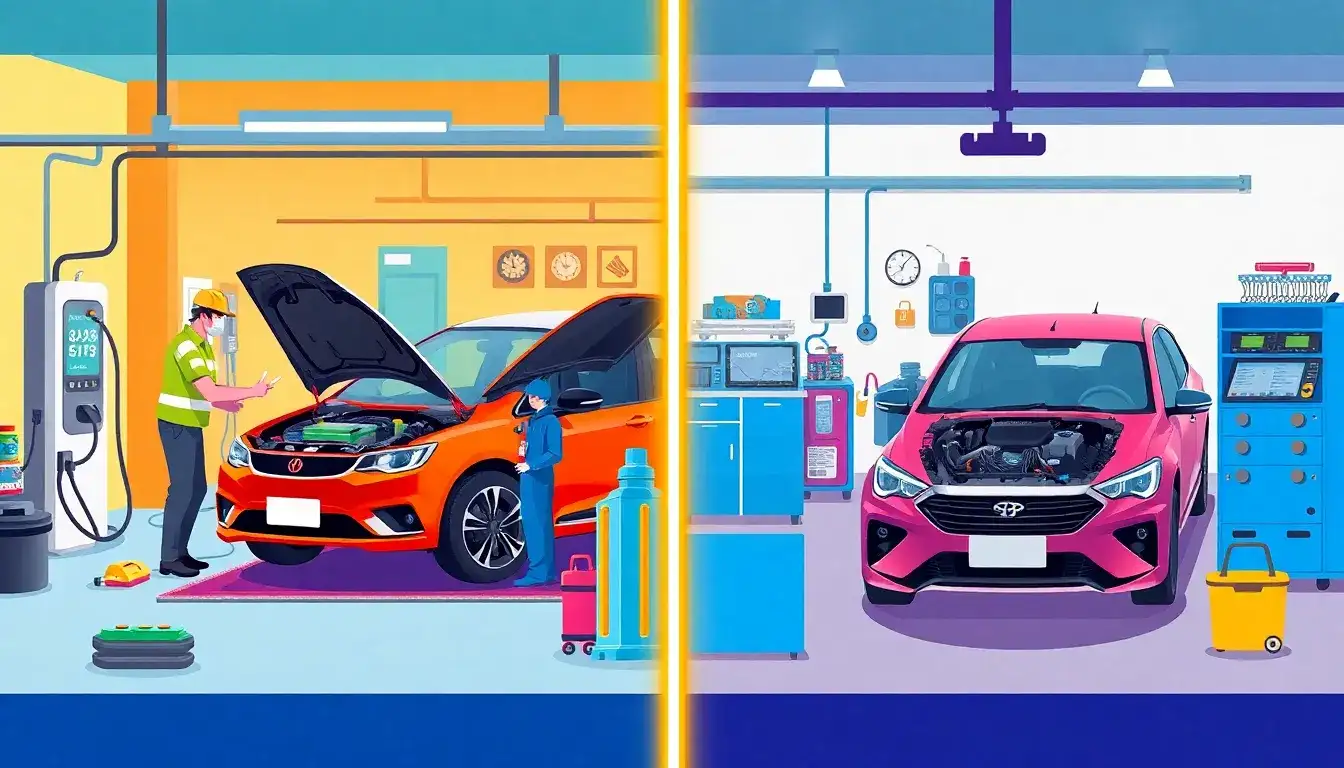
The maintenance of Plug-in Hybrid Electric Vehicles (PHEVs) differs from that of Hybrid Electric Vehicles (HEVs) primarily because of their battery size, charging methods, and the degree of reliance on the internal combustion engine (ICE).
Similarities in Maintenance
- Both PHEVs and HEVs have internal combustion engines alongside electric drivetrains, so their maintenance includes many conventional vehicle tasks such as engine oil and filter changes, transmission fluid changes, and cooling system maintenance.
- Both types benefit from regenerative braking, which reduces brake wear and extends the life of braking components compared to conventional vehicles.
- The electric system components (battery, motor, electronics) in both require minimal scheduled maintenance aside from battery health monitoring and occasional cooling system checks.
Key Differences in Maintenance Between PHEVs and HEVs
- Battery Size and Charging: PHEVs have larger batteries than HEVs, enabling longer all-electric driving ranges. The PHEV batteries can be recharged externally through a charging port, which adds the need for monitoring and maintaining the charging system and equipment. HEVs rely solely on regenerative braking and the ICE to recharge their smaller batteries.
- Battery Maintenance: Because PHEV batteries are larger and used more extensively in electric-only mode, their battery health and cooling systems might require more attention and monitoring compared to HEVs. This can include periodic inspection of the battery coolant system and software updates to maintain battery efficiency.
- Overall Maintenance Load: PHEVs might have slightly higher maintenance demands related to the battery and charging system, whereas HEVs have somewhat simpler electric systems since they don’t plug in for charging. However, both still require regular ICE maintenance, unlike fully electric vehicles.
Summary
| Maintenance Aspect | HEVs | PHEVs |
|---|---|---|
| Battery Size | Smaller | Larger |
| Battery Charging Method | Regenerative braking + ICE | Regenerative braking + ICE + Plug-in charging |
| Battery Maintenance | Minimal scheduled maintenance | More attention to battery health and cooling due to larger battery and plug-in use |
| ICE Maintenance | Required (oil changes, etc.) | Required (oil changes, etc.) |
| Brake Wear | Reduced due to regenerative braking | Reduced due to regenerative braking |
| Charging System Maintenance | Not applicable | Requires charging system checks and external charging equipment maintenance |
PHEVs combine aspects of HEVs and electric vehicles, leading to somewhat more complex maintenance related to their larger battery and charging infrastructure. Still, both PHEVs and HEVs require less maintenance compared to conventional ICE-only vehicles, mostly due to reduced brake wear and more efficient powertrains.
Original article by NenPower, If reposted, please credit the source: https://nenpower.com/blog/how-does-the-maintenance-of-phevs-differ-from-hevs/

