

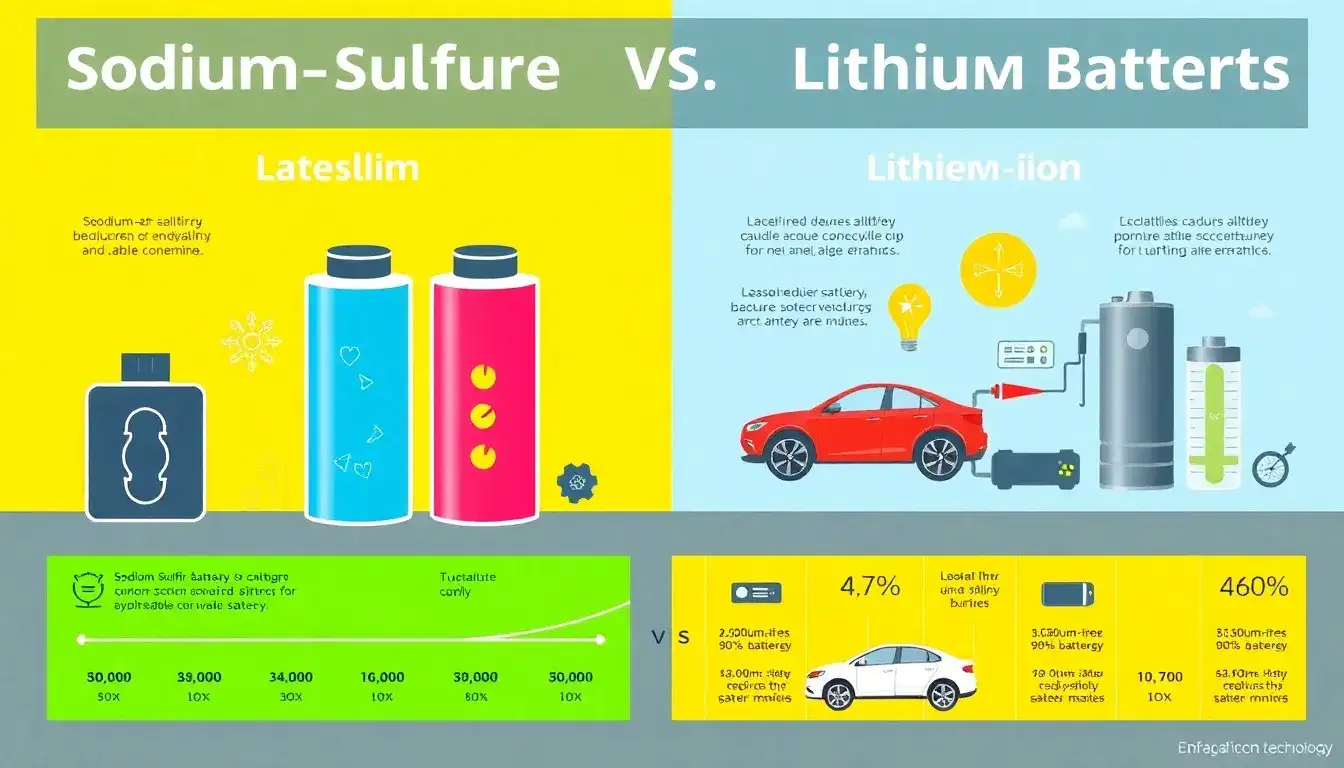
Comparing the lifespan of sodium-sulfur batteries with lithium-ion batteries involves several factors, including cycle life, durability, and operating conditions. Here’s an overview:
Sodium-Sulfur Batteries
- Cycle Life and Durability: Traditional sodium-sulfur batteries often have a relatively shorter cycle life compared to lithium-ion batteries, typically lasting fewer than 1000 cycles under practical conditions. However, recent advancements and developments, such as those using linalool and sulfur nanostructures, show promising improvements, maintaining more than 80% of their original capacity after 1500 cycles. Some new designs aim for a much longer lifespan, with reports suggesting up to 20 years or 7300 cycles with minimal degradation.
- Operating Conditions: Sodium-sulfur batteries typically require high operating temperatures, which can affect their energy efficiency and safety profile. Room temperature versions are being developed to mitigate these issues.
Lithium-Ion Batteries
- Cycle Life and Durability: Lithium-ion batteries generally have longer cycle lives compared to sodium-sulfur batteries, often maintaining a significant portion of their capacity well beyond 1000 cycles. They have a well-established safety record and extensive durability in a wide range of applications.
- Operating Conditions: Lithium-ion batteries operate at room temperature, contributing to their widespread adoption across various applications from portable devices to electric vehicles.
Comparison Summary
| Feature | Sodium-Sulfur Batteries | Lithium-Ion Batteries |
|---|---|---|
| Cycle Life | Generally shorter than Li-ion, but advancing research offers improvements up to 20 years or 7300 cycles | Longer, typically well beyond 1000 cycles |
| Operating Conditions | Require high temperatures, but room temperature versions are in development | Operate at room temperature |
| Material Cost | Utilizes abundant and less expensive materials like sulfur and sodium | Uses materials like lithium and cobalt, which are more expensive and less abundant |
| Energy Density | Comparable to Li-ion in some designs | Established high energy density |
In summary, while sodium-sulfur batteries offer advantages in terms of material cost and potential for high energy density, lithium-ion batteries currently have a longer proven cycle life and are more widely adopted across different applications. Sodium-sulfur batteries are primarily suited for stationary energy storage due to their high operating temperature requirements, but ongoing research aims to improve their performance and viability.
Original article by NenPower, If reposted, please credit the source: https://nenpower.com/blog/how-does-the-lifespan-of-sodium-sulfur-batteries-compare-to-lithium-ion-batteries/

