

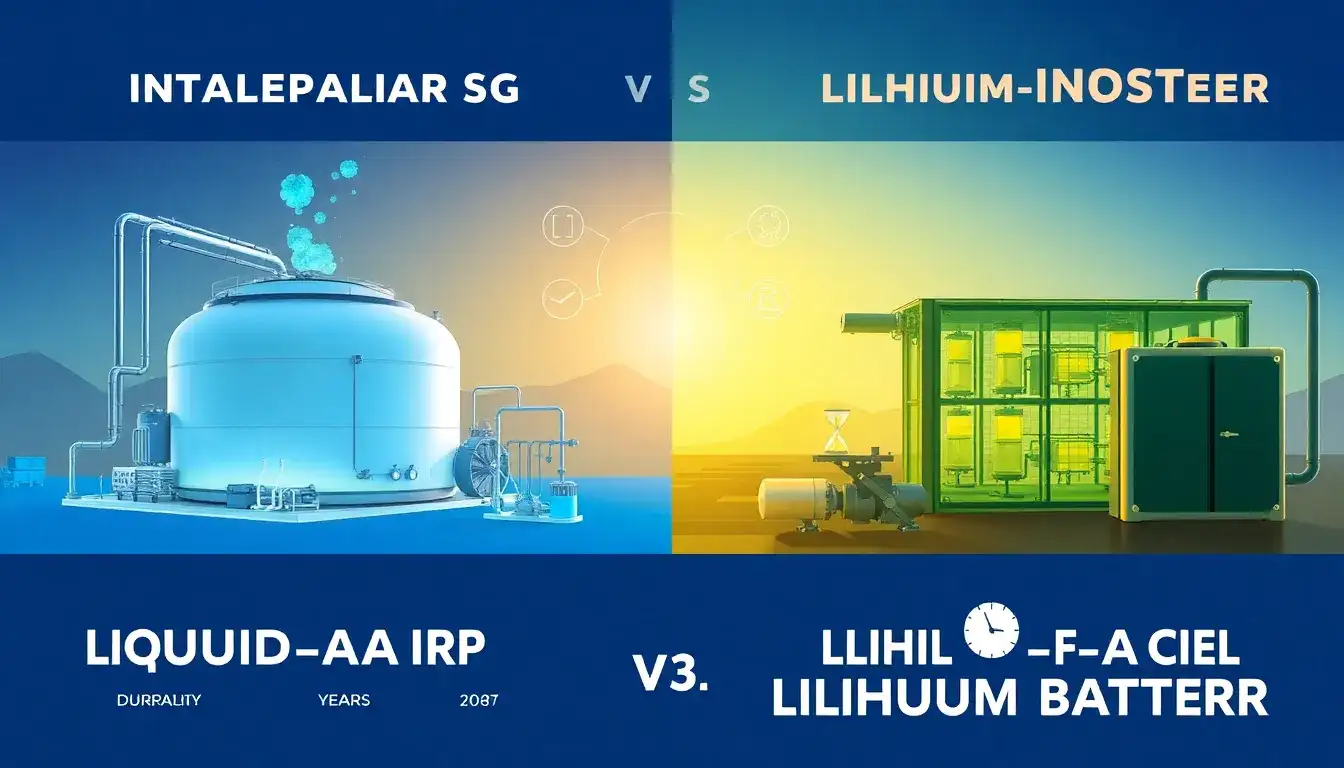
Lifespan of Liquid Air Energy Storage Systems
- LAES plants typically have a design lifetime of about 30 to 40 years. For example, Highview Power notes a 40-year lifespan for their large-scale LAES plants, which is considerably long for energy storage technologies.
- The components involved in LAES, such as cryogenic storage tanks and turbines, experience negligible degradation over time, helping maintain high performance levels throughout the lifespan.
- This longevity contrasts with the more common shorter operational lifetimes seen in many battery technologies.
Lifespan of Lithium-ion Batteries
- Lithium-ion battery systems commonly have lifespans ranging around 10 to 15 years, sometimes shorter depending on usage patterns, depth of discharge, and thermal management. Over time, lithium-ion batteries suffer capacity degradation due to chemical aging processes, which limit their effective service life.
Comparison Summary
| Feature | Liquid Air Energy Storage (LAES) | Lithium-ion Batteries |
|---|---|---|
| Typical lifespan | 30 to 40 years | 10 to 15 years (often less) |
| Degradation over time | Nebligible | Significant capacity fade |
| Component wear | Minimal (cryogenic tanks, turbines) | Internally chemical/electrochemical degradation |
| Suitability for long-term storage | Excellent | Limited by cycle life |
Therefore, LAES offers a much longer operational life, with minimal performance degradation, making it highly suitable for grid-scale, long-duration energy storage compared to lithium-ion batteries. This longevity also contributes to the potentially lower levelized cost of storage (LCOS) for LAES, as shown by research indicating LAES cost can be about one-third that of lithium-ion battery storage.
Original article by NenPower, If reposted, please credit the source: https://nenpower.com/blog/how-does-the-lifespan-of-liquid-air-energy-storage-systems-compare-to-lithium-ion-batteries/

