

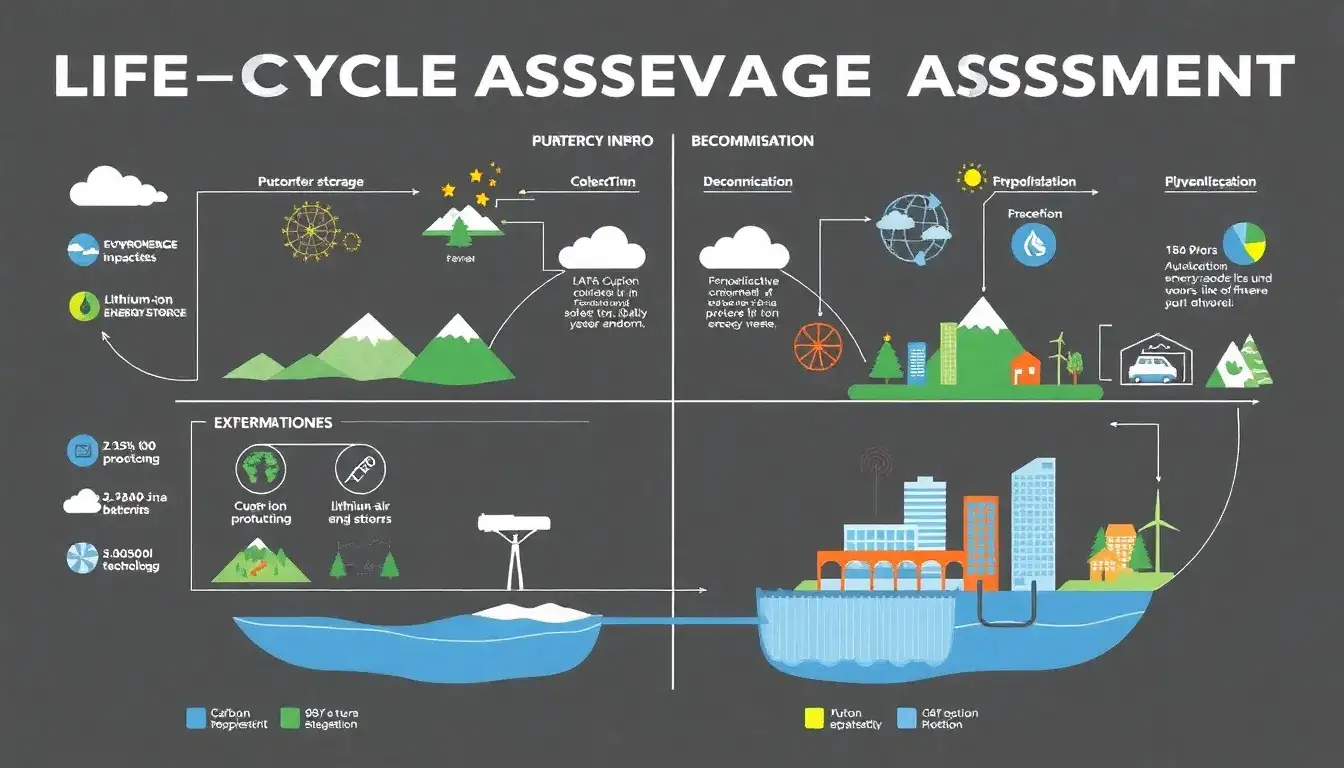
Life Cycle Assessment Comparison: Pumped Hydro Storage vs. Other Energy Storage Technologies
Pumped hydro storage (PHS) is a widely used technology for large-scale energy storage, but its environmental impact and life cycle assessment need comparison with other storage technologies to understand its advantages and disadvantages.
Key Findings for Pumped Hydro Storage (PHS)
- Lowest Life Cycle Greenhouse Gas Emissions: Studies have shown that PHS generally has the lowest life cycle greenhouse gas emissions compared to other energy storage systems like compressed air energy storage, vanadium redox flow batteries, and lithium-ion batteries.
- Impact Factors: The main contributors to PHS emissions are the grid mix used for pumping water and materials like concrete and steel used in construction.
- Site Selection: The choice of site can affect emissions, with brownfield sites offering a 20% reduction in greenhouse gas emissions compared to greenfield sites.
- Long Operational Lifespan: PHS facilities have a long operational lifespan, typically ranging from 80 to 100 years, which spreads out initial construction emissions over time.
Comparison with Other Energy Storage Technologies
- Compressed Air Energy Storage (CAES): CAES can have lower net greenhouse gas emissions when coupled with renewable energy systems. However, its overall emissions can be higher than PHS because it requires natural gas in some configurations.
- Vanadium Redox Flow Batteries (VRFB): VRFBs are gaining attention for their long cycle life and deep discharge capabilities, but their life cycle emissions are typically higher than PHS due to material extraction and production.
- Lithium-Ion Batteries: Lithium-ion batteries have been studied extensively and are known for their high energy density, but they have significant environmental impacts due to lithium and cobalt extraction, making them less sustainable from a life cycle perspective than PHS.
- Molten Salt Thermal Storage: This technology is often used with solar thermal systems and has lower environmental impacts than some other battery types but lacks the long-term energy storage capacity of PHS.
Conclusion
Pumped hydro storage offers significant environmental benefits compared to other energy storage technologies, particularly in terms of low life cycle greenhouse gas emissions. However, its deployment is limited by geographical constraints.
Future Development
As renewable energy integration continues to increase, expanding the use of PHS and developing new energy storage technologies will be crucial for achieving net-zero carbon economies. Effective site selection and enhancements in construction materials could further mitigate the environmental footprint of PHS facilities.
Original article by NenPower, If reposted, please credit the source: https://nenpower.com/blog/how-does-the-life-cycle-assessment-of-pumped-hydro-storage-facilities-compare-to-other-energy-storage-technologies/

