

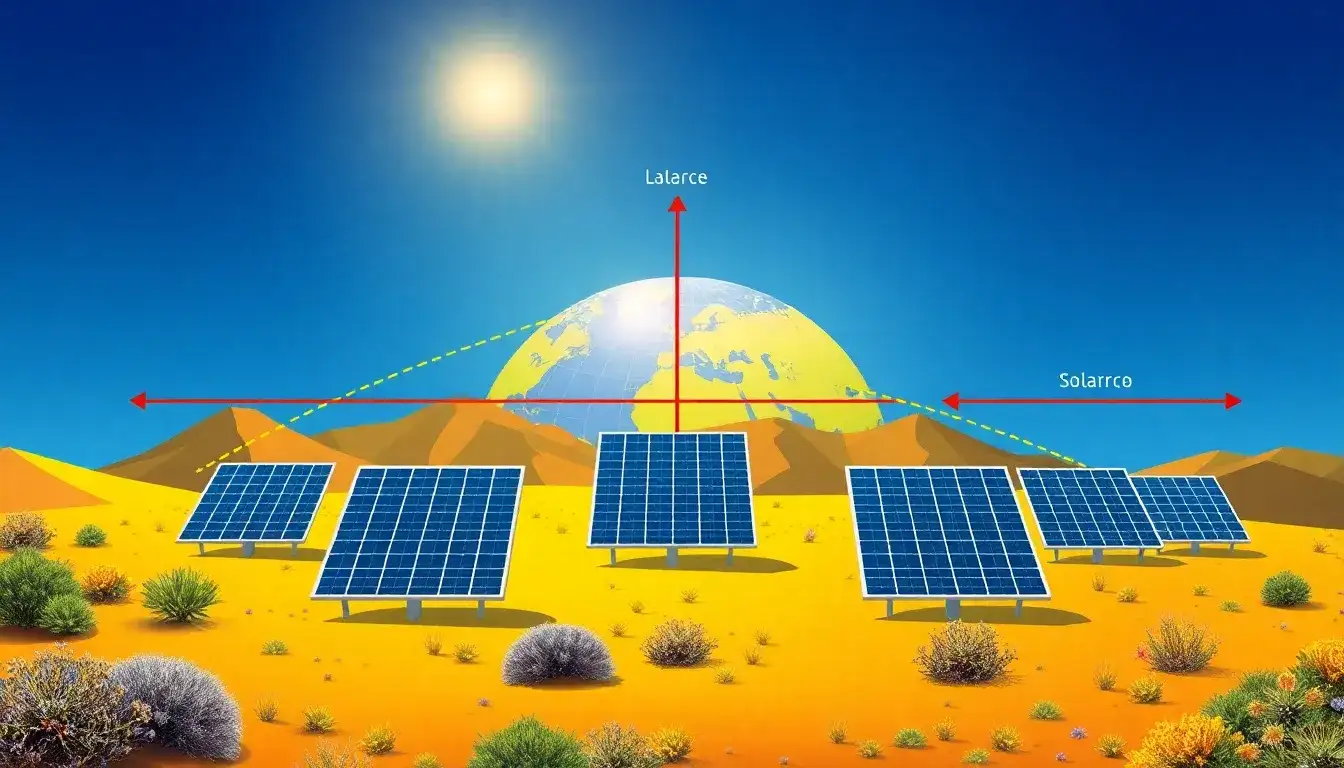
The latitude of a location significantly affects the optimal tilt angle for solar panels because it determines the sun’s path and elevation throughout the year. Solar panels generate the most electricity when their surface is perpendicular to the sun’s rays, so the tilt angle needs to be adjusted to capture the sun optimally at a given latitude and season.
Relationship Between Latitude and Tilt Angle
- General Rule:
The optimal fixed tilt angle of solar panels is approximately equal to the location’s latitude. For example, at 34° latitude, the ideal tilt is about 34° to maximize annual solar energy capture. - Seasonal Adjustments:
Since the sun’s elevation changes with seasons, the tilt angle should be adjusted to optimize energy production throughout the year:- In winter, the sun is lower in the sky, so panels should be tilted more steeply—roughly latitude + 15°.
- In summer, when the sun is higher, panels should be tilted less steeply—roughly latitude − 15°.
For example, at 34° latitude:
– Winter tilt ≈ 49° (34° + 15°)
– Summer tilt ≈ 19° (34° − 15°)
– Spring/Fall tilt ≈ latitude (34°)
More Precise Formulas
Some refined methods adjust these values slightly for better performance:
| Season | Tilt Angle Formula | Example at 34° Latitude |
|---|---|---|
| Winter | 0.9 × latitude + 29° | 0.9 × 34 + 29 = 59.6° (steeper) |
| Summer | 0.9 × latitude – 23.5° | 0.9 × 34 – 23.5 = 7.1° (flatter) |
| Spring/Fall | latitude − 2.5° | 34 – 2.5 = 31.5° |
These formulas provide better optimization of midday solar intensity, especially in winter.
Latitude Zones and Tilt Recommendations
- At latitudes below 25°, the tilt angle is often set to about 87% of the latitude for fixed panels.
- Between 25° and 50° latitude, more specific formulas apply to improve efficiency, with recommended winter tilt approximately latitude × 0.875 + 19.2°, and summer tilt latitude × 0.93 − 21°.
- Above 50°, the tilt angle increases further to face the lower sun angle near the poles.
Practical Considerations
- Higher latitudes (closer to poles) require steeper tilt angles to capture low-angle winter sunlight and help shed snow from panels, improving both energy yield and maintenance.
- Lower latitudes (near equator) require flatter tilt angles because the sun is higher in the sky year-round.
- Adjusting tilt for seasonality can increase energy output by several percentage points but may not be practical for all installations.
- Fixed tilt angles, typically equal to latitude, provide a good balance for annual energy production.
Summary Table for Typical Tilt Angles by Latitude and Season
| Latitude Range | Winter Tilt (°) | Spring/Fall Tilt (°) | Summer Tilt (°) |
|---|---|---|---|
| Below 25° | ~latitude × 0.875 + 19.2 | ~latitude | ~latitude × 0.93 − 21 |
| 25° to 50° | latitude + 15 (approx.) | latitude | latitude − 15 (approx.) |
| Above 50° | Steeper than latitude + 15 | Near latitude | Flatter than latitude − 15 |
In conclusion, the latitude directly determines the optimal tilt angle for solar panels because it reflects the sun’s average elevation in the sky. Solar panels should be tilted close to the latitude to maximize yearly energy production, with seasonal adjustments of about ±15° to account for the sun’s changing height during the year. Higher latitudes require steeper angles to capture the lower winter sun and shed snow, while lower latitudes use flatter angles due to the sun’s high position.
Original article by NenPower, If reposted, please credit the source: https://nenpower.com/blog/how-does-the-latitude-of-a-location-affect-the-optimal-tilt-angle-for-solar-panels/

